



When installing tires or wheels that are not specified in the technical passport, a corresponding entry should be made in the vehicle documents. As a rule, permission from the manufacturer is required for this.
When replacing a disc, you should consider not only its width and diameter, but also the depth of pressing. The depth of pressing is the distance from the middle of the disc to the surface where the wheel disc meets the brake disc.
All disc wheels are made with a ring protrusion. The ring protrusion is a bead pressed onto the landing shelf, which does not allow the disc to squeeze the tubeless tire even at a very sharp turn of the car.
According to existing legislation, the use of tires with a residual tread height of at least 1.6 mm over the entire tread pattern is permitted.
For safety reasons, it is recommended to replace summer tires when the remaining tread height is 2 mm, and winter tires when it is 4 mm.
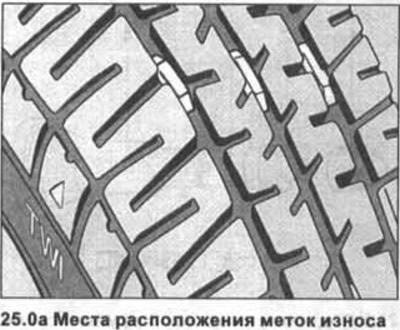
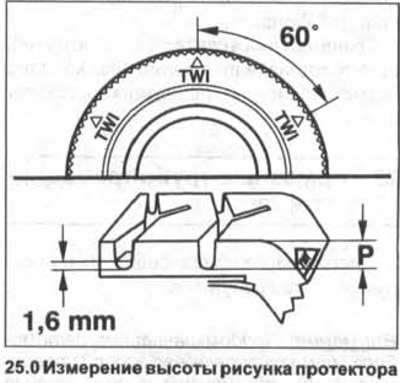
The tread depth should be measured at the points of greatest wear. There are tire wear marks (TWI) at the bottom of the longitudinal tread grooves.
The locations of the marks are marked on the sidewall of the tire with the letters TWI or triangles (see illustration 25.0a). The height of the wear marks is 1.6 mm.
When measuring the remaining tread pattern height, the height of the wear marks is not taken into account. The determining factor is the pattern height P at the point of greatest wear (see illustration 25.0).
Tires on balanced wheels, when the prescribed pressure is maintained, the wheel alignment angles are correctly adjusted, and the shock absorbers operate flawlessly, wear approximately evenly across the entire tread. In case of uneven wear, see the list of tire faults.
It is not possible to say anything definite about the service life of tires from different manufacturers, since this period depends on various factors, namely:
- road surface;
- tire pressure;
- driving style;
- weather conditions.
Rapid wear of the treads is primarily caused by sporty driving, rapid acceleration and sharp braking.
Please note: M+S tyres are effective in mud and snow conditions only when the minimum remaining tread depth is 4 mm.
Attention! Check the tires for cuts and, if there are any, use a small screwdriver to determine the depth of the cut. If the cuts reach the frame, the steel cord of the tire begins to rust under the influence of penetrating water. Because of this, the tread may peel off from the frame and the tire will break. Therefore, if the tread is cut deeply, the tires must be replaced for safety reasons.
Visitor comments