



- electric flashlight and mirror;
- calipers.
Attention! Due to dust particles, which are usually more abundant on the roadway on the passenger side than on the driver's side, the wear of the brake pads on the passenger side is somewhat greater. Therefore, it is recommended to check the residual thickness of these pads.
Warning! Jacking up a vehicle and placing it on stands may pose a risk of injury. Before starting work, it is recommended that you familiarize yourself with the safety precautions in Chapter "Jacking up a car".
1. Mark the position and direction of rotation of the wheel on the hub with paint.
The balanced wheel can be returned to its original position.
2. Loosen the wheel mounting bolts before jacking up the vehicle and placing it on jack stands.
The text is copied from this portal: VWMANUAL
3. Place the vehicle on jack stands and remove the wheels.
Caution! When checking the thickness of the brake pads, make sure that they are not contaminated with brake fluid or oil. Replace such brake pads immediately.
Front Disc Brake Pads
4. Check the thickness "a" of the inner and outer brake pads with a caliper, excluding the metal support (see illustration).
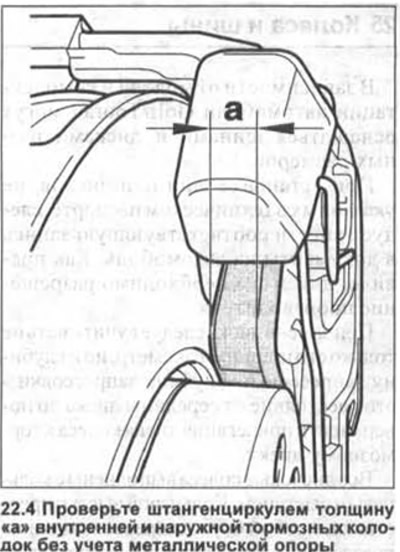
The wear limit is considered to be reached if the thickness "a" of the brake pads without a metal base is 2 mm. In this case, the pads are subject to replacement (see illustration 22.4).
5. Install the wheels using the marks made before removing the wheels.
6. Tighten the wheel bolts and lower the vehicle.
7. Tighten the wheel bolts in a criss-cross pattern to 120 Nm.
Attention! As a rule of thumb, 1 mm of brake shoe lining corresponds to at least 1000 km of mileage. This rule can be applied when operating the car in adverse conditions.
Rear disc brake pads
8. Check the thickness "a" of the outer brake linings through the inspection hole (see arrow in illustration) in the wheel disk, illuminating the block with a flashlight if necessary. There is no need to remove the wheel. If there is one, remove the wheel cap.
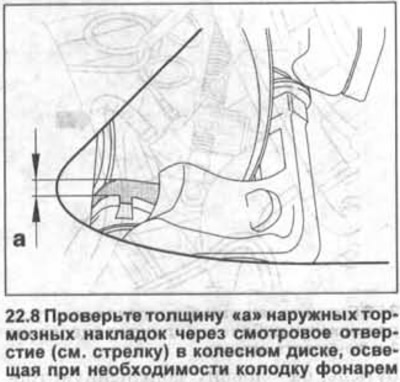
9. Inspect the inner brake shoe using a mirror and shining a flashlight on the shoe.
The wear limit is considered to be reached if the thickness of the rear brake pads without a metal base is 2 mm.
Visitor comments