



Contents: Front disc brakes ↓ Rear drum brakes ↓
The brake pads of the front disc brakes wear out faster than the rear drum brakes. However, it is advisable to check the brake pads of all 4 wheels during regular checks.
Front disc brakes
1. Mark the position of the front wheel relative to the hub with paint so that the balanced wheel can be installed in its previous position. Loosen the wheel bolts.
2. Place the car on stands, remove the front wheel. If the pads are relatively new, the check can be done on only one front wheel. In this case, the right front wheel is removed. Due to approximately the same wear, a conclusion can be made about the thickness of the pads and the other front wheel.
(The original can be viewed on the portal: VWManual)
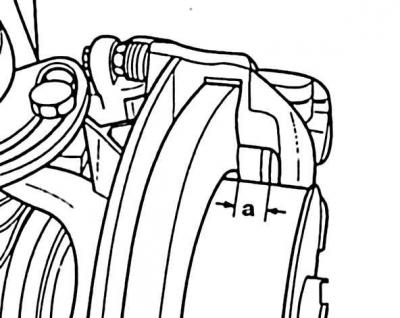
3. Check the thickness of the pads by eye together with the metal plate, at the rear, through the brake support. In doubtful cases, remove the brake pads and check the thickness (a) with a caliper. The figure shows the outer brake pad. The inner pad (on the back side of the brake disc) check in the same way.
4. The wear limit of the front brake pads has been reached if the brake pad thickness (together with the plate) is 7 mm.
Rear drum brakes
1. Place the machine on stands.
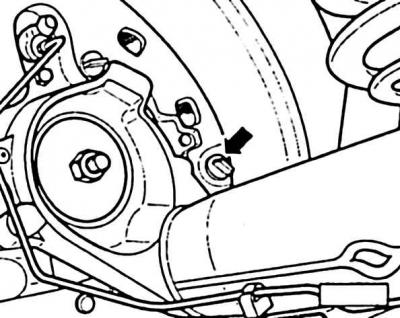
2. Remove the plug on the rear brake support (indicated by the arrow) and shine a flashlight into the hole. The wear limit is reached if the lining in this place has a thickness of 1.0 mm (without a block). In doubtful cases, remove the brake drum and measure the thickness of the lining. When checking the thickness of the linings, pay attention to the absence of brake fluid or oil on the brake linings. In this case, the brake linings must be replaced immediately.
3. If the wear limit is reached, replace the linings. Replace the linings of the entire bridge at once.
Attention! 1 mm of brake pad wear corresponds to approximately 1000 km of mileage, and under unfavorable driving conditions. Usually the pads last a long time. With a front disc brake pad thickness of about 10.0 mm (together with the plate) they are enough for at least another 3000 km of travel.
Visitor comments