



As part of the maintenance, you should only check the condition of the V-belt and, if there is any damage, replace it with a new one.
No special tools or devices are required.
To replace a worn or damaged belt, you will need a V-ribbed belt that matches the type of engine installed in the vehicle.
Examination
1. Shift into neutral.
Warning! Jacking up the vehicle and placing it on stands may pose a risk of injury. Read the safety precautions in Chapter "Jacking up a car".
2. Jack up the car and place it on jack stands.
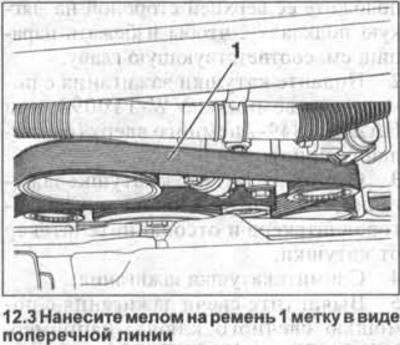
3. Apply 1 mark in the form of a transverse line on the belt with chalk (see illustration).
4. Turn the engine in the direction of its rotation, acting from under the car. To do this, install a socket head on the belt pulley mounting bolt.
Rotate the engine clockwise until the belt has made a full revolution and the chalk mark is visible.
While turning the engine, carefully inspect the belt to check its condition.
This inspection should reveal the absence or presence of the following damage to the V-belt:
- traces of oil and grease;
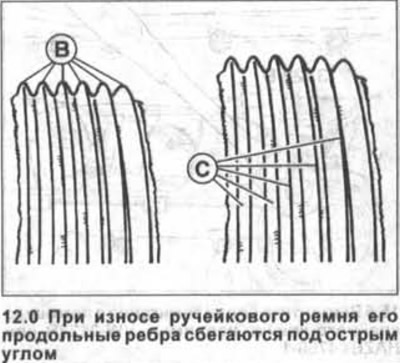
- belt wear. When a belt wears, its longitudinal ribs run together at an acute angle (see B in illustration 12.0). The ribs of the new belt have a trapezoid shape. The ribs of the belt extend away from the cord and it is noticeable due to its lighter color (see C in illustration 12.0);
- hardened or glassy edges.
Other damages to the V-belt include:
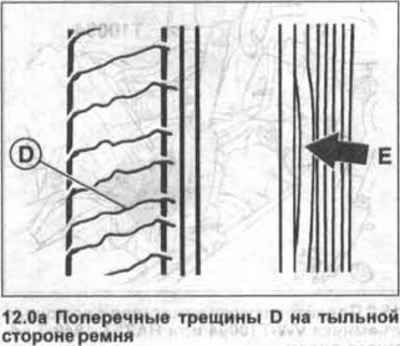
- a) transverse cracks D on the back side of the belt (see illustration 12.0a);
- b) detachment of part E of the ribs (see arrow in illustration 12.0a);
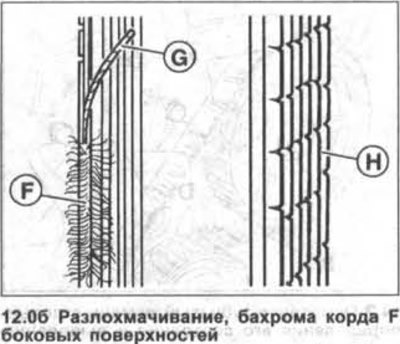
- c) fraying, fringe of the F cord on the side surfaces (see illustration 12.0b);
- d) G cord breaks (see illustration 12.0b);
- d) transverse cracks H on several ribs (see illustration 12.0b),
- e) breaks in belt ribs;
- g) transverse cracks on the ribs;
- c) deposits (stones) between the belt ribs;
- i) rolling of the rubber base of the belt.
If there is at least one or more of the above damages, the V-belt must be replaced, see the relevant chapter.
Visitor comments