
English Русский
Български
Беларускі
Український
Српски
Hrvatski
Română
Polski
Slovenský
Magyar
  |  Articles  |  Sitemap  |  Contacts  |    |
Car maintenance Ford Car maintenance Hyundai Car maintenance Chevrolet Car maintenance BMW Car maintenance Audi Car maintenance Opel Car maintenance AvtoVAZ
VWmanual.ru


Main   Passat   Golf   Polo   Touareg   Tiguan   Sharan   Transporter   Others  
Golf 1 (1974-1984, diesel) Golf 1 (1974-1984, petrol) Golf 2 (1984-1993, petrol) Golf 2 (1984-1993) Golf 3 (1991-1997) Golf 4 (1997-2004) Golf 5 (2003-2008)

Seat belts and airbags (VW Golf 5)

  • Main
  • Golf
  • Golf 5
  • General information
  • Maintenance
  • Seat belts and airbags
            0


Contents: Checking seat belts ↓ Checking seat belts ↓ Checking the activation of the front…↓ Ignition airbag unit lock for Golf…↓
In accordance with the maintenance plan, the following work must be performed:
  • Lubricate the door opening limiters.
  • Visually check the condition of the seat belts and airbags.
  • Sunroof. Clean the guides and lubricate them with special grease.
  • Front passenger airbag. Check the airbag unit activation.
  • Anti-corrosion protection of the bottom and paintwork. Check the condition.
  • Ventilation and heating. Replace the cabin filter and clean its housing.
  • First aid kit. Check expiration dates or replace the first aid kit.

Checking seat belts


No special equipment or consumables are required.

Warning! The noise that occurs when the seat belts are retracted is due to the operation of the automatic belt retractor mechanism. Never lubricate the mechanism to eliminate these noises. It is prohibited to disassemble the automatic seat belt retractor mechanism, because this may cause injury.


1. Pull the seat belt webbing completely out of the retractor. Check the belt webbing for broken fibers.

Damage may occur, in particular, due to a pinched belt or a burning cigarette. In this case, replace the belt (see illustration).
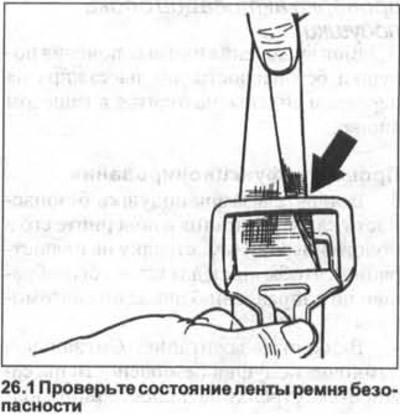
Damage may occur, in particular, due to a pinched belt or a burning cigarette. In this case,…


If areas with abrasions are found, but the fibers are intact, then the belt does not need to be replaced.


If the belt is difficult to move, make sure that the tape is not twisted. If necessary, remove the B-pillar trim.

If the automatic retractor does not work, replace the belt (the work is done in the workshop).

Clean the belt tape only with water and soap, never use solvents or chemical cleaning agents.

Checking seat belts


The airbag unit can be identified by the inscription "AIRBAG" on the steering wheel cover or on the cover on the right side of the instrument panel.

2. Inspect airbag units 1 and 2. They should not have any visible external damage (see illustration).
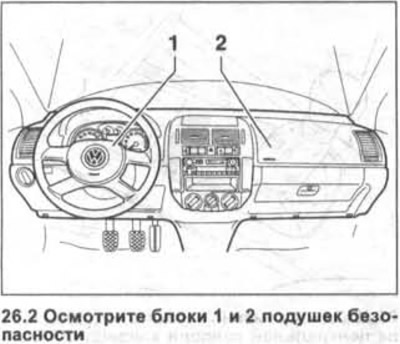
2. Inspect airbag units 1 and 2. They should not have any visible external damage (see…


Attention! The covers of the airbag units must not be sealed, covered with covers or modified. The covers of the units may be cleaned with a dry or water-soaked cloth.


Additional instructions: If the vehicle is equipped with side airbags, only special covers approved by VW may be placed on the seat backs.


Checking the activation of the front passenger airbag unit


The switch to turn the front passenger airbag on or off is located in the glove compartment.

Functional check


3. Insert the ignition key into the airbag switch and turn it to the OFF position (see arrow in illustration), so that the key slot faces the direction of vehicle travel.
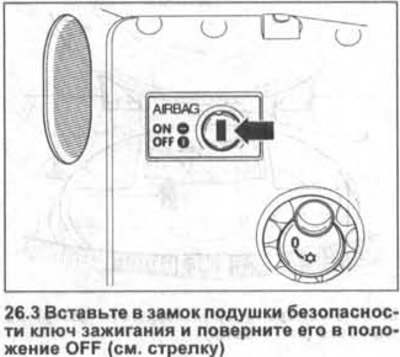

3. Insert the ignition key into the airbag switch and turn it to the OFF position (see arrow in…


4. Turn on the ignition. Passenger airbag indicator light (see arrow in illustration) should remain lit after the system self-test procedure has been completed. This means that the front passenger airbag control unit is deactivated.
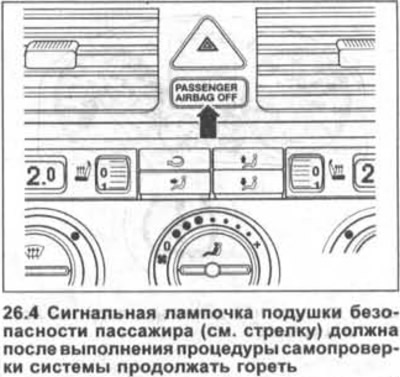
4. Turn on the ignition. Passenger airbag indicator light (see arrow in illustration) should remain…


5. Turn off the ignition.

6. Insert the ignition key into the airbag lock and turn it to the ON position (see arrow in illustration), so that the key slot is positioned across the direction of the vehicle's movement.
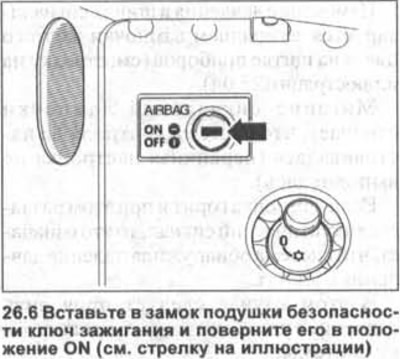
6. Insert the ignition key into the airbag lock and turn it to the ON position (see arrow in…


7. Turn on the ignition. Passenger airbag indicator light (see arrow in illustration) should go out after the system self-test procedure. This means that the front passenger airbag control unit is enabled.

8. Turn off the ignition.

Ignition airbag unit lock for Golf Plus cars


The procedure for checking the lock function is the same as for Golf cars. However, the lock is different. In order to switch the airbag unit off or on, the key in the lock must be turned so that the slot is vertical in both cases.

This article is available at russian, bulgarian, belarusian, ukrainian, serbian, croatian, romanian, polish, slovak, hungarian
The text has been checked: Kolesnikov Artem

Share information:

Previous articles
Tire Pressure Monitoring System Indicator — Setting
Tire Repair Kit — Check and Replace
Some recommendations for tire care
Tire pressure monitoring
Removal and installation wheels
Anti-skid chains
Next articles
Cabin filter — replacement
Electrical system of the car
Battery capacity — check
Windscreen wiper blades — checking the home position


Similar articles from other manuals for VW cars:
Seat belts Passat B4 (1988-1996)
Visual inspection of seat belts Polo 4 (2001-2009)
Removal seat belts Touareg 1 (2002-2006)
Removal and installation front seat belts Tiguan 1 (2007-2015)
Poly V-belt and toothed drive belts Sharan 1 (1995-2000)
Seat belts Transporter T4 (1990-2003)
Seat belts and handles — general information LT 28 (1975-1991)
Link to this page in different formats


Visitor comments


No comments yet


How much will 33 + 38 =


Golf 5 
  • General information
  • User manual
  • Maintenance
  • Troubleshooting
  • Power unit
  • Engine repair
  • Cooling and ventilation system
  • Fuel system
  • Ignition system
  • Transmission
  • Clutch
  • Mechanical gearbox
  • Automatic gearbox
  • Chassis
  • Brake system
  • Car suspension
  • Steering
  • Body
  • Interior (internal elements)
  • Exterior (external elements)
  • Doors and covers
  • Electrical equipment
  • Power devices
  • Washers and wipers
  • Lighting and appliances
  • Electrical circuits
Golf 4 
  • General information
  • User manual
  • Weekly checks
  • Maintenance
  • Power unit
  • Petrol engines
  • Diesel engines
  • Cooling system
  • Fuel system (petrol)
  • Control system (petrol)
  • Fuel system (diesel)
  • Exhaust system
  • Transmission
  • Clutch
  • Car gearbox
  • Drive shafts
  • Chassis
  • Car suspension
  • Steering
  • Wheels and tires
  • Brake system
  • Body
  • Exterior (external elements)
  • Interior (internal elements)
  • Ventilation and heating
  • Car doors and sunroof
  • Washers and glass cleaners
  • Electrical equipment
  • Power devices
  • Lighting and appliances
  • Electrical circuits
Golf 3 
  • Petrol engine
  • Engine repair
  • Lubrication system
  • Cooling system
  • Ignition system
  • Diesel engine
  • Engine repair
  • Diesel injection system
  • Pre-glow system
  • Transmission
  • Clutch
  • Gearbox and drive shafts
  • Chassis
  • Steering
  • Wheels and suspension
  • Brake system
  • Electrical equipment
  • Lighting and appliances
  • Electrical circuits
Golf 2 
  • General information
  • Introduction to guide
  • User manual
  • Petrol engines 1.3 l
  • Engine repair
  • Lubrication system
  • Cooling system
  • Carburetors
  • Supply system
  • Ignition system
  • Petrol engines 1.6/1.8 l
  • Engine repair
  • Supply system
  • Ignition system
  • Diesel engines
  • Engine repair
  • Lubrication system
  • Cooling system
  • Power and exhaust system
  • Transmission
  • Clutch
  • 4-speed gearbox 084
  • 5-speed gearbox 085
  • 4-speed gearbox 020/4R
  • 5-speed gearbox 020/4T
  • Automatic gearbox
  • Drive shafts
  • Chassis
  • Steering
  • Car suspension
  • Brake system
  • Body
  • Body elements
  • Doors, locks and windows
  • Electrical equipment
  • Equipment and devices
  • Power devices
Golf 2 (petrol) 
  • General information
  • Characteristics
  • Car care
  • Maintenance
  • Power unit
  • Engine repair
  • Engine 1.05/1.30
  • Engine 1.60/1.80
  • Cooling and lubrication system
  • Power and exhaust system
  • Transmission
  • Clutch
  • Car gearbox
  • Drive shafts
  • Chassis
  • Brake system
  • Steering
  • Suspension
  • Body
  • Body and equipment
  • Electrical equipment
  • Lighting and appliances
  • Electrical circuits
Golf 1 (petrol) 
  • General information
  • Characteristics
  • User manual
  • Maintenance
  • Power unit
  • Engine adjustment
  • Engine 1.1/1.3
  • Engine 1.5/1.6/1.8
  • Engine electrical equipment
  • Cooling system
  • Fuel system
  • Transmission
  • Clutch and manual gearbox
  • Automatic gearbox
  • Chassis
  • Steering
  • Front suspension
  • Rear suspension
  • Brake system
  • Electrical equipment
  • Lighting and appliances
  • Electrical circuits
  • Body
  • Body and equipment
  • Optional equipment
Golf 1 (diesel) 
  • General information
  • Specifications
  • Maintenance
  • Power unit
  • Engine repair
  • Exhaust and turbocharger
  • Cooling system
  • Fuel system
  • Fuel injection system
  • Transmission
  • Clutch and drive shafts
  • Car gearbox
  • Chassis
  • Suspension and wheels
  • Steering
  • Brake system
  • Wheels and tires
  • Body
  • Heating and ventilation
  • Exterior (external elements)
  • Interior (internal elements)
  • Doors and windows
  • Electrical equipment
  • Equipment and devices
  • Lighting system
  • Power devices
  • Electrical circuits
VWmanual.ru © 2016-2026 | Mobile version | News and articles | Sitemap: EN BG BY UA RS HR RO PL SK HU | Write message | Site search
Passat B2 • Passat B3 • Passat B4 • Passat B5 • Passat B6 • Golf 1, diesel • Golf 1, petrol • Golf 2, petrol • Golf 2 • Golf 3 • Golf 4 • Golf 5 • Polo 3 • Polo 4 • Touareg 1 • Tiguan 1 • Sharan 1 • Transporter T3 • Transporter T4 • LT 28 • LT 2D • Beetle • Caddy 3 •
Our website uses cookies to ensure functionality and convenience.