
English Русский
Български
Беларускі
Український
Српски
Hrvatski
Română
Polski
Slovenský
Magyar
  |  Articles  |  Sitemap  |  Contacts  |    |
Car maintenance Ford Car maintenance Hyundai Car maintenance Chevrolet Car maintenance BMW Car maintenance Audi Car maintenance Opel Car maintenance AvtoVAZ
VWmanual.ru


Main   Passat   Golf   Polo   Touareg   Tiguan   Sharan   Transporter   Others  
Golf 1 (1974-1984, diesel) Golf 1 (1974-1984, petrol) Golf 2 (1984-1993, petrol) Golf 2 (1984-1993) Golf 3 (1991-1997) Golf 4 (1997-2004) Golf 5 (2003-2008)

Battery capacity — check (VW Golf 5)

  • Main
  • Golf
  • Golf 5
  • General information
  • Maintenance
  • Battery capacity — check
            0


Contents: Checking the electrolyte level ↓ Filling with distilled water ↓
Tools required:
  • distilled water filling tank;
  • densimeter.

Materials needed: distilled water if the electrolyte level in the cells is low.

1. Inspect the battery and make sure that its casing is not damaged.

If the case is damaged, electrolyte may leak, which in turn may cause serious damage to nearby parts. Replace the battery if necessary.

2. Check the strength of the battery in the tray by pushing it from side to side with sufficient force. A poorly secured battery can cause the wires to catch fire or damage the electrical system.

3. Remove the battery cover, if present, by pressing the latch (see arrow in illustration) and moving the lid forward.
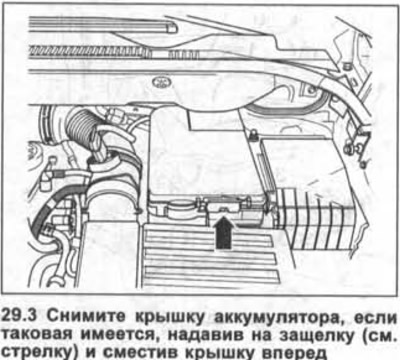
3. Remove the battery cover, if present, by pressing the latch (see arrow in illustration) and…


4. Check the strength of the battery fastening in the tray by pushing it from side to side with sufficient force. If the battery fits loosely in the tray, tighten the fastening bolt with a force of 20 Nm.

Caution! If the terminal on the positive pole of the battery is loose, remove the terminal of the ground wire (-) from the negative pole before tightening it to avoid a short circuit.


5. Check the strength of the fastening of terminals 1 and 2 of the power wires. If necessary, tighten the fastening nuts, bringing the tightening to 6 Nm (see illustration).
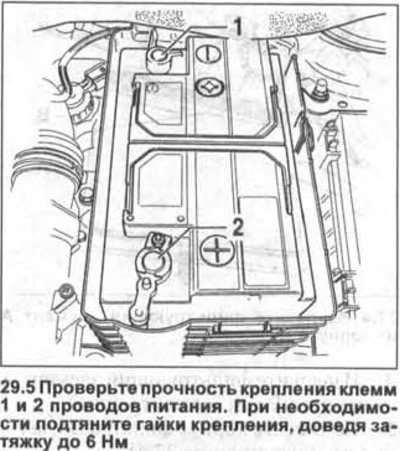
5. Check the strength of the fastening of terminals 1 and 2 of the power wires. If necessary,…


6. Close the battery cover, if applicable.

Checking the electrolyte level


Batteries with indicator and cell plugs


Attention! Indicator 1, called the "magic eye", may be located in a different place (see illustration 29.7). To check the electrolyte level in the cells, it may be necessary to remove the battery cover.


7. Check the electrolyte level and charge level using indicator 1 on the battery, illuminating the indicator with a flashlight (see illustration). The indicator optically displays the battery status and can be colored in one of the three colors listed below.
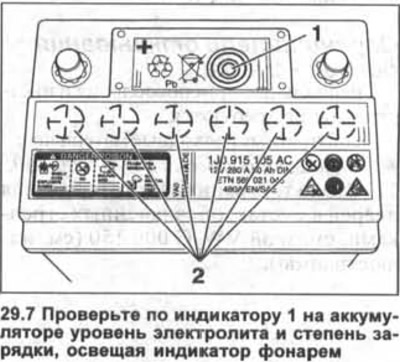
7. Check the electrolyte level and charge level using indicator 1 on the battery, illuminating the…


The color of the indicator is green. The battery is charged sufficiently. The electrolyte level is normal.


The color of the indicator is black. The battery is not charged or the charge is too weak.

The color of the indicator is yellow/colorless. The critical state of the electrolyte has been reached. Be sure to add distilled water.

The original article is available on the website www.VWmanual.ru

Warning! Air bubbles on the indicator may cause the battery condition assessment to be incorrect. In this case, it is recommended to lightly tap the battery case with a suitable object before inspection.


Attention! If the battery life is 5 years or more, and the indicator color is colorless, then it is recommended to replace this battery with a new one.


Since the indicator is located only above one cell, the reading only concerns this cell. An accurate assessment of the battery condition is only possible when testing it under load.

Warning! Do not use open flame to light an open battery (lighter, matches). Explosion possible. The battery should only be illuminated with a flashlight.


Filling with distilled water


8. Turn off the ignition.

9. Remove the foil that covers the cell plugs.

10. Unscrew the plugs 2 using, for example, a HAZET-4650-3 screwdriver (see illustration 29.7).

Attention! In workshops, the VAS-5045 container is used to fill the battery with distilled water (see illustration 29.0). The design of this container does not allow overflow and, accordingly, leakage of electrolyte. As soon as the electrolyte level during filling reaches the maximum permissible level, the supply of distilled water from the specified container automatically stops.
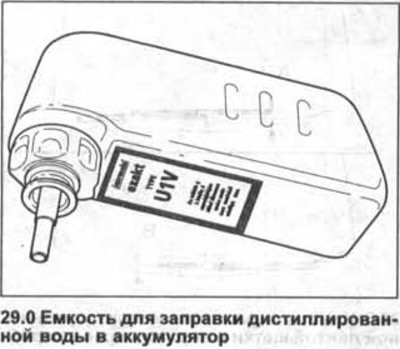

Attention! In workshops, the VAS-5045 container is used to fill the battery with distilled water…


11. Add distilled water up to the MAX mark on the battery case (see arrow in illustration), if there is no filling tank.
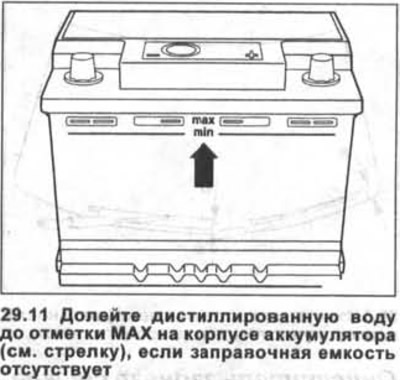
11. Add distilled water up to the MAX mark on the battery case (see arrow in illustration), if…


12. Add distilled water to the level of the plastic rib 1 in the cell if the electrolyte level cannot be determined from the outside, through the housing (see illustration).
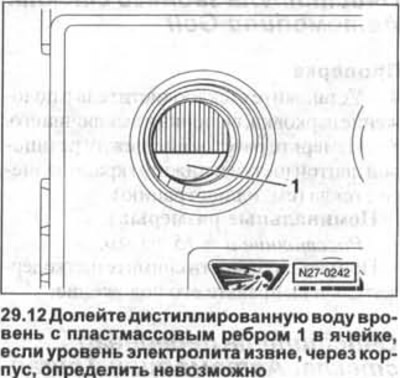
12. Add distilled water to the level of the plastic rib 1 in the cell if the electrolyte level…


13. Screw in and tighten the plugs.

Attention! Do not pour too much distilled water into the cells, because the electrolyte will spill out and damage nearby parts. If necessary, remove excess electrolyte.


Batteries with indicator and without cell plugs


Attention! The condition of such batteries is checked in the same way as for batteries with plugs. However, in this case, if the electrolyte level is low and the indicator 1 is yellow or colorless, the battery should be replaced (see illustration 29.0a).


Attention! Cover 2 is designed for filling the battery at the manufacturer's plant. It is not allowed to remove it. Otherwise, the battery will be unsuitable for operation (see illustration 29.0a).
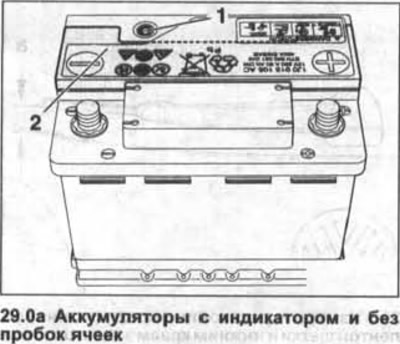

Attention! Cover 2 is designed for filling the battery at the manufacturer's plant. It is not…


Batteries without indicator


14. Check the electrolyte level and add distilled water to the cells if necessary.

15. Check the electrolyte level through the transparent battery case. If the electrolyte level in the battery cells has dropped below the MIN mark, it is necessary to add distilled water (see illustration).

Warning! If the battery case is opaque, unscrew the plugs and check the electrolyte level by looking into the holes. Do not expose the battery to an open flame. Explosion is possible!


16. Turn off the ignition.

17. Add distilled water to each cell up to the MAX mark or to the edge of the plastic rib 1 (see illustration 29.12).

18. Screw in and tighten the plugs.

Attention! Do not pour too much distilled water into the cells, because the electrolyte will spill out and damage nearby parts. If necessary, remove excess electrolyte.


Checking the battery open circuit voltage


19. Turn off the ignition, remove the key from the ignition switch and turn off all on-board electrical system consumers.

20. Disconnect the power wire terminals from the battery terminals.

The open circuit voltage should be measured no earlier than two hours after disconnecting the battery and turning off all consumers.

During this period, the battery should not be recharged or discharged.

21. Connect a combination instrument (voltmeter) to the battery terminals and measure the voltage.

Evaluation of the received readings


12.5V or higher - the battery condition is good. If the voltage below 12.5 V - the battery condition is unsatisfactory. Charge the battery.

If the battery was charged, check the open circuit voltage only two hours after charging is complete.

If the open circuit voltage is still less than 12.5 V after charging the battery, it is recommended to replace the battery.

This article is available at russian, bulgarian, belarusian, ukrainian, serbian, croatian, romanian, polish, slovak, hungarian
The text has been checked: Kolesnikov Artem

Share information:

Previous articles
Electrical system of the car
Cabin filter — replacement
Seat belts and airbags
Tire Pressure Monitoring System Indicator — Setting
Tire Repair Kit — Check and Replace
Some recommendations for tire care
Next articles
Windscreen wiper blades — checking the home position


Similar articles from other manuals for VW cars:
Car battery Passat B3 (1988-1993)
Starting the engine from an auxiliary battery Polo 3 (1995-2003)
Removal and installation the oil drain check valve (petrol… Touareg 1 (2002-2006)
Disconnecting and connecting the battery Tiguan 1 (2007-2015)
Cylinder Block — Check Sharan 1 (1995-2000)
Checking the battery Transporter T4 (1990-2003)
Remote control battery health indicator Caddy 3 (2003-2010)
Link to this page in different formats


Visitor comments


No comments yet


How much will 26 + 36 =


Golf 5 
  • General information
  • User manual
  • Maintenance
  • Troubleshooting
  • Power unit
  • Engine repair
  • Cooling and ventilation system
  • Fuel system
  • Ignition system
  • Transmission
  • Clutch
  • Mechanical gearbox
  • Automatic gearbox
  • Chassis
  • Brake system
  • Car suspension
  • Steering
  • Body
  • Interior (internal elements)
  • Exterior (external elements)
  • Doors and covers
  • Electrical equipment
  • Power devices
  • Washers and wipers
  • Lighting and appliances
  • Electrical circuits
Golf 4 
  • General information
  • User manual
  • Weekly checks
  • Maintenance
  • Power unit
  • Petrol engines
  • Diesel engines
  • Cooling system
  • Fuel system (petrol)
  • Control system (petrol)
  • Fuel system (diesel)
  • Exhaust system
  • Transmission
  • Clutch
  • Car gearbox
  • Drive shafts
  • Chassis
  • Car suspension
  • Steering
  • Wheels and tires
  • Brake system
  • Body
  • Exterior (external elements)
  • Interior (internal elements)
  • Ventilation and heating
  • Car doors and sunroof
  • Washers and glass cleaners
  • Electrical equipment
  • Power devices
  • Lighting and appliances
  • Electrical circuits
Golf 3 
  • Petrol engine
  • Engine repair
  • Lubrication system
  • Cooling system
  • Ignition system
  • Diesel engine
  • Engine repair
  • Diesel injection system
  • Pre-glow system
  • Transmission
  • Clutch
  • Gearbox and drive shafts
  • Chassis
  • Steering
  • Wheels and suspension
  • Brake system
  • Electrical equipment
  • Lighting and appliances
  • Electrical circuits
Golf 2 
  • General information
  • Introduction to guide
  • User manual
  • Petrol engines 1.3 l
  • Engine repair
  • Lubrication system
  • Cooling system
  • Carburetors
  • Supply system
  • Ignition system
  • Petrol engines 1.6/1.8 l
  • Engine repair
  • Supply system
  • Ignition system
  • Diesel engines
  • Engine repair
  • Lubrication system
  • Cooling system
  • Power and exhaust system
  • Transmission
  • Clutch
  • 4-speed gearbox 084
  • 5-speed gearbox 085
  • 4-speed gearbox 020/4R
  • 5-speed gearbox 020/4T
  • Automatic gearbox
  • Drive shafts
  • Chassis
  • Steering
  • Car suspension
  • Brake system
  • Body
  • Body elements
  • Doors, locks and windows
  • Electrical equipment
  • Equipment and devices
  • Power devices
Golf 2 (petrol) 
  • General information
  • Characteristics
  • Car care
  • Maintenance
  • Power unit
  • Engine repair
  • Engine 1.05/1.30
  • Engine 1.60/1.80
  • Cooling and lubrication system
  • Power and exhaust system
  • Transmission
  • Clutch
  • Car gearbox
  • Drive shafts
  • Chassis
  • Brake system
  • Steering
  • Suspension
  • Body
  • Body and equipment
  • Electrical equipment
  • Lighting and appliances
  • Electrical circuits
Golf 1 (petrol) 
  • General information
  • Characteristics
  • User manual
  • Maintenance
  • Power unit
  • Engine adjustment
  • Engine 1.1/1.3
  • Engine 1.5/1.6/1.8
  • Engine electrical equipment
  • Cooling system
  • Fuel system
  • Transmission
  • Clutch and manual gearbox
  • Automatic gearbox
  • Chassis
  • Steering
  • Front suspension
  • Rear suspension
  • Brake system
  • Electrical equipment
  • Lighting and appliances
  • Electrical circuits
  • Body
  • Body and equipment
  • Optional equipment
Golf 1 (diesel) 
  • General information
  • Specifications
  • Maintenance
  • Power unit
  • Engine repair
  • Exhaust and turbocharger
  • Cooling system
  • Fuel system
  • Fuel injection system
  • Transmission
  • Clutch and drive shafts
  • Car gearbox
  • Chassis
  • Suspension and wheels
  • Steering
  • Brake system
  • Wheels and tires
  • Body
  • Heating and ventilation
  • Exterior (external elements)
  • Interior (internal elements)
  • Doors and windows
  • Electrical equipment
  • Equipment and devices
  • Lighting system
  • Power devices
  • Electrical circuits
VWmanual.ru © 2016-2026 | Mobile version | News and articles | Sitemap: EN BG BY UA RS HR RO PL SK HU | Write message | Site search
Passat B2 • Passat B3 • Passat B4 • Passat B5 • Passat B6 • Golf 1, diesel • Golf 1, petrol • Golf 2, petrol • Golf 2 • Golf 3 • Golf 4 • Golf 5 • Polo 3 • Polo 4 • Touareg 1 • Tiguan 1 • Sharan 1 • Transporter T3 • Transporter T4 • LT 28 • LT 2D • Beetle • Caddy 3 •
Our website uses cookies to ensure functionality and convenience.