



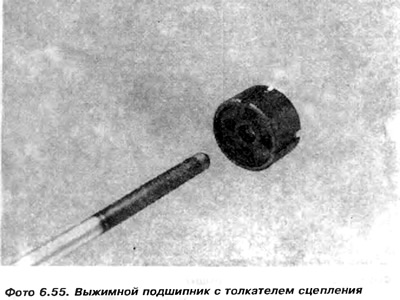
1. Remove the clutch pusher from the input shaft.
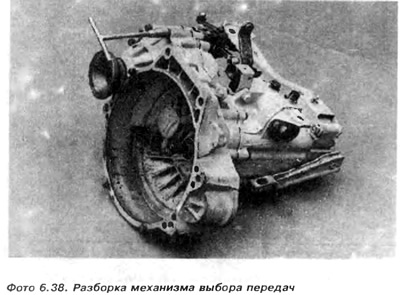
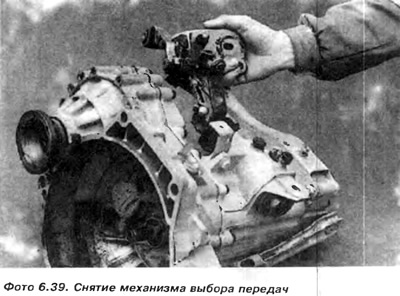
2. Unscrew the bolts and remove the outer gear selection mechanism components (photo 6.38 and 6.39).
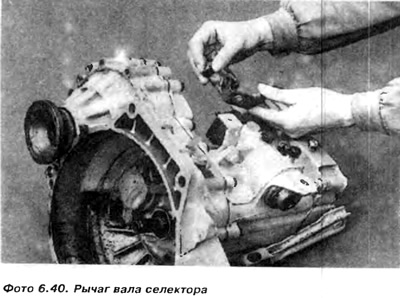
3. Loosen the nut and remove the selector shaft lever. Please note that the lever fits onto the shaft only in one position (photo at 6.40).
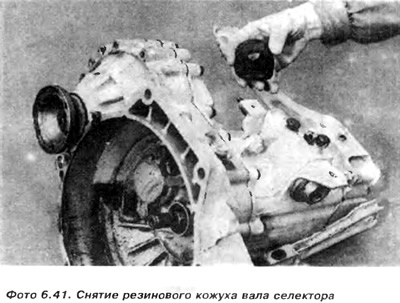
4. Remove the rubber cover of the selector shaft (photo 6.41).
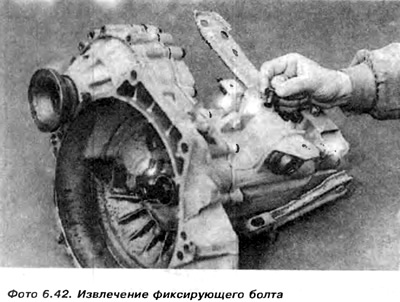
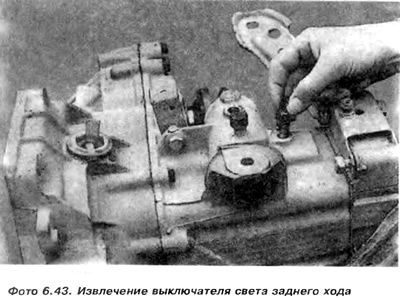
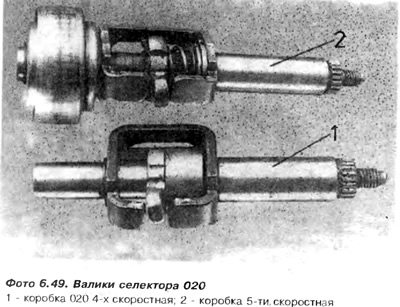
5. Unscrew the bolt securing (photo 6.42) the selector shaft assembly and the reverse light switch (photo 6.43).
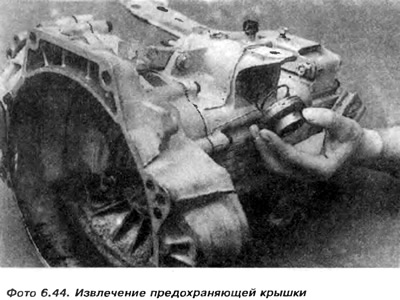
6. Using a spark plug wrench, unscrew the shaft protective cover and then remove the spring (photo 6.44).
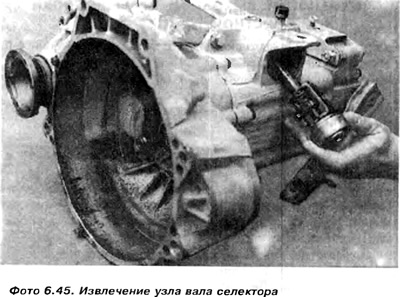
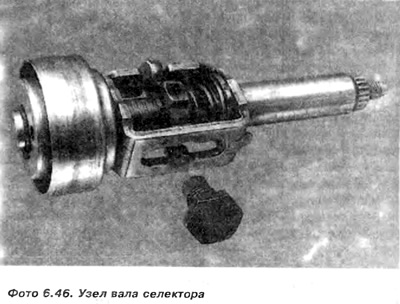
7. Set the selector shaft in the neutral position and only then knock the selector shaft assembly out of the housing (photo 6.45).
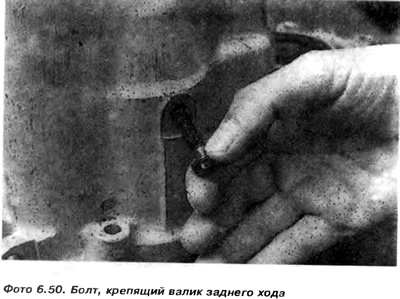
8. Unscrew and remove the bolt securing the reverse gear shaft.
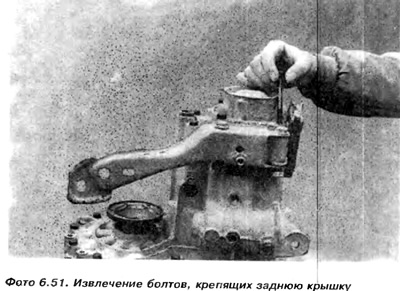
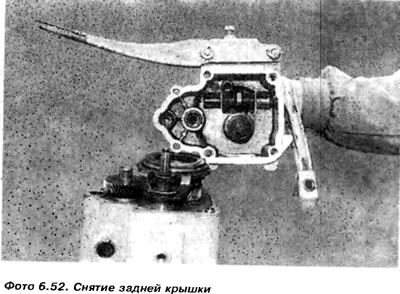
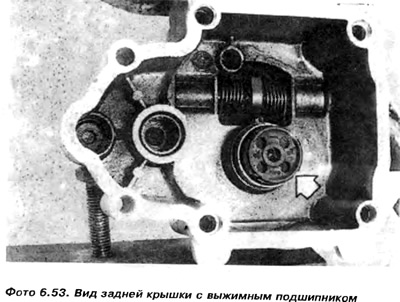
9. Loosen the bolts and remove the back cover from the main body. Remove the gasket (photo 6.51 and photo 6.52).
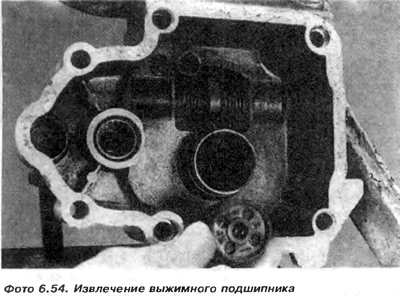
10. Remove the clutch release bearing from the rear cover (photo 6.54).
11. Remove the spring rings from the shaft of the release lever 6 (figure 6.13).
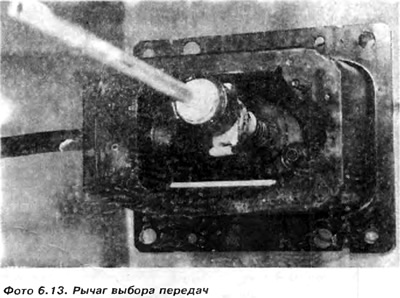
12. Pull the release lever out of the rear housing, paying attention to how the pusher lever 3 and return spring 2 were installed (figure 6.13).
Please note that return spring 1 has different coil diameters (figure 6.14).
Remember how the ends of the spring are hooked onto the body.
Caution: Do not remove the shaft of slider 1 from the center of the 5th speed slider (photo 6.62).
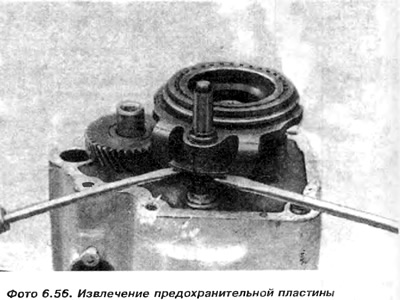
13. Use two screwdrivers to lift the 5th speed slider safety plate (photo 6.56).
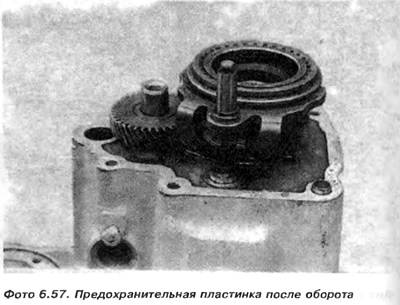
14. Turn (twist) the safety plate 90° (photo 6.57).
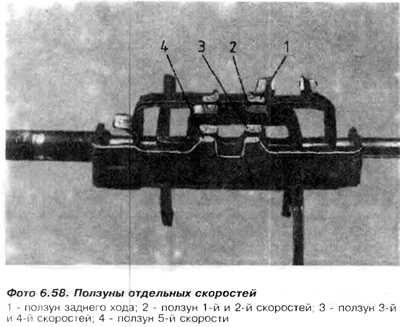
15. Notch the fifth and reverse speeds by pushing the slider visible in the hole in the selector shaft cover. The sliders of the individual speeds are shown (photo 6.58).
16. Loosen the bolt securing the fifth-speed synchronizer unit using a 12 mm slotted wrench (photo 6.59 and photo 6.60).
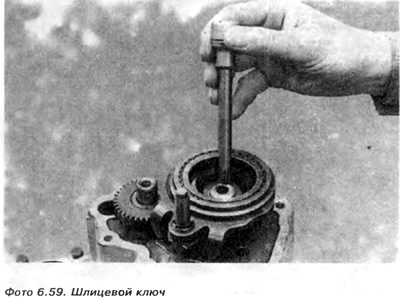
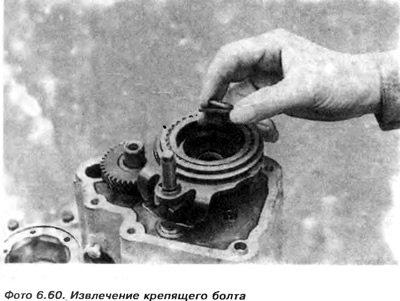
The bolt is screwed in very tightly, so you need an assistant to hold the gearbox.
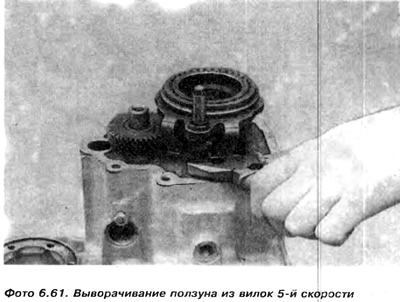
17. Unscrew the 5th speed slider from the 5th gear forks by turning it counterclockwise. The slider has a left-hand thread. The slider shaft still cannot be removed.
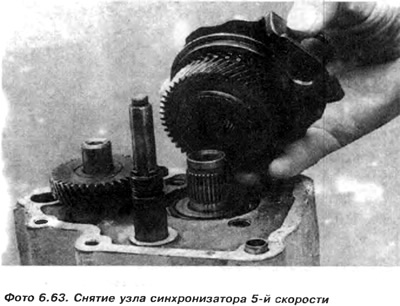
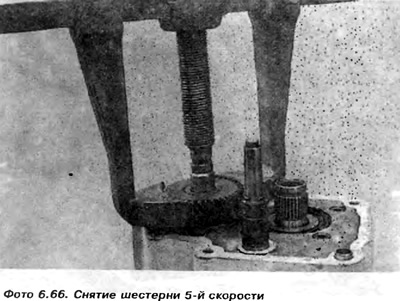
18. Remove the 5th speed synchronizer assembly from the input shaft 21. Pull the 5th speed gear off the output shaft (photo 6.63, 6.66).
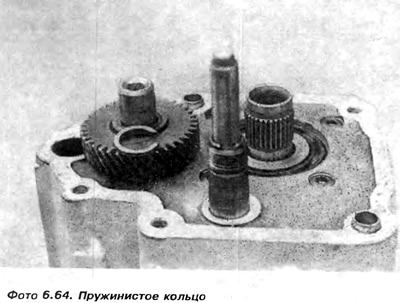
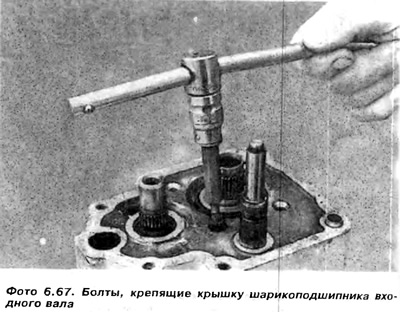
19. Remove the 5th speed gear retaining ring 22. Unscrew the spline bolts (with splined sockets) (photo 6.64, photo 6.67).
20. Remove the spacer washer (photo 6.65).
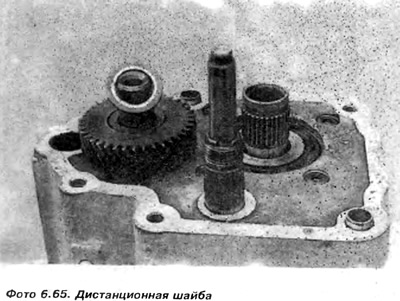
21. Pull the 5th speed gear off the output shaft (photo 6.66).
22. Remove the slotted bolts (with splined sockets) (photo 6.67).
23. Lift the plastic cover and remove it from the center of the drive flange on the side of the main gear housing (photo 6.68).
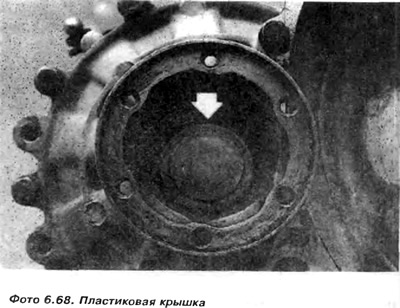
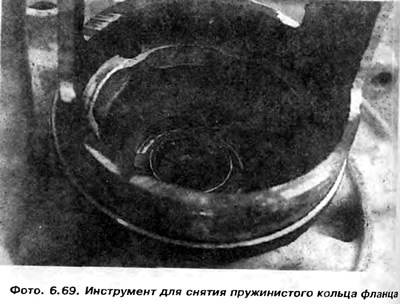
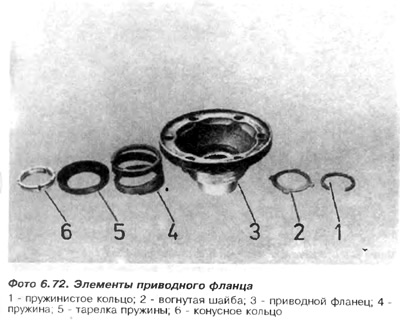
24. Bend the drive flange with a special sleeve and remove the spring ring through the side holes using pliers (photo 6.42).
25. Remove the concave washer (photo 6.70)
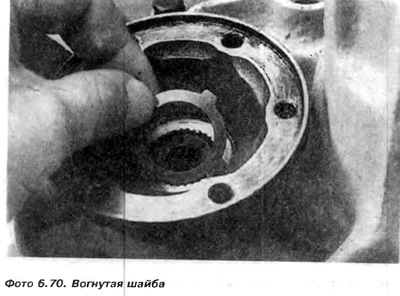
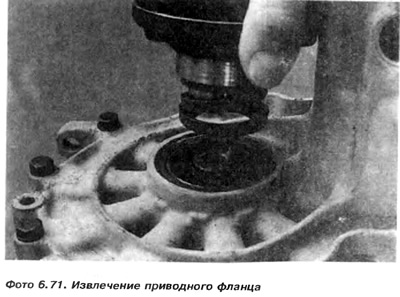
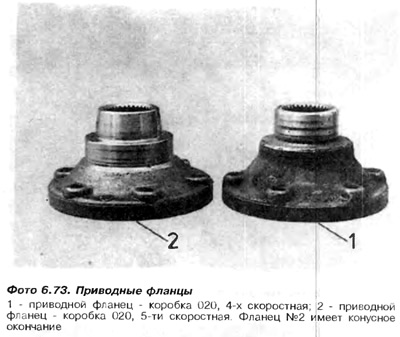
26. Remove the drive flange (photo 6.71).
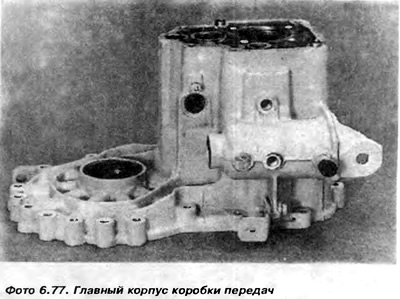
27. Unscrew the bolts connecting the main body to the clutch housing (photo 6.74).
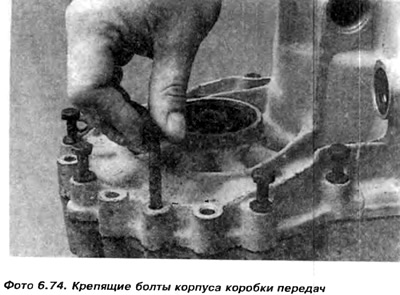
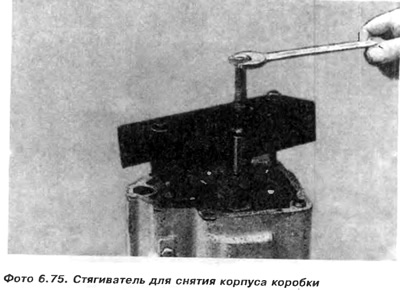
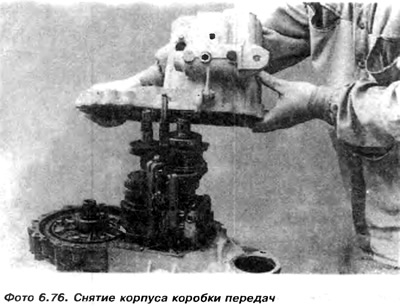
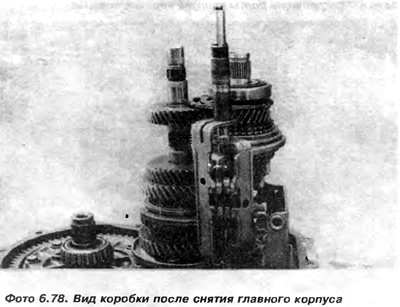
28. Next, use a puller to pull the main body off the input shaft. Keep the spacer washer located on the outer race of the input shaft ball bearing.
29. Remove the gasket and magnet from the clutch housing.
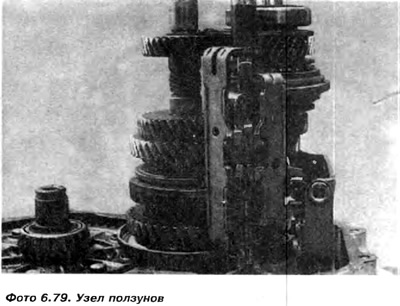
30. Raise the slider shaft and remove the slider assembly together with the shaft. Under the slider shaft, in the clutch housing, there is a spring that must also be removed and saved until assembly.
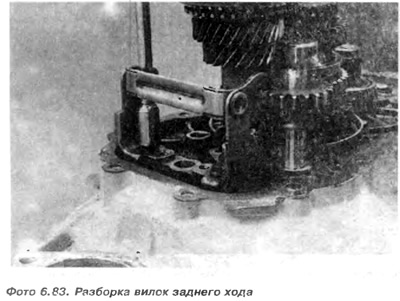
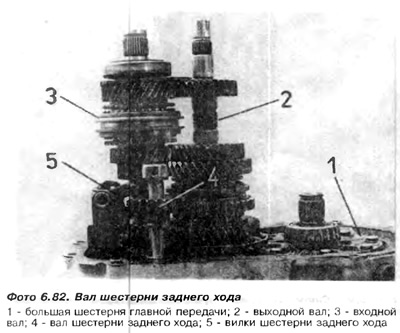
31. Turn the gearbox and loosen the bolts securing the supports of the reverse gear fork (photo 6.83).
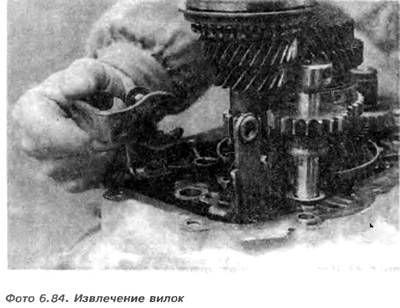
32. Remove the forks from the supports (photo 6.84).
[The original text can be found on the portal: VWmanual.ru]
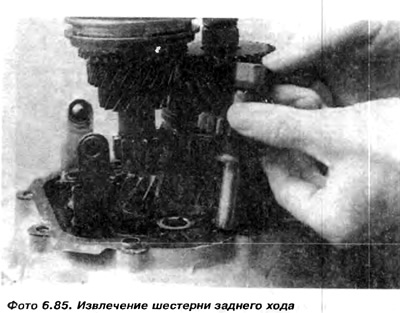
33. Remove the reverse gear together with the shaft (photo 6.85).
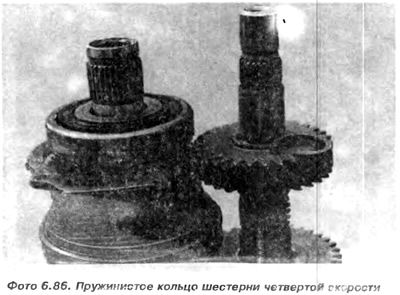
34. Remove the spring ring securing the fourth gear on the output shaft (photo 6.86).
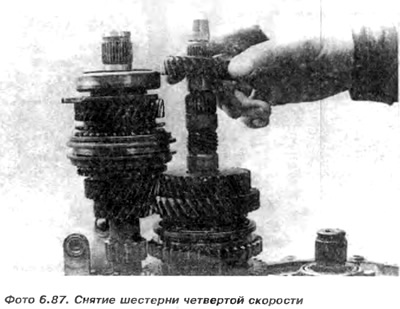
35. Remove the fourth speed gear from the output shaft (photo 6.87).
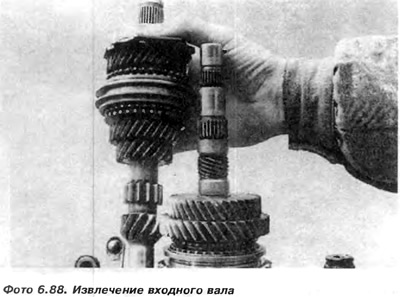
36. Remove the input shaft from the clutch housing. Set it aside (photo 6.88). Information on disassembly is provided below.
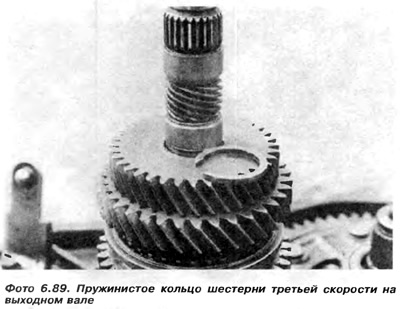
37. Remove the spring ring securing the 3rd gear pinion (photo 6.89).
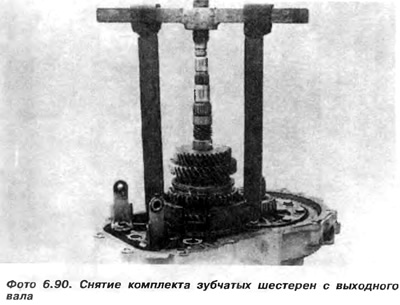
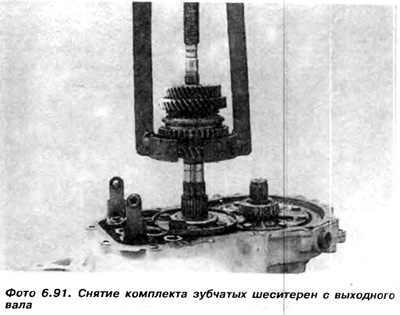
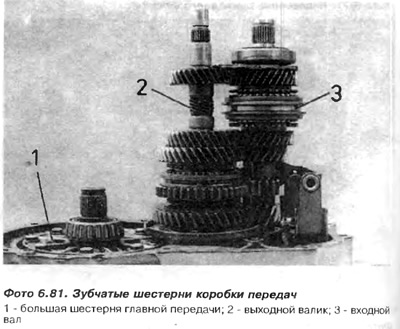
38. Using a special puller, remove the set of gears from the output shaft (photo 6.90 and photo 6.91). The description of disassembling the gear set is given below.
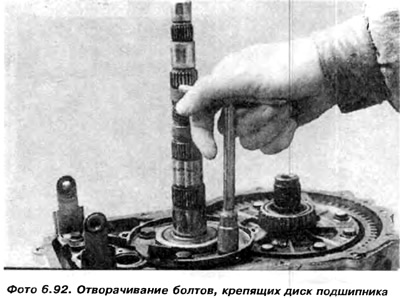
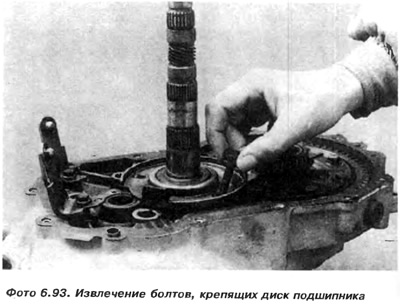
39. Remove the bolts securing the cone bearing disc (photo 6.92)
40. Remove the concave washer. The concave side of the washer faces the tapered bearing (photo 6.94).
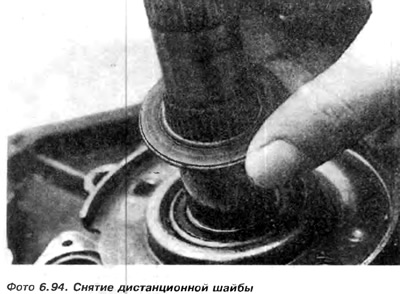
41. Remove the bearing disc (photo 6.95).
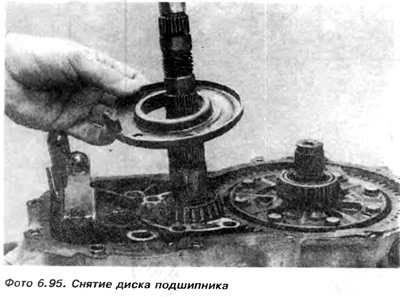
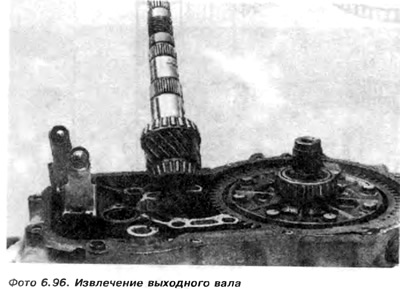
42. Remove the output shaft from the clutch housing (photo 6.96)
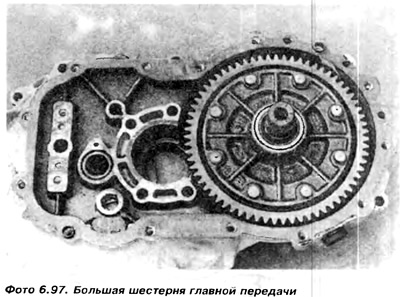
43. Remove the reverse fork supports (photo 6.97).
44. Remove the cone ring from the cone bearing of the differential mechanism (photo 6.98).
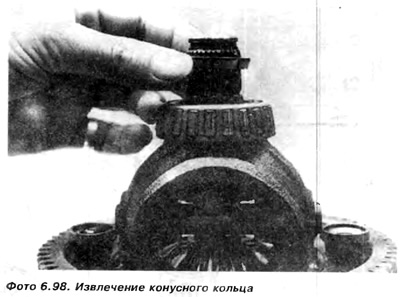
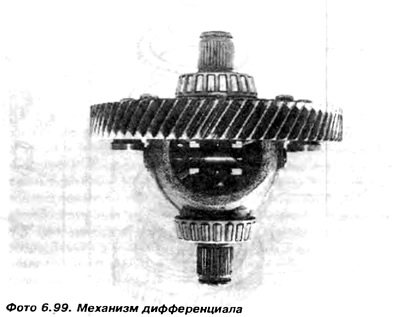
45. Remove the drive flange from the clutch housing side and remove the final drive gear with the differential mechanism from the clutch housing (photo 6.99).
46. If necessary, remove the needle bearing 1 of the input shaft, the track 2 of the lower bearing of the output shaft, the seal 3 of the differential mechanism from the clutch housing (photo 6.100).
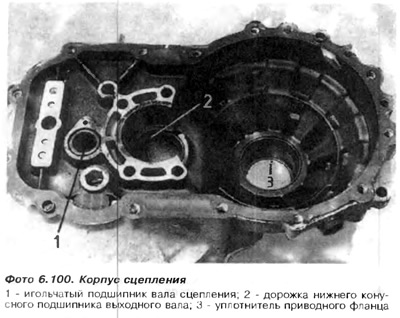
Seal 3 is seated in a plastic bushing, which can be knocked out with a screwdriver. Care must be taken not to damage the housing. After removal, the bushing must be replaced with a new one. The new bushing is pressed into place using a suitable tubular mallet.
If necessary, replace the output shaft cone bearings (respectively, the differential mechanism unit), then it should be noted that the small and large bearings fix the position of the output shaft in relation to the main gear pinion. The appropriate setting is obtained using a distance washer, which is selected from 16 different thicknesses. If at least one bearing is faulty, both must be replaced. During replacement, the old bearings break. New bearings must be seated under compression and the distance washer must be replaced with a corresponding washer under the lower bearing race. This operation is quite complex and requires special equipment to preload the shaft and measure the torque required to rotate the new bearing. In addition, replacing the washers under the lower bearing race will affect the distance washer on top of the input shaft and the axial clearance measured under the spring ring securing the 3rd speed gear to the output shaft. This means choosing a new distance washer and spring ring. There are 6 spring rings of different thicknesses. It is recommended that these bearings be replaced at a specialized gearbox repair facility.
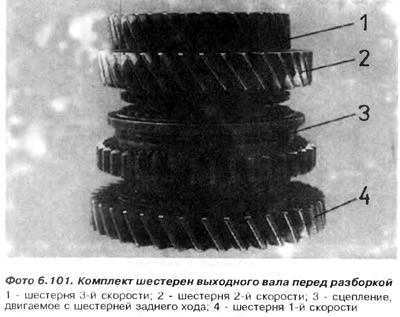
47. The gear set consists of the elements shown in positions 2 through 10 (photo 6.15).
43. Disassembling this kit does not cause any difficulties. However, it is necessary to pay attention to the order of disassembling the elements and their location relative to each other, see the pictures below.
49. Disassembly of the input shaft begins with the removal of the ball bearing (photo 6.111)
Please note that the bearing is directed with the large diameter of the inner race towards the 4th speed gear (photo 6.112).
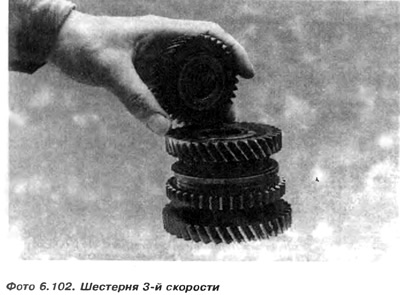
50. Remove the plate that secures the ball bearing to the gearbox housing. Pay attention to which side of the washer is adjacent to the bearing. It is suggested to mark with dots (dashed line) the location of the plate on the bearing side (photo 6.113).
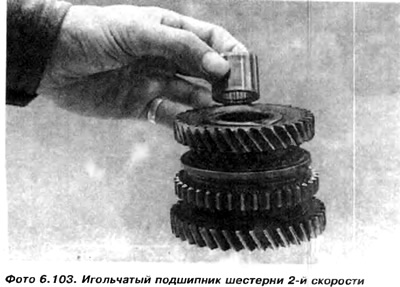
51. Remove the 4th speed gear from the needle bearing (photo 6.114).
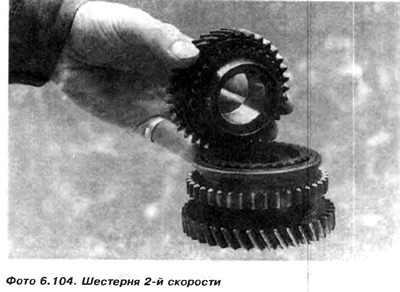
52. Remove the 4th speed gear needle bearing from the input shaft (photo 6.115).
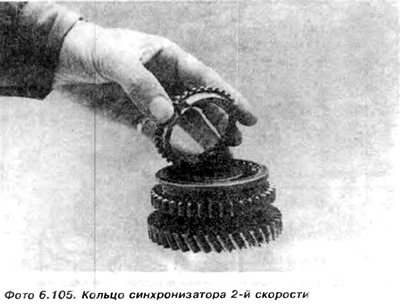
53. Remove the 4th speed gear synchronizer ring (photo 6.116).
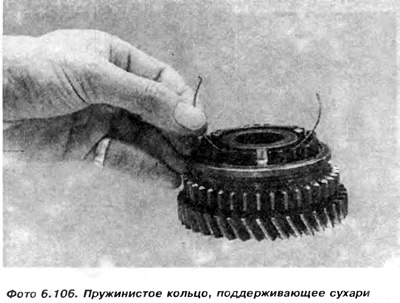
54. Mark with quick-drying paint the side of the movable gear that is on the side of the 3rd speed toothed gear. This does not matter if it is going to be replaced. If the gear is going to be reinstalled, it is recommended that it operates in the same position in which it was ground in. After removing the movable gear, assemble and secure the crackers for assembly.
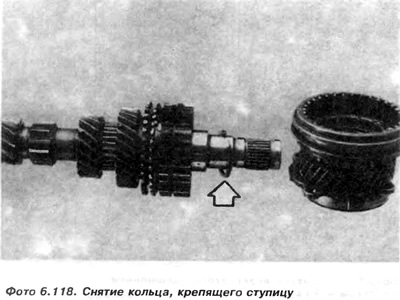
55. The synchronizer hub is secured to the shaft using a spring ring, which must be removed before pulling the hub off the splines (photo 6.118).
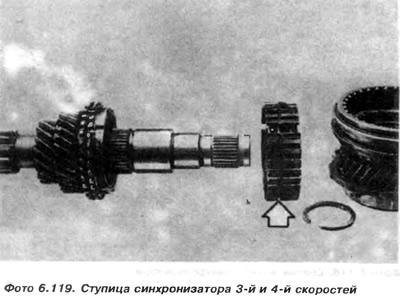
56. Remove the hub from the splines, paying attention to how it faces the 3rd speed gear. If there are difficulties in removing the hub from the splines, it is necessary to remove it together with the 3rd speed gear, hooking the arms of the tightener onto this gear.
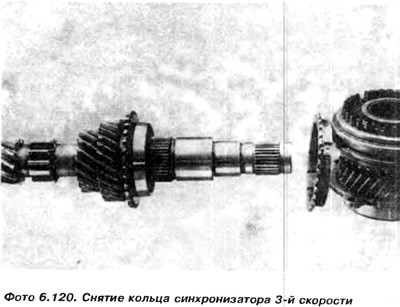
57. Remove the 3rd speed synchronizer ring (photo 6.120).
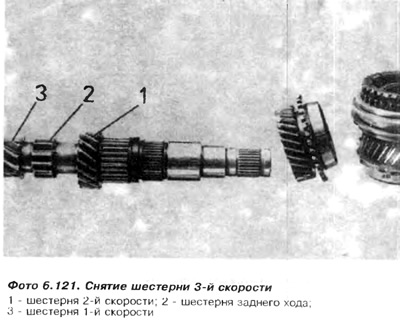
58. Remove the 3rd speed gear (photo 6.121)
59. Remove the 3rd speed gear needle bearing. Further down the input shaft are the 2nd speed, reverse and 1st speed gears (photo 6.122).
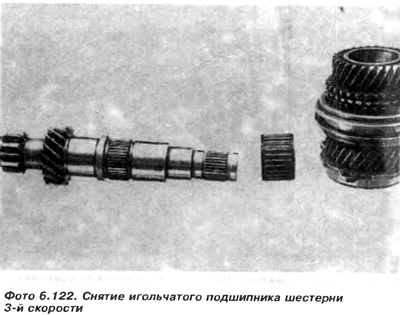
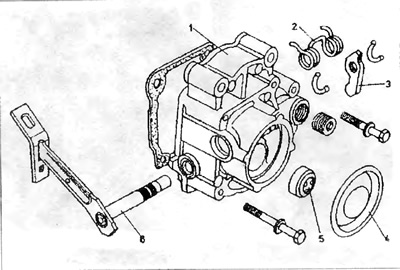
Figure 6.13. Rear cover of the 020 box, 5-speed
1 - rear cover of the box; 2 - return spring; 3 - pusher lever; 4 - back cover; 5 - release bearing; 6 - release lever shaft.
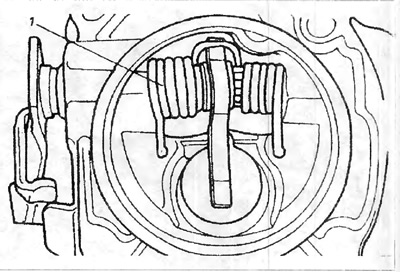
Figure 6.14. Return spring of the release lever
1 - return spring of the release lever.
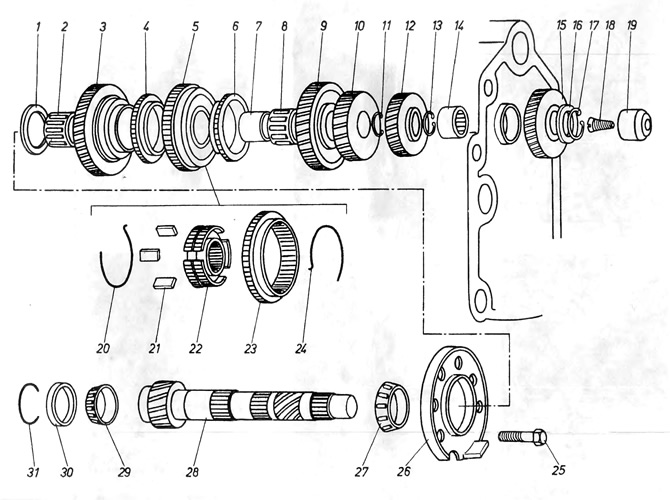
Figure 6.15. Output shaft of the 020 box - 5-speed
1 concave washer; 2 - 1st gear needle bearing; 3 - 1st gear pinion; 4 - synchronizer ring; 5 - 1st and 2nd speed synchronizer unit; 6 - synchronizer ring; 7 - needle bearing track; 8 - needle bearing; 9 - 2nd speed gear; 10 - 3rd gear pinion; 11 - spring ring; 12 - 4th speed gear; 13 - spring ring; 14 - screw securing the needle bearing in the gearbox housing; 15 - needle bearing; 20 - ring that holds the crackers; 21 - crackers; 22 - synchronizer hub; 23 - movable gear with reverse gear; 24 - ring supporting crackers, 25 - bolt securing bearing disk; 26 - bearing disc; 27 - cone bearing; 28 - output shaft; 29 - lower cone bearing; 30 - lower bearing track; 31 spacer washer for the lower bearing track.
Visitor comments