



The elements should lie on clean paper or foil.
1. Using a metal tube, drive the output shaft bearing into the gearbox housing with the closed side of the bearing facing the inside of the gearbox.
2. Lubricate the locking rods 21 and insert them into the housing (figure 6.3 and photo 6.11).
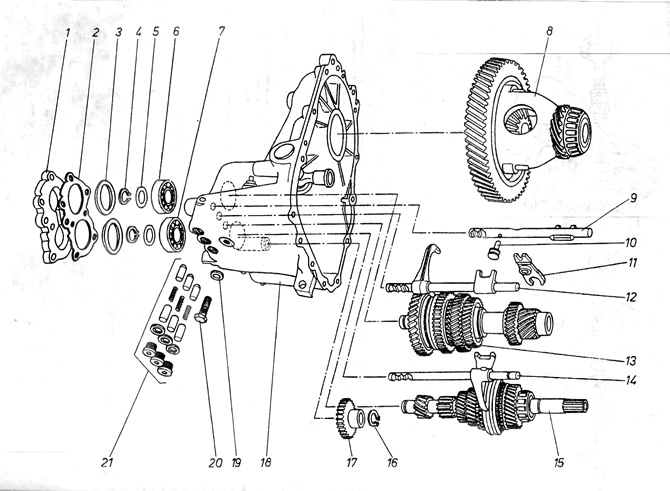
Figure 6.3. Gearbox - 084
1 - rear bearing cover; 2 - gasket; 3 - spacer washers; 4 - spring rings; 5 - spacer washers; 6 - output shaft ball bearing; 7 - Input shaft ball bearing; 8 - differential mechanism; 9 - reverse gear fork slider; 10 - reverse gear pinion fork; 11 - reverse gear forks; 12 - 1st and 2nd speed fork slider; 13 - output roller; 14 - 3rd and 4th speed fork slider; 15 - input roller; 16 - spring ring; 17 - reverse gear; 18 - gearbox housing; 19 - washer; 20 - bolt (axis of rotation) reverse gear fork; 21 - a unit of blocking elements against simultaneous activation of two speeds.
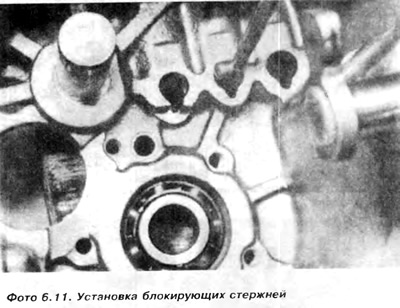
You can use a magnetized screwdriver for this if necessary.
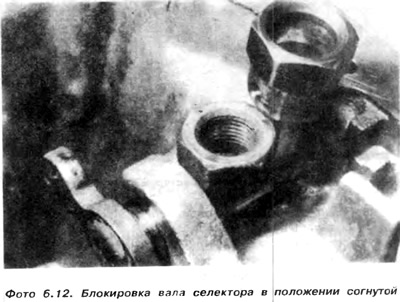
3. Move the selector shaft by bending the spring and the M16 nut or using a piece of wire to lock the selector shaft in the appropriate position (photo 6.12).
4. Install the slider with the 1st and 2nd speed forks 12 into the groove of the synchronizer movable gear on the output shaft 13 (figure 6.3).
5. Place the reverse gear pinion 17 on its shaft, lift it up and hold it in this position with a piece of wire.
6. Install the output shaft and slider into the gearbox housing, and at the same time lower the reverse gear behind the first gear gear.
7. After the final installation of the output shaft in its bearing, check whether the slider forks are in a free position and whether the reverse gear can move freely.
8. If a new transmission housing, bearing or output shaft is installed, new bearing spacers must be identified and installed.
a) Install the spring ring 17 and use a feeler gauge to measure the gap between the ring and the inner race of the ball bearing 15 (figure 6.6).
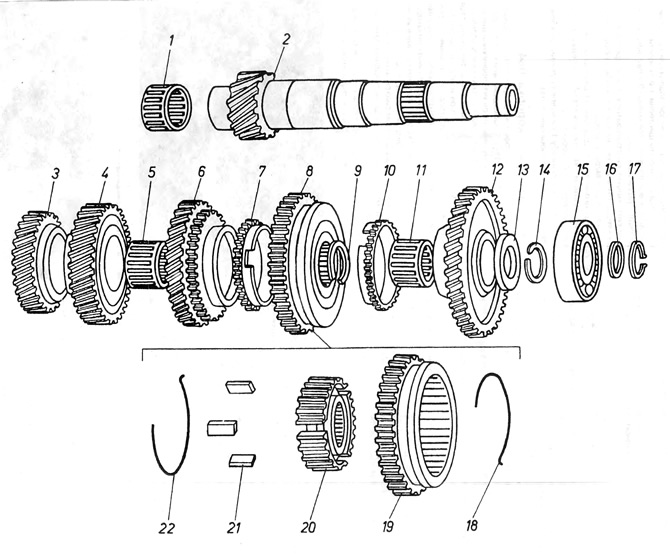
Figure 6.6. Output shaft 084
1 - needle bearing; 2 - output shaft; 3 - 4th speed gear; 4 - 3rd speed gear; 5 - 2nd speed gear needle bearing; 6 - second speed gear; 7 - synchronizer ring; 8 - synchronizer unit; 9 - spring ring; 10-ring synchronizer; 11 - needle bearing; 12 - 1st speed gear; 13 - spacer washer; 14 - spring ring; 15 ball bearing; 16 - spacer washer; 17 - spring ring; 18 - ring supporting crackers; 19 - movable gear with reverse gear pinion; 20 - synchronizer hub; 21 - synchronizer crackers; 22 - ring that holds the crackers.
b) Select a small spacer washer 16 such that the gap is 0-0.05 mm.
c) Place the washer on the shaft and fasten the spring ring.
d) Using a clock gauge or feeler gauge, measure the distance C between the surface of the gearbox housing (without gasket) and the outer race of the ball bearing 15 (figure 6.6).
Add between 0.27 and 0.31 mm to the gap size C to get the thickness of the large spacer washer to fit on the outer track. When determining the dimensions of a large spacer washer, it is necessary to make sure that the bearing is completely located (sitting) in the housing, and also, if a time sensor is used, it must have a zero reading with a two-millimeter pre-stretch.
9. Place the slider with the 3rd and 4th speed forks 14 in the groove of the synchronizer movable gear on the input shaft.
10. Install the input shaft and slider with forks into the gearbox housing so that the gear teeth come into contact with the gear teeth on the output shaft.
Caution: Raise the reverse gear slightly so that the first gear gear of the input shaft can pass.
11. Support the output shaft with the special plate described in point 4, and then remove the wire from the reverse gear.
12. Drive the input shaft bearing 7 into the gearbox housing and onto the shaft using a metal tube. The closed side of the bearing must face the inside of the gearbox.
13. According to the description of paragraph 8.8, determine and place the small and large spacer washers on the end of the input shaft.
14. Remove the special plate from the input shaft (Fig. 6.4).
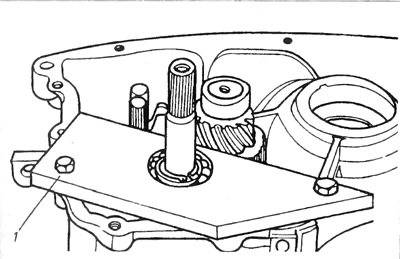
Figure 6.4. Fixing plate (input shaft)
1 - fixing plate.
15. Remove the M16 nut or wire blocking the selector shaft.
16. Place the forks of the reverse gear pinion 11 on the reverse gear slider 9, then insert the forks and slider into the housing and notch the forks with the reverse gear pinion. It will be necessary to slightly raise the toothed gears.
17. Install the reverse gear forks approximately 200 mm from the 1st and 2nd gear slider. Make sure that the rotation axis on the slider 9 is level with the hole in the forks (figure 6.3).
18. Install the washer and screw in the screw with a faceted head 20, then tighten it further. Check whether the gap between the forks 11 and the slider 9 is equal to 1.3-2.8 mm, see Figure 6.7.
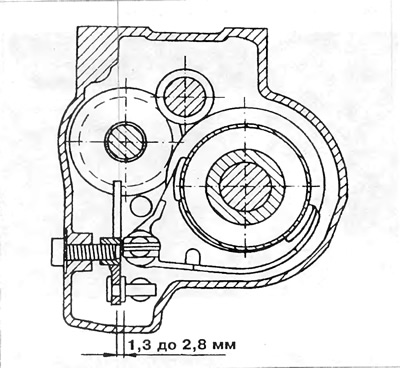
Figure 6.7. Clearance between forks and slider
19. Install the locking rods, springs and bushings into the housing holes, then the plugs with washers. Press the plugs with a hex key (figure 6.8).
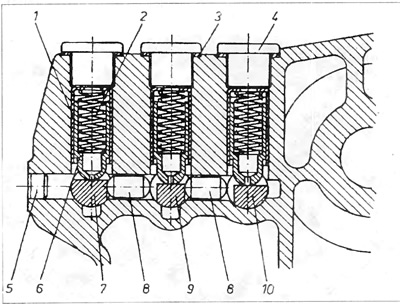
Figure 6.8. Mechanism for blocking simultaneous engagement of two gears
1 - gearbox housing; 2 - spring; 3 - washer; 4 - threaded plug; 5 - plug; 6 - locking rod; 7 - reverse slider; 8 - locking plug; 9 - 1st and 2nd gear slider; 10 - 3rd and 4th gear slider.
20. Move the selector shaft lever and check whether the gears engage easily. It is also necessary to check whether it is possible to move adjacent sliders simultaneously.
21. Place large adjusting washers on the ball bearings of the input and output shafts, put on the rear cover 1 of the gearbox together with a new gasket. Lubricate the threads of the bolts with a liquid preservative. Insert the bolts and tighten them to the appropriate torque crosswise (figure 6.3).
22. Unscrew the gearbox and install the differential mechanism (photo 6.10).
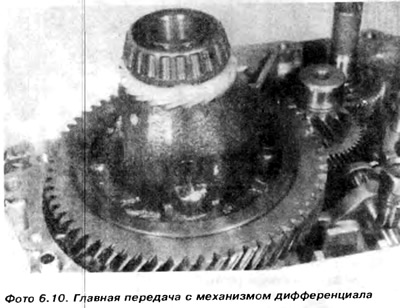
23. Clean the mating surfaces of the clutch housing and the main housing. Install a new gasket if one was installed previously, otherwise it is necessary to apply sealing paste to these surfaces
24. Place the magnet in the gap of the gearbox housing.
25. Check whether the sliders are in a free position, and then push the clutch housing onto the main gearbox housing, checking whether the gear selection lever of the clutch housing is notched with the central lever of the selector shaft.
26. Drive in the locking pins, then install the bolts and tighten them evenly in a cross pattern to the appropriate torque.
27. Insert the drive flanges into the differential mechanism together with the cone ring, support washer and spring. Insert the bolts and tighten them to the appropriate torque. Hold the flanges motionless with a rod placed between two bolts inserted into adjacent holes in the drive flange. It is necessary to pay attention that the right and left flanges differ from each other (see box disassembly).
28. Insert and press the reverse light switch.
29. Insert the shaft into the clutch release bearing.
30. After screwing the gearbox to the engine, it is necessary to fill it with oil.
Visitor comments