



Contents: Removal ↓ Installation ↓
Since this work requires the toothed belt to be removed, it is essential to take into account the requirements in the section "Timing Belt Adjustment". Along with special tools for dismantling the timing belt and exhaust manifold for the exhaust gas outlet (for cars produced after August 1979.) the following parts are required: cylinder head gasket, valve cover gasket set, long Allen key or SW 12 internal tooth key, and a set of new cylinder head screws for the engine (1.6L). The internal tooth screws for the engine (1.6L) must be replaced. The internal Allen screws for the engine (1.5L) can be reused.
Removal
Disconnect the wires from the battery.
Drain the coolant into a container.
For a suction diesel engine, remove the air cleaner cover and filter element.
For a turbodiesel engine, remove the air filter housing and intake.
Remove the valve cover.
Remove the injection system pipes and lay them out on a clean surface.
Close the connections on the injectors and fuel pump with plugs.
Remove the drain line running from the injectors to the pump.
Disconnect the wires from the glow plugs.
Mark and remove the wire leading to the oil pressure sensor and to the temperature sensors.
Remove the exhaust pipe.
Remove the timing belt.
Remove the cooling system hoses from the cylinder head.
Disconnect the oil lines leading to the turbocharger and the line to the fuel pump.
Move the cold start accelerator rod to the side or suspend it.
Remove the cylinder head bolts in reverse order (compared to that shown in the figure).
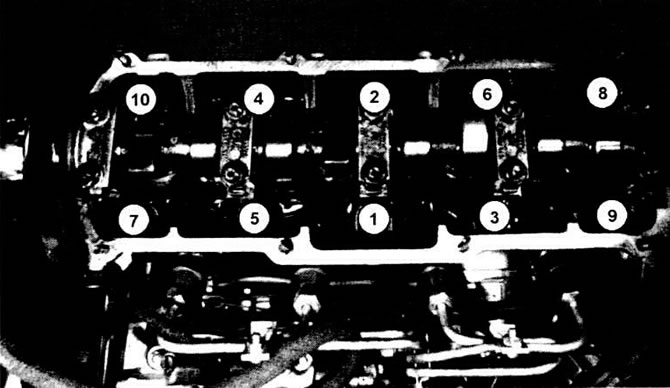
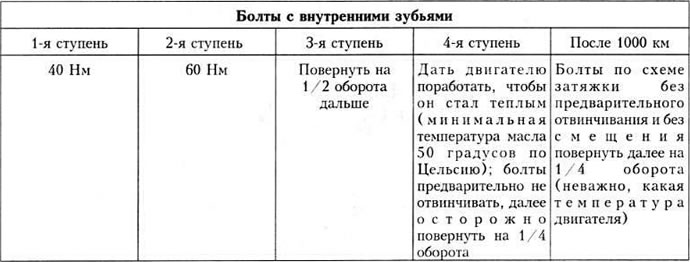
To ensure that the cylinder head fits perfectly flat and evenly, the ten head screws must be tightened in the sequence shown in the illustration. The tables below show the torques and rotation angles that must be observed when tightening the bolts
Remove the cylinder head.
Installation
The cylinder head gasket thickness must be determined correctly (see next section).
[The original information is posted on the website VWmanual.ru]
Check the cylinder head joint surface for any distortions. To do this, place a long metal ruler or a perfectly straight metal square along the cleaned surface of the cylinder head. Measure the deflection using a feeler gauge. The maximum permissible deflection is 0.1 mm. Volkswagen does not recommend additional grinding of the cylinder head. Therefore, if the deflection is more significant, the head must be replaced immediately.
Clean the engine block mating surface.
Clean the threads of the holes in the engine block. The holes should be free of dirt, oil and water. Blow with air.
Place the cylinder head gasket into the engine block.
Place the cylinder head on the engine. First, tighten all the bolts loosely so that the gasket can be centered.
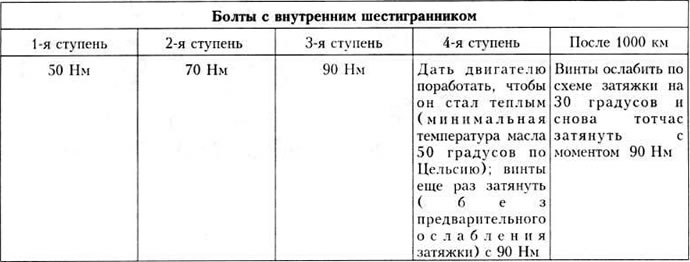
With the engine cold, tighten the cylinder head bolts according to the tightening diagram (see picture), observing the tightening torque values prescribed for your machine (see table).
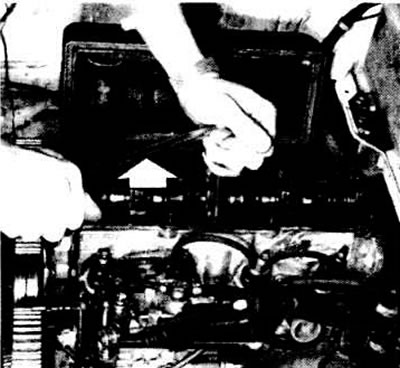
At the first stages of tightening, the cylinder head bolts are tightened with a wrench and a dynamometer. At further stages, tightening is carried out (depending on the screw design) maintaining the angle of rotation with a rigid key (see arrow) or again with a wrench and a dynamometer (see tables). |
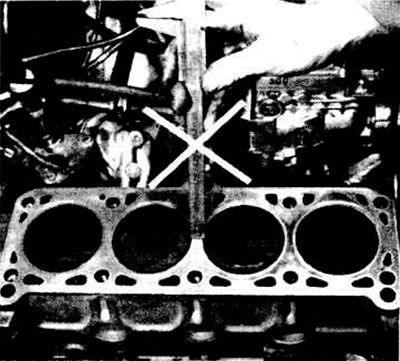
This will not work! For additional measurement of piston protrusion, a sliding template or caliper is too inaccurate. It should be measured with an indicator or micrometer. |
Carry out further assembly (assembly is carried out in the opposite order to disassembly).
After driving 1000 km, do not forget to additionally tighten the threads of the cylinder head screws!
Tightening torques for cylinder head threaded connections
Visitor comments