
English Русский
Български
Беларускі
Український
Српски
Hrvatski
Română
Polski
Slovenský
Magyar
  |  Articles  |  Sitemap  |  Contacts  |    |
Car maintenance Ford Car maintenance Hyundai Car maintenance Chevrolet Car maintenance BMW Car maintenance Audi Car maintenance Opel Car maintenance AvtoVAZ
VWmanual.ru


Main   Passat   Golf   Polo   Touareg   Tiguan   Sharan   Transporter   Others  
Golf 1 (1974-1984, diesel) Golf 1 (1974-1984, petrol) Golf 2 (1984-1993, petrol) Golf 2 (1984-1993) Golf 3 (1991-1997) Golf 4 (1997-2004) Golf 5 (2003-2008)

Thermal valve clearance (VW Golf 1)

  • Main
  • Golf
  • Golf 1
  • Power unit
  • Engine repair
  • Thermal valve clearance
            0


Contents: Thermal clearance too small ↓ Thermal clearance too large ↓ Checking the thermal gap ↓ Correctly set valve clearance ↓
Due to engine heating, individual valve parts expand and lengthen. Therefore, there must be a small gap between the camshaft and the cup tappets. Only then can the valves be properly sealed even in a hot engine, despite the lengthening of their stems.

Below we will list the consequences of an incorrectly set valve clearance.

Thermal clearance too small


The valves do not fit tightly to the seats, very hot exhaust valves cannot transfer heat to the seat chamfers because of this. Then the valves and their seats burn out, since hot combustion products pass through the latter. In milder cases, the valves are warped. The seal is damaged, as a result of which the seat soon burns out. Compression decreases, the engine loses power, runs worse and consumes more fuel.

Thermal clearance too large


The valves open a little later than usual: the cylinders are filled worse, the engine does not develop full power. The wear of the camshaft and the adjusting washer, folded at the top into the cup tappet, becomes greater. This is evidenced by the loud noise coming from the valves.

Checking the thermal gap


You can check the thermal gap yourself. The engine must be warm to check (the coolant temperature is 35 degrees Celsius). This is achieved after idling the engine for about 5 minutes. When reinstalling the valve cover, a new seal should be inserted to avoid leaks (three parts).


  • Remove the valve cover.
  • Measurements are taken simultaneously at the inlet and outlet valves of the cylinder. The valves must be in a free state.
  • Turn the engine crankshaft manually until the tips of both cams on the camshaft at the first cylinder point upward.
  • First try inserting a feeler gauge that matches the upper tolerance value between the camshaft and the tappet (see table below), then insert thinner sheets equal to 0.05 mm.
  • The feeler gauge for the smaller value should be inserted with slight resistance, otherwise the valve clearance is too small
  • Less often, the gap is too large, then you can insert a feeler gauge sheet that is thicker than the specified upper tolerance limit.
  • Record the measured value.
  • In accordance with the operating procedure, the 3rd cylinder (1-3-4-2) is then checked.
  • To do this, the engine crankshaft should be turned another 1/2 turn. Now, at the 3rd cylinder, both camshaft cams should be facing upwards. You can take a measurement at cylinder 3.
  • Check the remaining cylinders in the same way. To do this, turn the engine crankshaft 1-2 turns further.

Correctly set valve clearance


The table shows the values within which the valve clearance should be at a coolant temperature of 35 degrees Celsius.
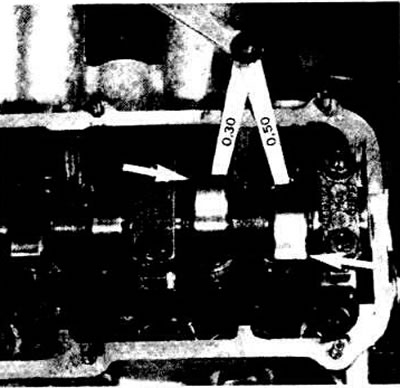
The figure shows a feeler gauge that is inserted at the 4th cylinder to measure the thermal valve…

The figure shows a feeler gauge that is inserted at the 4th cylinder to measure the thermal valve clearance. The clearance of the intake valves should be 0.20-0.30 mm, and the exhaust valves should be 0.40-0.50 mm. These parameters are given for a warm engine. To measure the valve clearance of any cylinder, both camshaft cams should be facing outward (mirror image inverted), as the arrows show.

Suction diesel and turbo diesel engineInlet valveExhaust valve
Valve play in a warm engine0.20-0.30 mm0.40-0.50 mm

This article is available at russian, bulgarian, belarusian, ukrainian, serbian, croatian, romanian, polish, slovak, hungarian
The text has been checked: Medvedeva Elena

Share information:

Previous articles
Finding Top Dead Center
Cranking the engine crankshaft
Measuring compression in cylinders
Uncontrolled increase in RPM
Running in a new engine
Individual engine components
Next articles
Valve adjustment
Timing Belt Adjustment
Checking the condition and tension of the toothed belt
Timing Belt Tension
Replacing the timing belt
Removal and installation the cylinder head


Similar articles from other manuals for VW cars:
Checking the time-delay thermal valve Passat B3 (1988-1993)
Valve seat machining Polo 3 (1995-2003)
Checking the valve timing Touareg 1 (2002-2006)
Removal and installation the throttle valve control unit and the… Tiguan 1 (2007-2015)
Measuring connecting rod clearance Sharan 1 (1995-2000)
Basic valve clearance adjustment Transporter T3 (1979-1992)
Checking the thermal clearance in the joints of piston rings Caddy 3 (2003-2010)
Link to this page in different formats


Visitor comments


No comments yet


How much will 24 + 35 =


Golf 5 
  • General information
  • User manual
  • Maintenance
  • Troubleshooting
  • Power unit
  • Engine repair
  • Cooling and ventilation system
  • Fuel system
  • Ignition system
  • Transmission
  • Clutch
  • Mechanical gearbox
  • Automatic gearbox
  • Chassis
  • Brake system
  • Car suspension
  • Steering
  • Body
  • Interior (internal elements)
  • Exterior (external elements)
  • Doors and covers
  • Electrical equipment
  • Power devices
  • Washers and wipers
  • Lighting and appliances
  • Electrical circuits
Golf 4 
  • General information
  • User manual
  • Weekly checks
  • Maintenance
  • Power unit
  • Petrol engines
  • Diesel engines
  • Cooling system
  • Fuel system (petrol)
  • Control system (petrol)
  • Fuel system (diesel)
  • Exhaust system
  • Transmission
  • Clutch
  • Car gearbox
  • Drive shafts
  • Chassis
  • Car suspension
  • Steering
  • Wheels and tires
  • Brake system
  • Body
  • Exterior (external elements)
  • Interior (internal elements)
  • Ventilation and heating
  • Car doors and sunroof
  • Washers and glass cleaners
  • Electrical equipment
  • Power devices
  • Lighting and appliances
  • Electrical circuits
Golf 3 
  • Petrol engine
  • Engine repair
  • Lubrication system
  • Cooling system
  • Ignition system
  • Diesel engine
  • Engine repair
  • Diesel injection system
  • Pre-glow system
  • Transmission
  • Clutch
  • Gearbox and drive shafts
  • Chassis
  • Steering
  • Wheels and suspension
  • Brake system
  • Electrical equipment
  • Lighting and appliances
  • Electrical circuits
Golf 2 
  • General information
  • Introduction to guide
  • User manual
  • Petrol engines 1.3 l
  • Engine repair
  • Lubrication system
  • Cooling system
  • Carburetors
  • Supply system
  • Ignition system
  • Petrol engines 1.6/1.8 l
  • Engine repair
  • Supply system
  • Ignition system
  • Diesel engines
  • Engine repair
  • Lubrication system
  • Cooling system
  • Power and exhaust system
  • Transmission
  • Clutch
  • 4-speed gearbox 084
  • 5-speed gearbox 085
  • 4-speed gearbox 020/4R
  • 5-speed gearbox 020/4T
  • Automatic gearbox
  • Drive shafts
  • Chassis
  • Steering
  • Car suspension
  • Brake system
  • Body
  • Body elements
  • Doors, locks and windows
  • Electrical equipment
  • Equipment and devices
  • Power devices
Golf 2 (petrol) 
  • General information
  • Characteristics
  • Car care
  • Maintenance
  • Power unit
  • Engine repair
  • Engine 1.05/1.30
  • Engine 1.60/1.80
  • Cooling and lubrication system
  • Power and exhaust system
  • Transmission
  • Clutch
  • Car gearbox
  • Drive shafts
  • Chassis
  • Brake system
  • Steering
  • Suspension
  • Body
  • Body and equipment
  • Electrical equipment
  • Lighting and appliances
  • Electrical circuits
Golf 1 (petrol) 
  • General information
  • Characteristics
  • User manual
  • Maintenance
  • Power unit
  • Engine adjustment
  • Engine 1.1/1.3
  • Engine 1.5/1.6/1.8
  • Engine electrical equipment
  • Cooling system
  • Fuel system
  • Transmission
  • Clutch and manual gearbox
  • Automatic gearbox
  • Chassis
  • Steering
  • Front suspension
  • Rear suspension
  • Brake system
  • Electrical equipment
  • Lighting and appliances
  • Electrical circuits
  • Body
  • Body and equipment
  • Optional equipment
Golf 1 (diesel) 
  • General information
  • Specifications
  • Maintenance
  • Power unit
  • Engine repair
  • Exhaust and turbocharger
  • Cooling system
  • Fuel system
  • Fuel injection system
  • Transmission
  • Clutch and drive shafts
  • Car gearbox
  • Chassis
  • Suspension and wheels
  • Steering
  • Brake system
  • Wheels and tires
  • Body
  • Heating and ventilation
  • Exterior (external elements)
  • Interior (internal elements)
  • Doors and windows
  • Electrical equipment
  • Equipment and devices
  • Lighting system
  • Power devices
  • Electrical circuits
VWmanual.ru © 2016-2026 | Mobile version | News and articles | Sitemap: EN BG BY UA RS HR RO PL SK HU | Write message | Site search
Passat B2 • Passat B3 • Passat B4 • Passat B5 • Passat B6 • Golf 1, diesel • Golf 1, petrol • Golf 2, petrol • Golf 2 • Golf 3 • Golf 4 • Golf 5 • Polo 3 • Polo 4 • Touareg 1 • Tiguan 1 • Sharan 1 • Transporter T3 • Transporter T4 • LT 28 • LT 2D • Beetle • Caddy 3 •
Our website uses cookies to ensure functionality and convenience.