



This effect occurs when a large number of engine oil particles are entrained by the engine crankcase ventilation system.
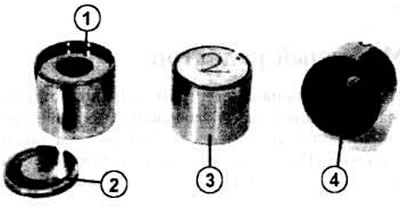
The removed cup tappets are shown from all sides: 1 - cup pusher with removed adjusting washer (2); the adjusting washer is lying nearby; 3 - cup pusher assembly, top view; 4 - lower side of the cup pusher.
The particles then settle in the air filter housing and are sucked into the combustion chambers. The diesel engine processes the oil, causing noise and smoke. The air filter becomes clogged, and the mixture in the cylinders becomes enriched. The "excess" fuel entering the engine, of course, causes a clear increase in the number of revolutions, and this phenomenon can no longer be controlled using the accelerator pedal. If the driver reacts incorrectly and disengages the clutch, the engine "runs away". The valves hit the pistons, the connecting rods break off, and the crankshaft "jams". Therefore, the clutch should be left engaged, the car should be slowed down to a stop, and the engine should be turned off in gear. Before further driving, replace the oiled air filter element, wipe off the oil in the housing. Set the first gear, start the engine, do not press the clutch pedal, but operate the starter. Touch the brake pedal with your right foot (since the engine is probably still revving hard at high RPMs), until the remaining oil burns out. A blue cloud of oil from the exhaust pipe is normal. For prevention, a kit of equipment should be installed (see description below).
Measures to prevent "runaway" work
As already mentioned, some engines of the first diesel series sometimes develop uncontrolled high speeds after long trips. This phenomenon can be eliminated in many cases by installing a modified crankcase ventilation system. Equipment kit (N det.068198999) consists of a special hose (figure) and a modified flange, which is installed at the engine crankcase instead of the original flange.
(View the original on the website vwmanual.ru)
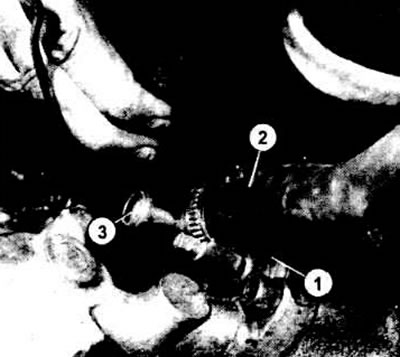
The lower end of the special branched hose (2) is fixed at the modified flange (1). The free state (3) is intended for connecting the hose coming from the vacuum pump.
Visitor comments