



Removal
Remove the gearbox.
Insert the support to release the screws.
Loosen the screws little by little, in a crisscross pattern.
Remove the pressure plate and clutch disc.
Installation
Installation is carried out in the reverse order, and it is necessary to pay attention to the following points.
Note: Replace the pressure plate and clutch disc only together. Identify the pressure plate and clutch disc by the engine letter designations.
Note: The adjusting ring of the pressure plate of the clutch with automatic adjustment of the working clearance should only be checked or, if necessary, returned to its original position in new clutches manufactured by LuK.
Note: Check if there are fitted bushings for engine/gearbox alignment in the cylinder block, insert them if necessary.
Note: If the bushings are not fitted, there will be difficulties with shifting, clutch problems and, accordingly, noise in the gearbox (crackling noise in drive wheels).
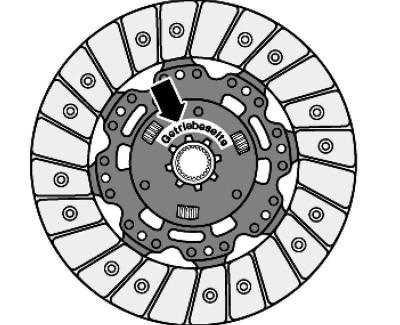
Fig. 3.30. Installation position of the clutch driven disc
The inscription "Gearbox side" faces the gearbox (Fig. 3.30).
Checking the ends of the membrane spring
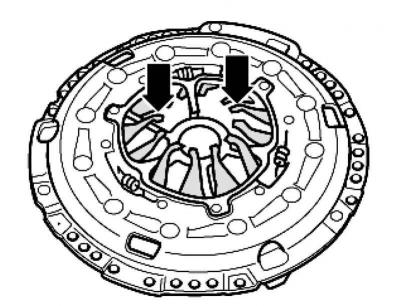
Fig. 3.34. Checking the ends of the membrane spring
Check the ends of the membrane spring (Fig. 3.34).
Wear of the membrane spring up to half its thickness is allowed.
Checking keyed and riveted joints
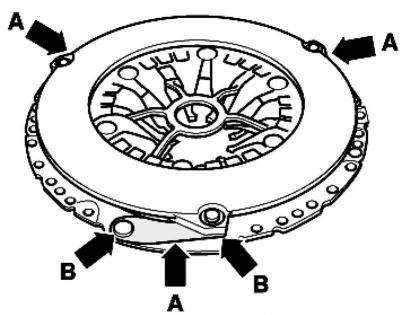
Fig. 3.35. Checking keyed and riveted connections
Check for damage to the key connections A, as well as the strength of the fastening of the connections on rivets B (Fig. 3.35).
Note: Replace clutch discs and pressure plates with damaged or missing riveted connections.
Note: Replace the clutch disc and pressure plate only together.
Note: Identify the pressure plate and clutch disc by the engine letter designations.
Note: To reduce the smell in case of a burnt clutch, it is necessary to thoroughly clean the clutch cap, as well as the flywheel and engine side of the gearbox.
Note: Clean the primary shaft gear and, if using a clutch disc, the hub gear, remove any corrosion and apply a very thin layer of clutch disc gear grease to the gear. Then move the clutch disc back and forth until the hub moves easily on the shaft. Be sure to remove any excess grease.
Note: The pressure plates are protected against corrosion and greased. Only the working surface can be cleaned, otherwise the service life of the clutch will be significantly reduced.
Note: The working surface of the pressure plate and the clutch disc lining must fit tightly against the flywheel. Only then can the mounting screws be inserted.
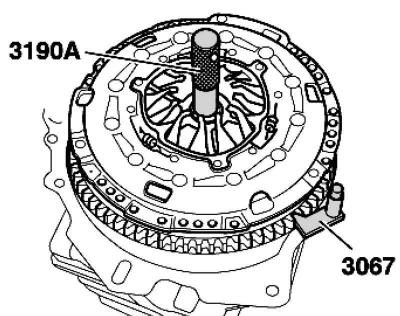
Fig. 3.36. Installation of the support
When installing, insert the support (Fig. 3.36).
Place the pressure plate onto the centering pins.
Use a centering rod to center the clutch disc.
Hand tighten all screws evenly until the screw head contacts the pressure plate.
Tighten the screws gradually in a crisscross pattern to avoid damaging the pressure plate centering holes and dual mass flywheel centering pins.
Install the gearbox.
Checking and, if necessary, returning the self-aligning pressure plate adjusting ring to its original position (only on new LuK brand clutches)
The working operations described below apply only to LuK clutches.
The prerequisite is the installation of a new pressure plate and a new clutch disc.
When installing a used pressure plate and clutch disc, it is not permitted to return the adjusting ring to its original position.
In clutches manufactured by "Sachs" it is not possible to return the pressure plate to its original position
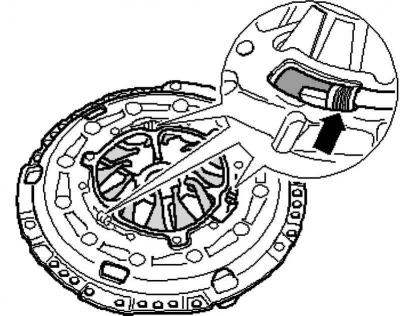
Fig. 3.37. Position of the adjusting ring in the pressure plate
When installing a new pressure plate and clutch disc, check the position of the adjusting ring in the pressure plate (Fig. 3.37).
The adjustment ring must be pulled back to the stop
In this case, the springs are compressed to "touch adjacent turns"
Otherwise, due to the reduced clutch contact pressure, the clutch disc will be subject to increased wear.
If the springs are not compressed to the point of "touching adjacent coils", it is necessary to unscrew the adjusting ring to its original position
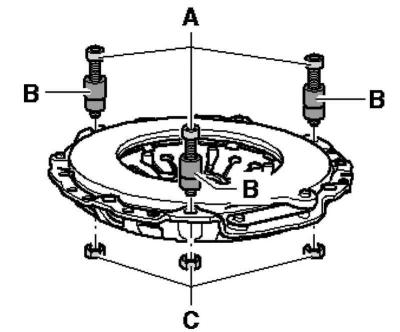
Fig. 3.38. Pressure plate mounting bolts
Insert, as shown in Figure 3.38, 3 pressure plate mounting bolts, M6x35, A with an offset of 120° into the pressure plate mounting holes.
B – a spacer approximately 20 mm high, for example: a socket wrench attachment SW 10 for a 1/4 inch drive.
Screw 3 nuts C onto screws A.
Place the pressure plate in the production press so that it is in contact with only the 3 bolt heads.
Center the thrust washer over the center of the pressure plate.
In the following operation, do not apply excessive force, otherwise the forks of the adjusting ring may be damaged
Place two screwdrivers against the pins of the adjustment ring.
Press down on the pressure plate until the setting ring can no longer move.
Using both screwdrivers evenly, move the mounting ring in the direction of the arrow back until it stops.
Hold the adjustment ring in the stop position and at the same time reduce the press pressure so that the adjustment ring remains in this position.
Visitor comments