



Remove the four injectors and protect them from possible damage.
Secure the cylinder head in a vice using a clamp screwed to the exhaust manifold mounting studs.
Remove the camshaft.
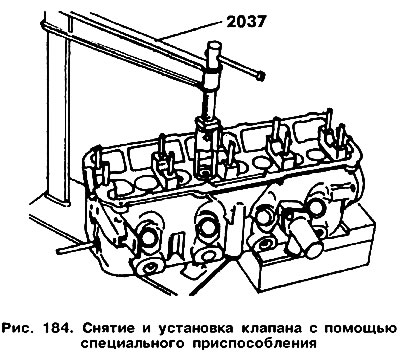
The device used for removing and installing valves is shown in Fig. 184. If you have one, install it on the cylinder head. Its tip must touch the inner recess of the valve spring plate, otherwise the spring will not be compressed. Using the device, compress the spring enough to remove the lock crackers (with tweezers with sharp long ends), after which the valves can be removed.
If you do not have a device, the valve mount can also be released using a piece of pipe that fits onto the upper spring plate. In this case, you need to support the valve from below. Hit the pipe with a hammer so that the crackers come out of the groove of the valve stem. The crackers will remain inside the pipe. The spring plates are removed using two screwdrivers. A rag should be placed in the combustion chamber of the head so that it does not allow the valves to fall out. Remove the springs and valves.
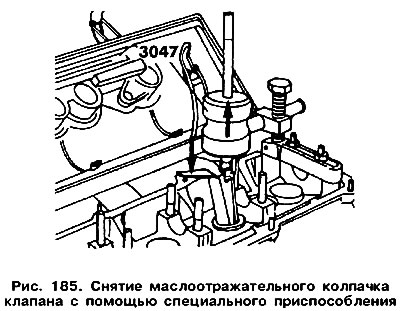
Remove the oil deflector caps. It is best to use a special tool to remove them (figure 185). If using anything else, the caps must be replaced.
Remove the lower spring plate from the hole using special pliers or pliers for installing and removing spring retaining rings. Figure 186 shows the design of the cylinder head of an engine manufactured before 1986 (without hydraulic valve clearance compensators).
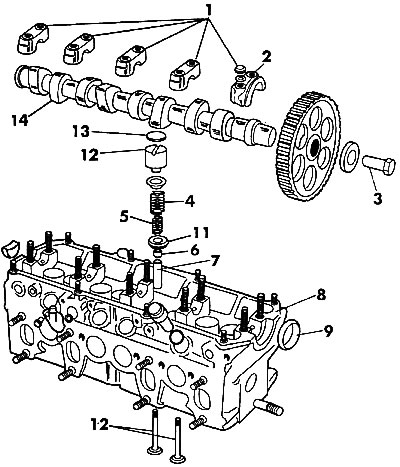
Figure 186. Cylinder head components: 1 - camshaft bearing caps; 2 - cover nut (20 Nm); 3 - bolt (45 Nm); 4 - internal valve spring; 6 - oil seal; 7 - bushing; 8 - camshaft oil seal; 9 - cylinder head; 10 - valves; 12 - pusher; 13 - adjusting washer; 14 - camshaft
The information is presented on the website [vwmanual.ru]
Visitor comments