



Loosen the guide pin on the inside (Figure) using a SW 7 Allen key.
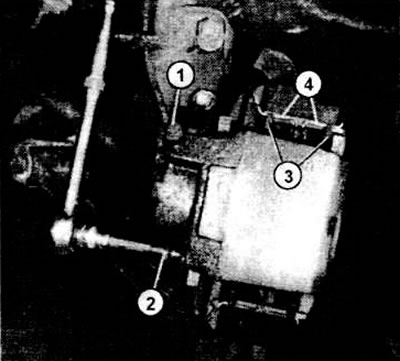
To remove the linings (3) in the cam disc brake mechanism, remove the retaining springs at the top (4) and bottom. Then unscrew the upper and lower guide pins (2) using a socket wrench with an internal Allen key.
Pull out the finger and remove the bracket housing.
To prevent the bracket from pulling on the brake hose, it is suspended on a wire near the shock absorber strut.
Remove the pads on the right and left from the guides.
Move the piston back in the bracket using a clamp. To prevent the piston from being damaged or warped, place a wooden pad on the support ring.
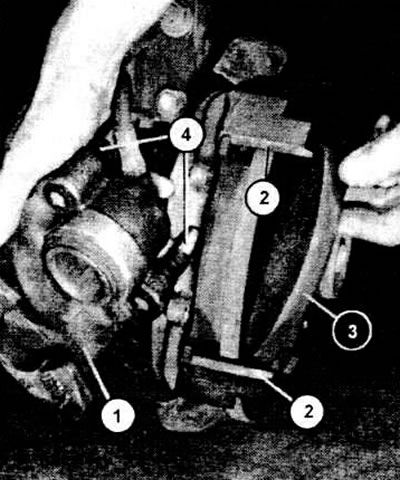
The illustration shows a dismantled cam bracket (1) of a disc brake with a guide pin (4). Near the brake pad (3), pulled to the side, there are guides (2) at the top and bottom.
Insert a new inner lining.
Install the retaining springs, then insert the outer trim.
Secure the bracket body.
Insert the long guide pin at the top and the shorter one at the bottom.
View the original article on the resource VWManual
The tightening torque is 10 Nm.
After assembly, press the brake pedal several times until the pads are flush with the discs.
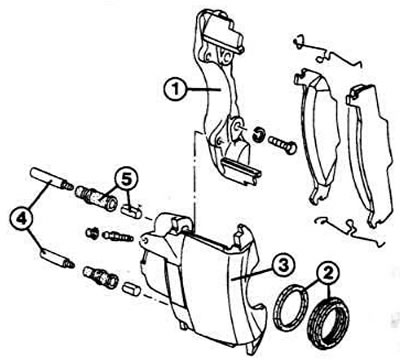
Details of the cam disc brake mechanism with a floating caliper: 1 - holder; 2 - seals; 3 - brake cylinder housing; 4 - guide fingers; 5 - guide bushings.
Note: When new brake pads are installed, brake carefully for the first 500 km, if possible. Strong braking at the very beginning leads to burnt spots on the pads. The pad structure changes. The most effective braking action is not achieved, the pad hardens.
Visitor comments