



Remove the brake pads.
Check whether the pads move easily in their guides.
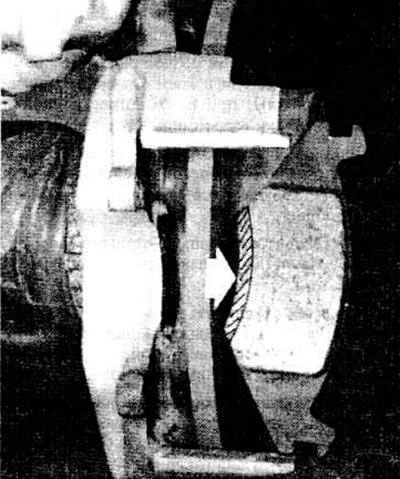
The guide pad must be clean and free of corrosion for good braking effect. If the brake discs are already worn in, the inner edge of the new pad (see arrow) need to be filed down a little; so that the pad immediately fits completely onto the disc
If necessary, clean the guides with a screwdriver. Be careful not to damage the piston seal.
For a disc brake mechanism with a floating caliper (ATE company), check the mobility of the frame.
Clean the guides.
To prevent the guides from rusting later, lubricate the sliding surfaces with a small amount of copper grease.
Note for the Girling brake: in winter, when a lot of salt is spread on the roads, a thick layer of rust is deposited on the clamp, causing the pads to jam. As a result, the pedal stroke is extended, and the braking effect is impaired.
The fixing clamp of the lining must be polished and coated with a layer of copper grease.
Additionally, drill out the lining lugs with a drill 0.1-0.2 mm larger. A hole that is too large will weaken the lug.
Check: does the piston move easily?.
In a disc brake mechanism with a floating caliper, insert an old, if possible very worn, lining or a thin wooden lining as a stop on the side where the piston is located.
In the cam disc brake mechanism, install a clamp with an intermediate wooden lining as a stop for the piston (see section "Replacing disc brake pads") so that the piston cannot exit the cylinder.
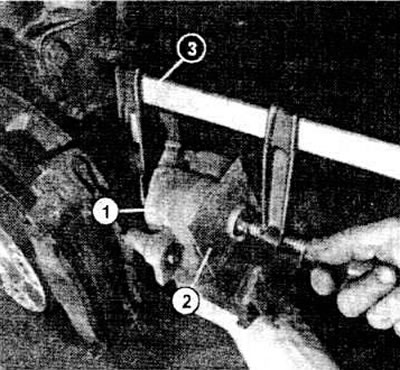
The clamp (3) is the best tool for pushing back the piston in the housing (1) of the cam caliper of the disc brake mechanism. To protect the piston, a wooden shim or a small metal plate (2) is used, which is visible in the illustration.
The assistant carefully presses the pedal. Check: does the piston move?
If the piston does not come out, press the brake pedal until the piston begins to move.
Move the piston back as indicated in the section "Replacing disc brake pads".
Repeat this process until the piston begins to move easily.
The information is posted on this website: www.VWmanual.ru
Cover the side surfaces of the piston with a layer of ATE brake paste.
Visitor comments