



NOTE: To bleed brake fluid from the reservoir, use the brake filling and bleeding device MS 5234 or the brake filling and bleeding device - VAG 1869/4. Before removing the brake caliper or disconnecting the brake hose, install the brake pedal stop VAG 1869/2 (while doing this, reduce the pressure).
Removal brake pads
Mark the brake pads if they are to be reused. They must be installed back in their original positions, otherwise uneven distribution of braking forces between the wheels will occur.
Remove the wheels.
Disconnect plug connection 1 of the brake pad wear indicator (Fig. 6.36).
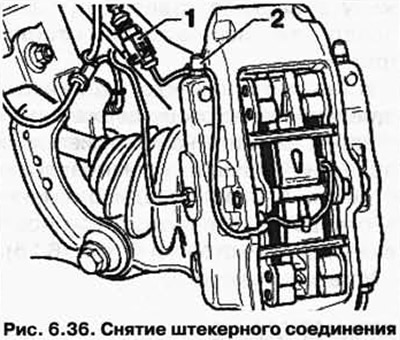
Remove cap 2 and remove the brake pad wear indicator cable.
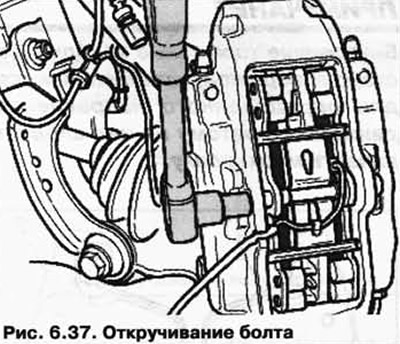
Unscrew the bolt (Fig. 6.37).
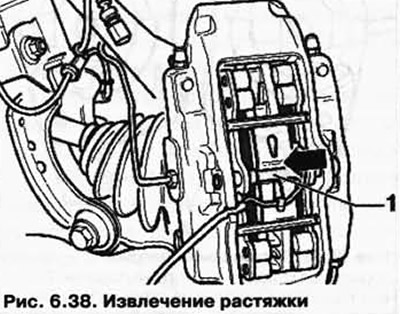
Press the retaining spring down and simultaneously remove tension rod 1 (Fig. 6.38).
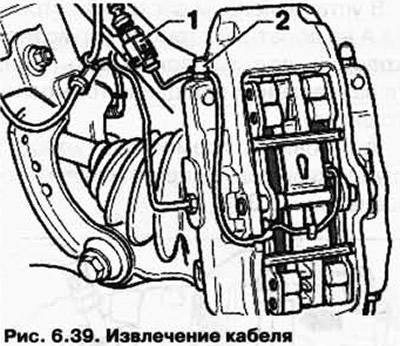
Remove the brake pad wear indicator cable from the brake caliper housing and retaining spring 1 (Fig. 6.39).
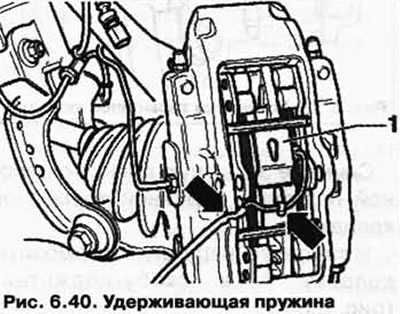
Remove the retaining spring (Fig. 6.40).
Before squeezing the brake pads, it is necessary to pump out the brake fluid from the reservoir. If the brake fluid was added as the brake pads wore out, this will prevent leaks and the damage caused by them.
Press the brake pads away from the brake disc and remove them from the brake caliper.
If necessary, replace the brake pads. Carefully remove the contact sensor with the brake pad wear indicator cable from the brake pads and check for damage.
The original material is available on the portal www.vwmanual.ru
The undamaged contact sensor and cables can be used further.
Clean the caliper.
Use only alcohol to clean the brake caliper.
Installing brake pads
Before pressing the pistons into the cylinder using a special device, it is necessary to pump out the brake fluid from the reservoir. If the brake fluid was added as the brake pads wore out, this will prevent leaks and the damage caused by them. Press the pistons.
Carefully install the brake pad wear indicator cable contact sensor into the new brake pads.
Install the brake pads into the brake caliper.
Install retaining spring 1 (Fig. 6.40).
Install the brake pad wear indicator cable under the retaining spring tab in the brake caliper housing.
Press the retaining spring down and press the tensioner 1 until it stops (Fig. 6.39).
Make sure that the side end surfaces of the brace are seated correctly in the brake caliper housing so that they cannot turn.
Tighten the bolt (Fig. 6.37).
Connect the plugs 1 of the brake pad wear indicator to the holder on the wheel bearing housing (Fig. 6.36).
Secure the brake pad wear indicator cable with cap 2 to the bleed nipple.
Install the wheels.
NOTE: After each brake pad replacement, press the brake pedal firmly several times. This is necessary to ensure that the brake pads are in their working position. After replacing the pads, check the brake fluid level.
Tightening torque
Hex bolt to tensioner: 30 Nm.
Visitor comments