



Working with the VAG 1356 pipe flaring tool on black brake lines is not permitted due to their coating and diameter.
NOTE: Brake pipes may not be bent more than 90°, otherwise they may crack or deform so much that their flow cross-section will be critically reduced. It is better to locate the connection point of the pipes under the bottom of the car.
NOTE: The connecting nipples should be positioned so that they do not touch moving parts and components. Do not lubricate the lead screw, but only clean it with alcohol.
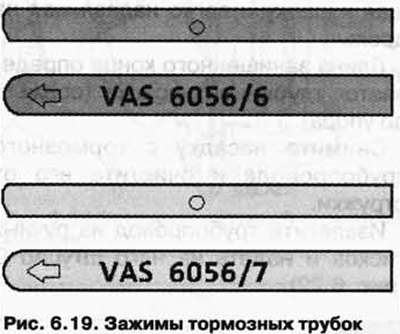
The arrow on the round side of the clamps must point towards the edge of the housing, and the straight side of the clamps must be installed towards the spindle, otherwise the flaring head will not form correctly (Fig. 6.19).
Carrying out works
Unbolt the brake line from the appropriate caliper or wheel cylinder. Collect and properly dispose of any leaking brake fluid.
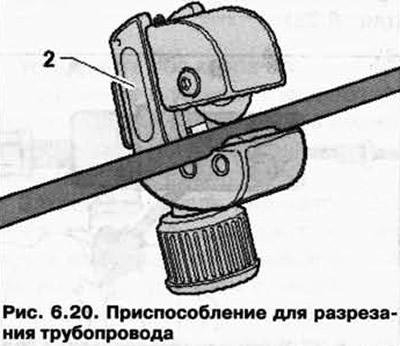
Cut the pipeline at a suitable location (no bends, easy access) using device 2 (Fig. 6.20).
Remove the damaged area.
Remove the casing from the end of the pipe.
Clamp the brake pipe in pliers 4 so that about 50 mm protrudes from the plastic clamping jaws (Fig. 6.21).
(The information is posted on this website: «VWManual.ru»)
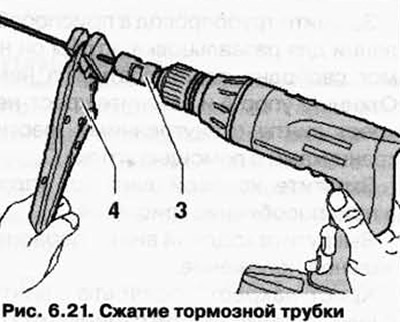
Fit the trim removal attachment 3 to the drill and insert the end of the pipe into the attachment.
Cut away the casing by slowly rotating the bit and applying light pressure on the drill.
The length of the stripped end is determined by the depth nozzle (cut to the stop).
Remove the nozzle from the brake line and clean it from chips.
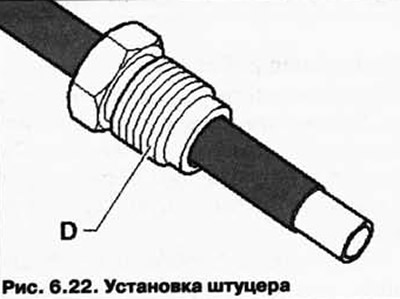
Remove the pipeline from the hand vice and place the D fitting on it (Fig. 6.22).
Insert pipe B until it reaches stop A of the flaring tool (Fig. 6.23).
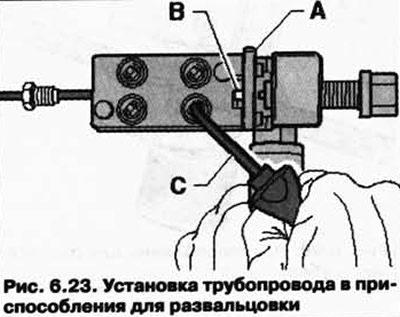
NOTE: When tightening the Allen screws, the brake line must be in contact with the stop, otherwise the line will not flare correctly.
Clamp the pipe in the flaring tool so that it cannot move freely in it. Fold back the stop A and tighten the Allen screws crosswise using the angle C.
Screw the lead screw into the fixture until it stops (Fig. 6.24).
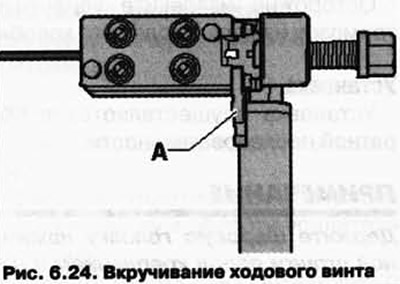
Turn the lead screw back to its original position.
Loosen the Allen screws in a cross pattern.
Remove the brake line from the fixture, clean and inspect the line and flaring.
Flush the brake line installed on the vehicle.
Connect the VAS 5234 brake filling and bleeding device, place the hose of the bleeding container on the flared end of the line and briefly switch on the VAS 5234 brake filling and bleeding device to allow the brake fluid to flush out the filings.
Blow out the pipeline being installed with compressed air.
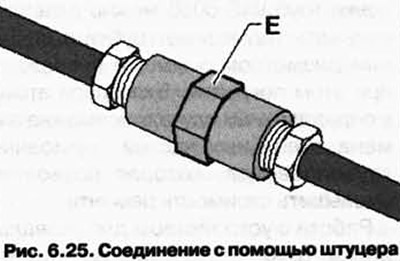
Connect the brake pipes using the fitting E (Fig. 6.25).
Secure the brake lines.
Bleed the brake system.
Removing and installing brake pads.
Removal
Mark the brake pads if they are to be reused. They must be installed back in their original positions, otherwise uneven distribution of braking forces between the wheels will occur.
Remove the wheels.
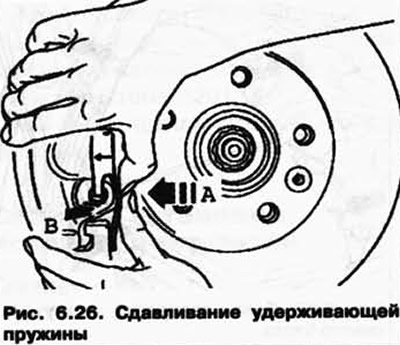
Compress the retaining spring in the direction of arrow A until it can be pressed from the hole in the direction of arrow B (Fig. 6.26).
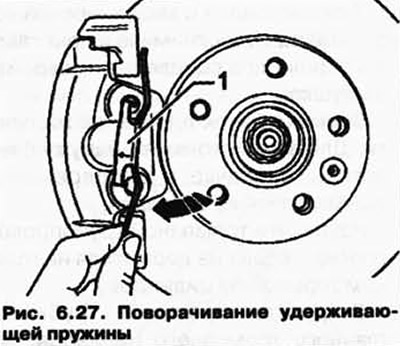
Turn the retaining spring 1 clockwise until it can be removed from the upper hole (Fig. 6.27).
Disconnect plug connection 1 of the brake pad wear indicator, remove cap 2 and remove the brake pad wear indicator cable (Fig. 6.28).
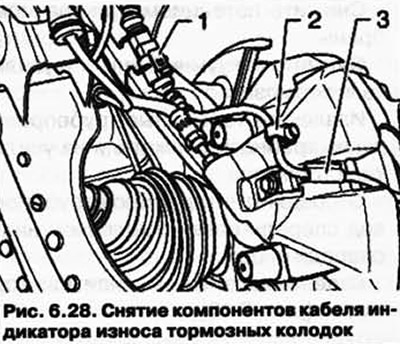
Remove the brake pad indicator cable from the holder 3 on the brake caliper.
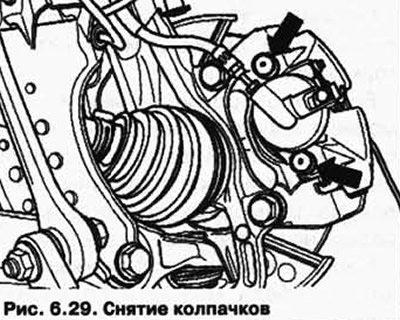
Remove the caps (Fig. 6.29).
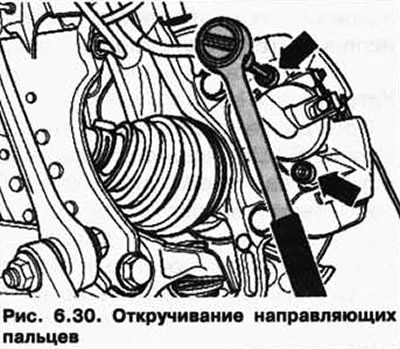
Unscrew and remove both guide pins from the brake caliper (Fig. 6.30).
Remove the brake caliper and secure it with wire so that its weight does not press on the brake hose and damage it.
Remove the brake pads.
CAUTION: Do not blow out the brake system with compressed air. This creates harmful dust.
Clean the bearing surface of the brake pads in the bracket, remove corrosion.
Clean the brake caliper (remove any remaining glue) - the adhesive surface must be dry and clean.
Use only alcohol to clean the brake caliper.
Installation
Before pressing the pistons into the cylinder using a special device, it is necessary to pump out the brake fluid from the reservoir. Otherwise, if the fluid is added, it may leak out and cause damage.
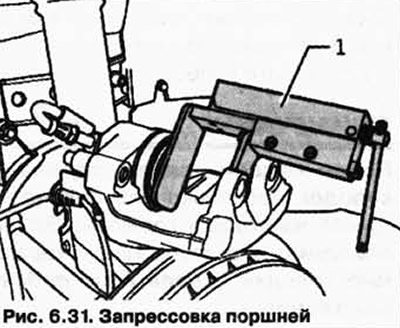
Press in the pistons using tool T10145 1 (Fig. 6.31).
NOTE: Inner brake pads (on the piston side) are installed for a specific direction of movement, so they should be marked.
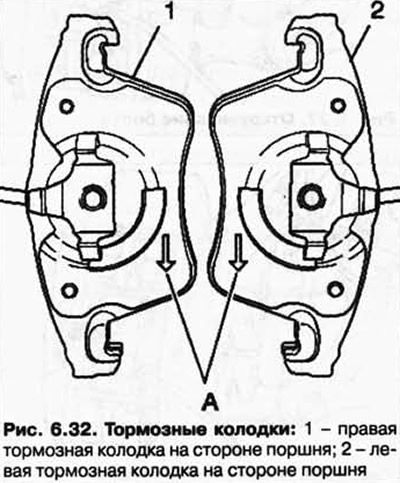
When installed, arrow A on the back of the brake shoe should point downwards (in the direction of rotation of the brake disc).
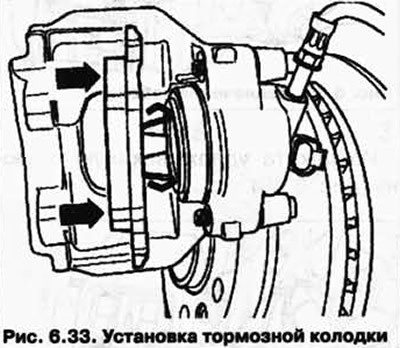
Install the brake shoe with retaining springs into the piston (Fig. 6.33).
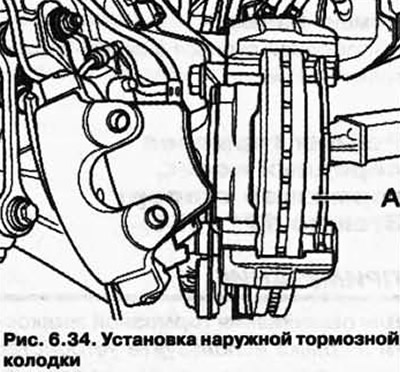
Remove the protective film from the outer brake shoe backing plate.
Install the outer brake shoe A into the retainer bracket (Fig. 6.34).
When installing the brake caliper, make sure that the brake pad does not stick to the brake caliper before the correct mounting position is achieved.
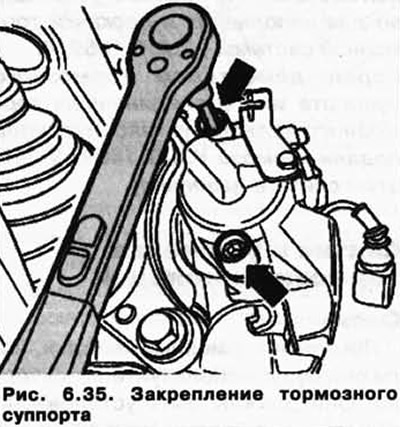
Secure the brake caliper with two guide bolts to the bracket (Fig. 6.35).
Install both caps.
Connect the plugs 1 of the brake pad wear indicator to the holder on the wheel bearing housing (Fig. 6.28).
Secure the brake pad wear indicator cable with cap 2 to the bleed nipple with holder 3 on the brake caliper.
Place the retaining spring into the top hole, then turn it clockwise (Fig. 6.27).
Install the lower retaining spring onto the retaining bracket.
Then press the retaining spring first in the direction of arrow A and then simultaneously into the hole in the brake caliper in the direction of arrow B (Fig. 6.26).
Install the wheels.
NOTE: After each brake pad replacement, press the brake pedal firmly several times to ensure that the brake pads are in their proper operating position.
After replacing the pads, check the brake fluid level.
Tightening torque
Brake caliper to bracket: 30 Nm.
Visitor comments