



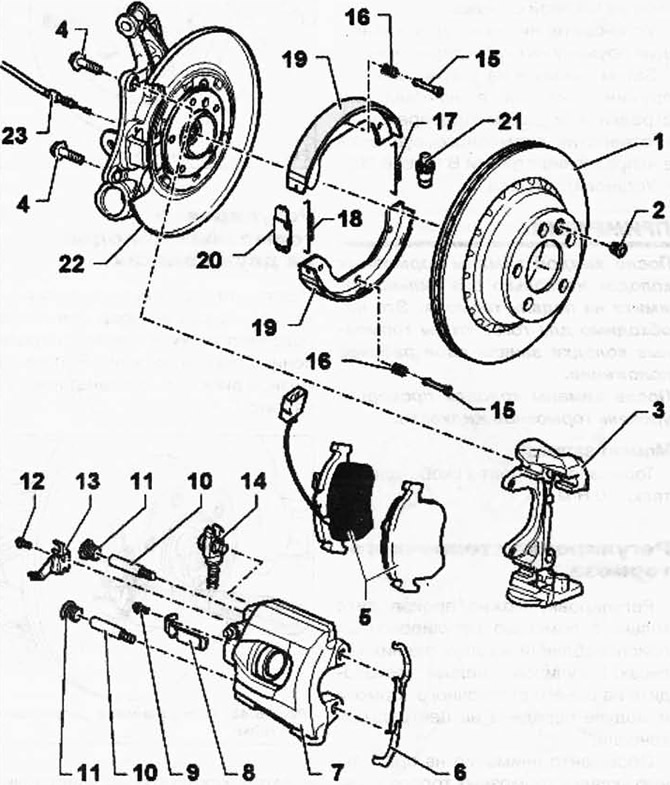
Fig. 6.41. Rear brake components:
1 - brake disc/brake drum; 2 - mounting bolt, 20 Nm; 3 - bracket-holder; 4 - Hexagon head bolt, 200 Nm; 5 - brake pads; 6 - retaining spring; 7 - brake caliper; 8 - Brake pad wear indicator cable holder; 9 - screw, 10 Nm; 10 - guide bolt, 30 Nm; 11 -cap; 12 - Allen bolt, 8 Nm; 13 - bracket; 14 - brake hose with nipple and hollow screw, 38 Nm; 15 - tie pin; 16 - pressure spring; 17 - retractor spring; 18 - retractor spring; 19 - brake shoe; 20 - expansion lock; 21 - adjusting nut; 22 - bracket holder; 23 - rear brake cable.
NOTE: To bleed brake fluid from the reservoir, use the brake filling and bleeding device VAS 5234 or the brake filling and bleeding device VAG 1869/4. Before removing the brake caliper or disconnecting the brake hose, install the brake pedal stop VAG 1869/2 (while doing this, reduce the pressure).
Removal brake pads
Mark the brake pads if they are to be reused. They must be installed back in their original positions, otherwise there will be uneven distribution of braking forces between the wheels.
Remove the wheels.
Press the retaining spring in the direction of arrow A until it can be pressed out of the hole in the direction of arrow B (fig. 6.26).
Turn the retaining spring 1 clockwise until it can be removed from the upper hole (fig. 6.27).
Disconnect plug connection 1 of the brake pad wear indicator (Fig. 6.42).
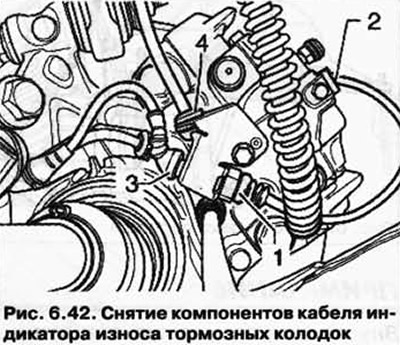
Remove the brake pad indicator cable from the holder 2 on the brake caliper.
Remove the lower part of the plug 3 of the brake pad wear indicator and the speed sensor cable 4 from the holder on the brake caliper.
Remove the caps (Fig. 6.43).
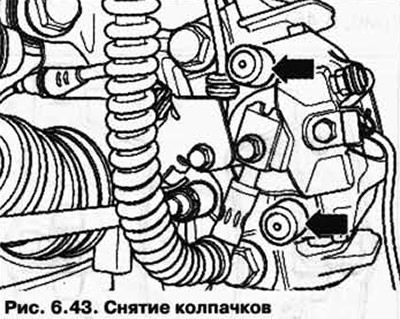
Unscrew and remove both guide pins from the brake caliper.
Remove the brake caliper and secure it with wire so that its weight does not press on the brake hose and damage it.
Remove the brake pads.
Clean the bearing surface of the brake pads in the bracket, remove corrosion.
Cleaning the brake caliper.
Use only alcohol to clean the brake caliper.
Installing brake pads
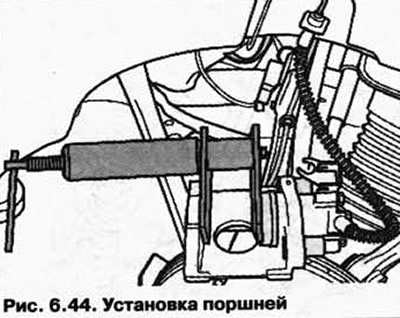
Before pressing the pistons into the cylinder using a special device, it is necessary to pump out the brake fluid from the reservoir. Otherwise, if the fluid is added, it may leak out and cause damage.
Press in the pistons using tool T10145 (Fig. 6.44).
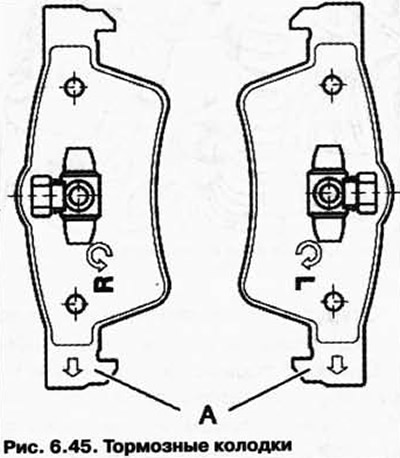
NOTE: Inner brake pads (on the piston side) are installed for a specific direction of movement, so they should be marked.
Brake pads that are installed for a specific direction of travel.
when installed, the reverse side of the brake pad should point downwards (in the direction of rotation of the brake disc) (Fig. 6.45).
Install the brake shoe with retaining springs into the piston (Fig. 6.46).
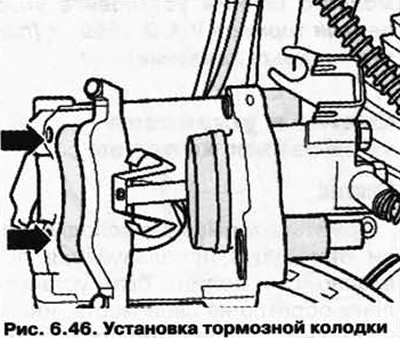
Install the outer brake shoe into the retainer bracket.
Secure the brake caliper to the retaining bracket with two guide bolts.
Install both caps.
Press the speed sensor cable 4 into the holder on the brake caliper.
Connect plugs 3 and 1 of the brake pad wear indicator to the holder on the brake caliper.
Secure the brake pad wear indicator cable to the holder 2 on the brake caliper.
Place the retaining spring into the top hole, then turn clockwise.
Install the lower retaining spring onto the retaining bracket.
Then press the retaining spring first in the direction of arrow A and then simultaneously into the hole in the brake caliper in the direction of arrow B (fig. 6.26).
Install the wheels.
NOTE: After each brake pad replacement, press the brake pedal firmly several times. This is necessary to ensure that the brake pads are in their working position. After replacing the pads, check the brake fluid level.
Tightening torque
Brake caliper to bracket: 30 Nm.
View the original on the website (VWmanual.ru)
Visitor comments