



Contents: Removal ↓ Installation ↓
Support C-38/C-II41
Removal
Warning! Jacking up a vehicle may pose a risk of injury. It is recommended that you familiarize yourself with the safety precautions for installing a vehicle on jack stands.
1. Mark the direction of rotation of the wheel with an arrow on the sidewall of the tire and loosen the wheel bolts.
2. Jack up the rear of the car and remove the rear wheel.
3. Remove the pressure spring 1 by prying it off with a screwdriver (see illustration).
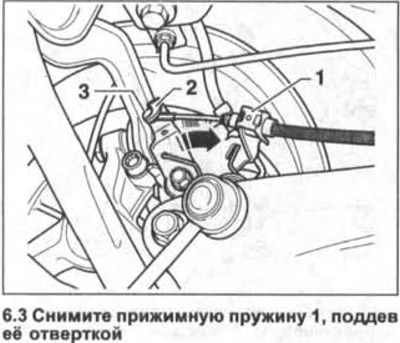
4. Press lever 2 on the caliper in the direction of the arrow in Illustration 6.3 and disconnect the parking brake cable.
5. Release the parking brake cable from the holders.
6. Disconnect the brake hose from the pipeline by unscrewing the hollow bolt and releasing the hose from the holder. Plug the hose opening with a plug.
Caution! When opening the brake circuit, brake fluid will leak out. Place a suitable container underneath to collect the fluid. You can also first collect the brake fluid from the expansion tank.
[View the original on the website VWManual]
7. Remove the upper and lower caliper mounting bolts, holding the guide pins from turning.
8. Remove the caliper from the brake pad guide.
9. Remove the two bolts and disconnect the brake shoe guide from the steering knuckle.
Attention! The tightening torque of the shoe guide bolts is very high. It is recommended to install the wheels and lower the car before performing this operation. If the car remains installed on the support trestles, it should be ensured that it is secure, and the wrench should be placed horizontally when unscrewing the bolts.
Installation
Caution! When the brake pads are removed, do not press the brake pedal. In this case, pressing the pedal will push the piston out of the brake cylinder.
10. Install the shoe guide onto the steering knuckle and secure it with new self-locking bolts, tightening them in two passes in a cross pattern.
- 1st pass: Tighten the bolts with a torque wrench to 90 Nm.
- 2nd pass: Tighten the bolts with a wrench by 90°.
Attention! To maintain the required angle of rotation, make a template out of cardboard or use the HAZET 6690 angle gauge.
11. Install the brake pads.
12. Install the caliper on the pad guide and secure it with new self-locking bolts, applying a force of 35 Nm, while holding the guide pins from turning.
13. Secure the parking brake cable to the bracket on the caliper and install the pressure springs.
14. Push the lever on the caliper forward and put on the parking brake cable.
15. Connect the pipe and the brake hose by screwing in the hollow bolt with a force of 14 Nm.
16. Bleed the brake system, see the relevant chapter.
17. Press the brake pedal several times with the vehicle stationary.
18. Adjust the parking brake, see the relevant chapter.
19. Install the removed wheel in accordance with the marks made during removal.
20. Screw in the wheel bolts and lower the car onto its wheels.
21. Tighten the wheel bolts in a criss-cross pattern to a torque of 120 Nm.
Visitor comments