
English Русский
Български
Беларускі
Український
Српски
Hrvatski
Română
Polski
Slovenský
Magyar
  |  Articles  |  Sitemap  |  Contacts  |    |
Car maintenance Ford Car maintenance Hyundai Car maintenance Chevrolet Car maintenance BMW Car maintenance Audi Car maintenance Opel Car maintenance AvtoVAZ
VWmanual.ru


Main   Passat   Golf   Polo   Touareg   Tiguan   Sharan   Transporter   Others  
Golf 1 (1974-1984, diesel) Golf 1 (1974-1984, petrol) Golf 2 (1984-1993, petrol) Golf 2 (1984-1993) Golf 3 (1991-1997) Golf 4 (1997-2004) Golf 5 (2003-2008)

Rear Brake Pads — Removal and Installation (VW Golf 5)

  • Main
  • Golf
  • Golf 5
  • Chassis
  • Brake system
  • Rear Brake Pads — Removal and Installation
            0


Contents: Removal ↓ Installation ↓

Support C-38/C-II41


Attention! The brake mechanisms of the front wheels of Golf cars can be equipped with two types of calipers. It is recommended to use the illustrations to determine the type of caliper on the car being repaired.


Removal


Attention! Brake linings are classified as materials that require an operating permit and are included in the General Operating Permit Register (ABE). In addition, they are selected by the manufacturer for specific vehicle models. Therefore, it is recommended to use only the linings offered by the manufacturer.


Warning! Jacking up a vehicle may pose a risk of injury. It is recommended that you familiarize yourself with the safety precautions for installing a vehicle on jack stands.


1. Jack up the car and place it on jack stands.

2. Mark the direction of rotation of the wheel with an arrow on the sidewall of the tire and loosen the wheel bolts.

3. Jack up the rear of the car and remove the rear wheel.

Caution! If the brake pads are to be reinstalled for further use, they must be marked before removal. Switching the pads from the right wheel to the left and vice versa or switching the outer and inner pads is not allowed. Be sure to change all the brake pad linings on the front wheels, even if only one of them has reached the maximum permissible thickness.


4. Unscrew the caliper mounting bolts, holding the guide pins from turning (see illustration).
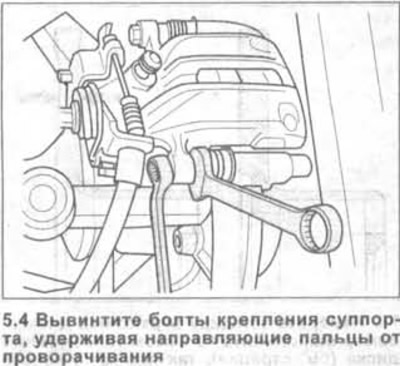
4. Unscrew the caliper mounting bolts, holding the guide pins from turning (see illustration).


5. Remove the caliper from the brake shoe guide and secure it to the body with wire.


Caution! The caliper must be secured so that it does not sag and does not stretch or twist the connected brake hose with its weight.


6. Caliper C-38. Remove the brake pads.

7. Caliper C-II41. Remove the brake pads together with the pressure springs.

Installation


Caution! When the brake pads are removed, do not press the brake pedal. In this case, pressing the pedal will push the piston out of the brake cylinder.


8. Inspect the brake disc and make sure it is not damaged or worn. Clean the caliper only with alcohol.

The use of sharp objects or metal brushes for these purposes is not permitted.

9. Press in the brake cylinder piston using a special pressing tool 1 for rear disc brakes, e.g. HAZET 4970/6 (see illustration).
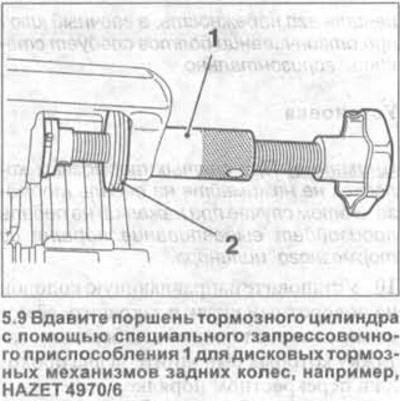
9. Press in the brake cylinder piston using a special pressing tool 1 for rear disc brakes, e.g.…


Caution! Pressing in the wheel cylinder piston with conventional tools is not permitted, as this will damage the parking brake adjusting device.


10. Screw the piston into the wheel cylinder by turning the handle of the special device clockwise. The projection 2 of the device should be adjacent to the caliper.

Make sure that the protective cap of the cylinder is not damaged. If the piston enters with difficulty, then when screwing in the piston, turn the rod of the device by the flats with a wrench.


Caution! When screwing in the piston, brake fluid is squeezed out of the wheel brake cylinder into the expansion tank. Monitor the brake fluid level in the expansion tank and remove it if necessary to prevent it from spilling out.


11. Apply a thin coat of heat resistant grease to the caliper guide surfaces, such as Liqui Moly, before installing the brake pads.

12. Remove the protective foil from the brake pad backing plate.

13. Caliper C-38. Install brake pads 1 into the guide 2 of the pads (see illustration).
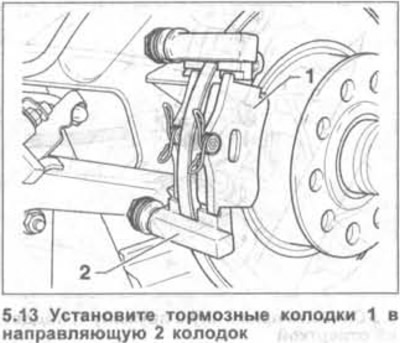
13. Caliper C-38. Install brake pads 1 into the guide 2 of the pads (see illustration).


14. Caliper C-II41. Install new pressure springs (see arrows in the illustration) and new brake pads 1 into the pad guide. Make sure the pads are seated correctly in the pressure springs.
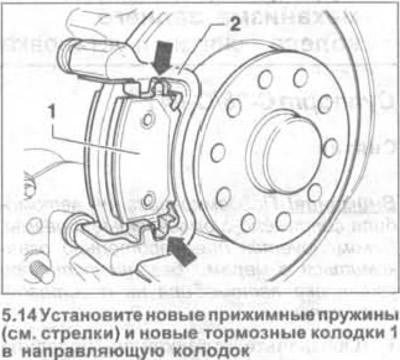
14. Caliper C-II41. Install new pressure springs (see arrows in the illustration) and new brake…


15. Secure the caliper with new self-locking bolts, applying a tightening torque of 35 Nm, holding the guide pins from turning.

Attention! Self-locking bolts are included in the repair kit.


16. Install the removed wheel in accordance with the marks made during removal.

17. Screw in the wheel bolts and lower the car onto its wheels.

18. Tighten the wheel bolts in a criss-cross pattern to a torque of 120 Nm.

Attention! Press the brake pedal several times until you feel a strong resistance to pressing. When you do this, the brake pads are centered and they automatically set themselves to the working position.


19. Check the brake fluid level in the expansion tank. If necessary, top up the fluid to the maximum mark

This article is available at russian, bulgarian, belarusian, ukrainian, serbian, croatian, romanian, polish, slovak, hungarian
The text has been checked: Kolesnikov Artem

Share information:

Previous articles
Rear disc brakes
Front Brake Caliper — Removal and Installation
Front Disc Brake Pads — Removal and Installation
General information about the braking system
Brake system specifications
Next articles
Rear Wheel Brake Caliper — Removal and Installation
Brake disc — check
Brake disc — removal and installation
Parking brake cable — removal and installation
Parking brake — adjustment
Brake system — bleeding


Similar articles from other manuals for VW cars:
Checking the rear brake pads Passat B5 (1996-2005)
Removal and installation rear disc brake pads Polo 4 (2001-2009)
Adjusting brake pads on two wheels Touareg 1 (2002-2006)
Removal and installation rear brake pads CII41 Tiguan 1 (2007-2015)
Checking the thickness of the rear brake pads Sharan 1 (1995-2000)
Rear drum brake, brake lining control Transporter T3 (1979-1992)
Removal and installation rear brake pads Caddy 3 (2003-2010)
Link to this page in different formats


Visitor comments


No comments yet


How much will 22 + 37 =


Golf 5 
  • General information
  • User manual
  • Maintenance
  • Troubleshooting
  • Power unit
  • Engine repair
  • Cooling and ventilation system
  • Fuel system
  • Ignition system
  • Transmission
  • Clutch
  • Mechanical gearbox
  • Automatic gearbox
  • Chassis
  • Brake system
  • Car suspension
  • Steering
  • Body
  • Interior (internal elements)
  • Exterior (external elements)
  • Doors and covers
  • Electrical equipment
  • Power devices
  • Washers and wipers
  • Lighting and appliances
  • Electrical circuits
Golf 4 
  • General information
  • User manual
  • Weekly checks
  • Maintenance
  • Power unit
  • Petrol engines
  • Diesel engines
  • Cooling system
  • Fuel system (petrol)
  • Control system (petrol)
  • Fuel system (diesel)
  • Exhaust system
  • Transmission
  • Clutch
  • Car gearbox
  • Drive shafts
  • Chassis
  • Car suspension
  • Steering
  • Wheels and tires
  • Brake system
  • Body
  • Exterior (external elements)
  • Interior (internal elements)
  • Ventilation and heating
  • Car doors and sunroof
  • Washers and glass cleaners
  • Electrical equipment
  • Power devices
  • Lighting and appliances
  • Electrical circuits
Golf 3 
  • Petrol engine
  • Engine repair
  • Lubrication system
  • Cooling system
  • Ignition system
  • Diesel engine
  • Engine repair
  • Diesel injection system
  • Pre-glow system
  • Transmission
  • Clutch
  • Gearbox and drive shafts
  • Chassis
  • Steering
  • Wheels and suspension
  • Brake system
  • Electrical equipment
  • Lighting and appliances
  • Electrical circuits
Golf 2 
  • General information
  • Introduction to guide
  • User manual
  • Petrol engines 1.3 l
  • Engine repair
  • Lubrication system
  • Cooling system
  • Carburetors
  • Supply system
  • Ignition system
  • Petrol engines 1.6/1.8 l
  • Engine repair
  • Supply system
  • Ignition system
  • Diesel engines
  • Engine repair
  • Lubrication system
  • Cooling system
  • Power and exhaust system
  • Transmission
  • Clutch
  • 4-speed gearbox 084
  • 5-speed gearbox 085
  • 4-speed gearbox 020/4R
  • 5-speed gearbox 020/4T
  • Automatic gearbox
  • Drive shafts
  • Chassis
  • Steering
  • Car suspension
  • Brake system
  • Body
  • Body elements
  • Doors, locks and windows
  • Electrical equipment
  • Equipment and devices
  • Power devices
Golf 2 (petrol) 
  • General information
  • Characteristics
  • Car care
  • Maintenance
  • Power unit
  • Engine repair
  • Engine 1.05/1.30
  • Engine 1.60/1.80
  • Cooling and lubrication system
  • Power and exhaust system
  • Transmission
  • Clutch
  • Car gearbox
  • Drive shafts
  • Chassis
  • Brake system
  • Steering
  • Suspension
  • Body
  • Body and equipment
  • Electrical equipment
  • Lighting and appliances
  • Electrical circuits
Golf 1 (petrol) 
  • General information
  • Characteristics
  • User manual
  • Maintenance
  • Power unit
  • Engine adjustment
  • Engine 1.1/1.3
  • Engine 1.5/1.6/1.8
  • Engine electrical equipment
  • Cooling system
  • Fuel system
  • Transmission
  • Clutch and manual gearbox
  • Automatic gearbox
  • Chassis
  • Steering
  • Front suspension
  • Rear suspension
  • Brake system
  • Electrical equipment
  • Lighting and appliances
  • Electrical circuits
  • Body
  • Body and equipment
  • Optional equipment
Golf 1 (diesel) 
  • General information
  • Specifications
  • Maintenance
  • Power unit
  • Engine repair
  • Exhaust and turbocharger
  • Cooling system
  • Fuel system
  • Fuel injection system
  • Transmission
  • Clutch and drive shafts
  • Car gearbox
  • Chassis
  • Suspension and wheels
  • Steering
  • Brake system
  • Wheels and tires
  • Body
  • Heating and ventilation
  • Exterior (external elements)
  • Interior (internal elements)
  • Doors and windows
  • Electrical equipment
  • Equipment and devices
  • Lighting system
  • Power devices
  • Electrical circuits
VWmanual.ru © 2016-2026 | Mobile version | News and articles | Sitemap: EN BG BY UA RS HR RO PL SK HU | Write message | Site search
Passat B2 • Passat B3 • Passat B4 • Passat B5 • Passat B6 • Golf 1, diesel • Golf 1, petrol • Golf 2, petrol • Golf 2 • Golf 3 • Golf 4 • Golf 5 • Polo 3 • Polo 4 • Touareg 1 • Tiguan 1 • Sharan 1 • Transporter T3 • Transporter T4 • LT 28 • LT 2D • Beetle • Caddy 3 •
Our website uses cookies to ensure functionality and convenience.