



Contents: Removal ↓ Installation ↓
Removal
Remove the brake drum, see above.
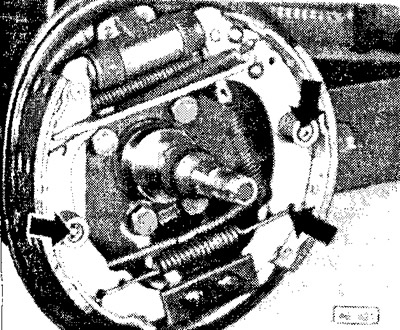
Press the spring plate firmly with pliers against the pressure spring and turn it 90° (1/4 turn). When tightening, press the pin on the back side of the brake shield forward.
Remove the second spring plate.
Remove the lower return spring.
Use your hand to remove the brake pads from the lower support and remove the lower return spring.
Remove the handbrake cable.
Clamp the brake pads in a vice.
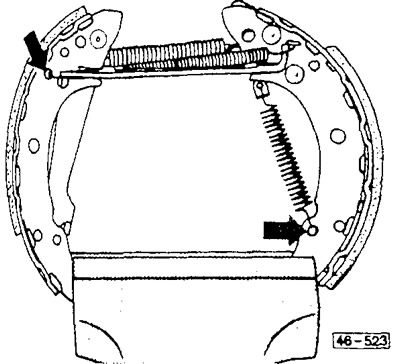
Remove the tension spring for the wedge and the upper tension spring with pliers.
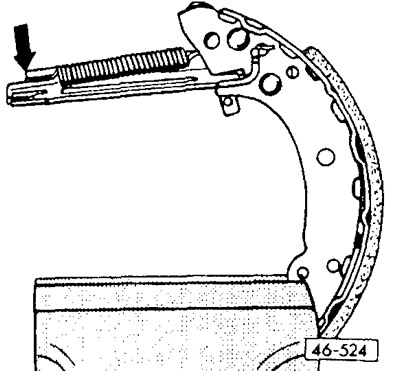
Clamp the primary shoe in a vice and remove the tension spring.
Installation
It is essential to use brake shoes of the same quality, and if possible blow the brake drum and brake shield with compressed air. When the brake shoes are removed, do not press the brake pedal, as this will cause the pistons to slip out of the wheel brake cylinder. If the wheel brake cylinder is wet, it must be repaired. If there are any scratches, turn the brake drum. In this case, always turn both drums of the rear axle.
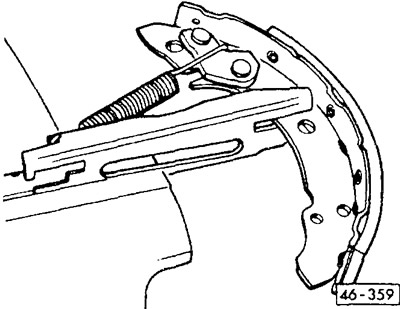
Clamp the pressure bar in a vice, install the tension spring and insert the brake shoe into the pressure bar.
Insert the wedge. The wedge is located between the primary shoe and the pressure plate.
Note: The protrusion on the wedge must face the pressure plate.
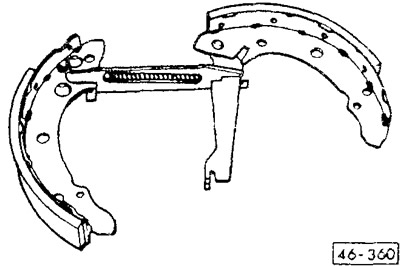
Insert the brake shoe with the lever of the brake mechanism into the groove of the pressure plate (fig.46-360).
Install the upper tension spring,
Connect the handbrake cable to the brake lever.
Support the brake shoes on the pistons of the wheel brake cylinder.
Install the lower tension spring and support the brake shoes on the lower support.
Hang a tension spring on the wedge.
Insert the pins of the pressure springs through the holes in the brake shoes. Insert the pressure springs, place the spring plate with pliers and compress the spring. At the same time, hold the pin on the other side of the brake shield. Turn the spring plate 90° with pliers (1/4 turn) and thus fix it. Install the second spring plate in the same way.
Install the brake drum and adjust the axial clearance of the wheel hub bearing, see above.
Press the foot brake pedal hard several times. This will adjust the rear wheel brakes.
Screw on the wheel, lower the car and tighten the wheel bolts in a crosswise manner to a torque of 110 Nm.
Perform test braking while driving at an average speed.
Visitor comments