
English Русский
Български
Беларускі
Український
Српски
Hrvatski
Română
Polski
Slovenský
Magyar
  |  Articles  |  Sitemap  |  Contacts  |    |
Car maintenance Ford Car maintenance Hyundai Car maintenance Chevrolet Car maintenance BMW Car maintenance Audi Car maintenance Opel Car maintenance AvtoVAZ
VWmanual.ru


Main   Passat   Golf   Polo   Touareg   Tiguan   Sharan   Transporter   Others  
Golf 1 (1974-1984, diesel) Golf 1 (1974-1984, petrol) Golf 2 (1984-1993, petrol) Golf 2 (1984-1993) Golf 3 (1991-1997) Golf 4 (1997-2004) Golf 5 (2003-2008)

Replacing rear drum brake pads (VW Golf 1)

  • Main
  • Golf
  • Golf 1
  • Chassis
  • Brake system
  • Replacing rear drum brake pads
            0


Contents: Replacing the pads - manual brake…↓ Replacing pads - brake mechanism…↓
Replace drum brake shoes when worn to the minimum permissible thickness (total shoe thickness of at least 5 mm), or if they cause improper brake operation.

You can check the thickness of the pads through the inspection holes in the shields without removing the brake drums.

Replace brake pads in sets (i.e. all four pads at the same time). Replacing the pad on only one brake results in uneven braking.

Replacing the pads - manual brake mechanism (drawing O:14)
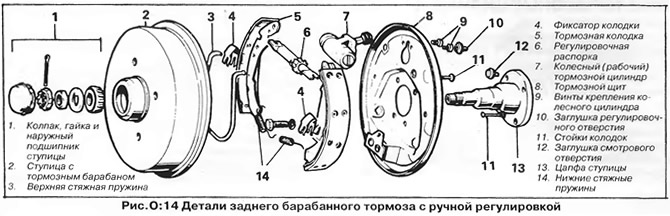


Replacing the pads - manual brake mechanism (drawing O:14)


1. Loosen the rear wheel mounting bolts, lift and support the rear of the vehicle and remove the wheels. Release the handbrake completely.

2. Remove the hub cap, then remove the cotter pin and crown nut retainer from the hub journal, unscrew the hub nut and remove the thrust washer.

Move the brake shoes to release the drum. To do this, turn the adjusting nut with a screwdriver through the adjusting hole in the brake shield.

3. Carefully remove the hub and brake drum together with the bearings.

NOTE: On vehicles with a rear brake pressure regulator, drum removal may be difficult due to residual pressure in the system. To relieve residual pressure, push the pressure regulator lever toward the rear axle.


4. Remove the upper brake shoe tension spring. The spring is U-shaped and under a lot of tension - be careful when disconnecting the spring.

5. Remove the shoe retainers. To remove a retainer, press it down and pull the retainer off the shoe until the strut head comes out of the retainer slot.

6. Remove the adjusting spacer located between the pads.

7. Disconnect the front shoe from the wheel cylinder and lower support; unhook the lower tension spring from the shoe.

8. Remove the rear brake shoe in the same way; disconnect the handbrake cable from the brake shoe lever.

9. Place a rubber ring on the wheel brake cylinder to press the pistons together.

10. Inspect the wheel cylinder, brake drum and springs. If there are signs of fluid leakage, replace or repair the cylinder.

11. Clean the brake shield and brake drum from dust. Apply a small amount of high-melting grease to the shoe supports on the brake shield and the ends of the brake shoes.

12. Thoroughly clean the brake drum from dust and dirt. If there are uneven areas on the friction surface of the drum, the drum must be bored or replaced, otherwise the uneven areas will cause accelerated wear of the new pads.

13. Inspect the brake shoe tension springs. If there are cracks, deep corrosion, signs of overheating or other defects, replace the spring.

14. Check the ease of rotation of the adjusting nut. If necessary, thoroughly clean the threads and lubricate the adjusting spacer parts.

15. Attach the handbrake cable to the lever on the rear shoe. To hook the end of the cable onto the lever, pull back the cable return spring.


16. Install the brake shoes and return springs on the brake shield in the reverse order of removal. Make sure that the springs, brake shoes, and adjusting spacer are positioned correctly. Secure the shoes with stands and clamps.

17. Install the hub and brake drum and adjust the hub bearings (see chapter "Rear suspension").

18. Insert a screwdriver into the adjustment hole of the brake shield and turn the adjusting nut until the shoes lock the drum. Then turn the nut in the opposite direction just enough so that the drum starts to rotate freely. Adjust the handbrake cable (see chapter "Car maintenance work").

19. After replacing the pads on both brakes, install the wheels, lower the vehicle to the ground and tighten the wheel mounting bolts to the torque specified in section "Technical data".

Replacing pads - brake mechanism with automatic regulator (drawing O:19)
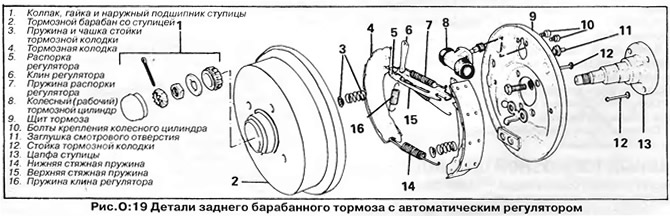


Replacing pads - brake mechanism with automatic regulator (drawing O:19)


1. Raise and support the rear of the vehicle. Remove the rear wheels, fully release the handbrake and remove the brake drums as described above. To move the brake shoes, insert a screwdriver through the hole in the wheel bolt and push the adjuster wedge upwards (drawing O:15).
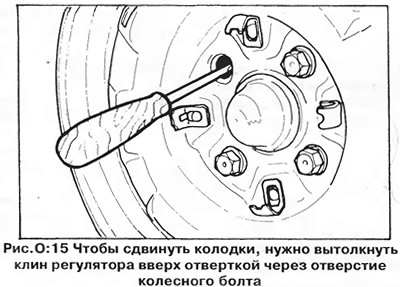
1. Raise and support the rear of the vehicle. Remove the rear wheels, fully release the handbrake…


2. Remove the brake shoe struts. To remove the strut, press on the strut cup and remove it by turning it a quarter turn. Remove the strut spring (drawing O:16).
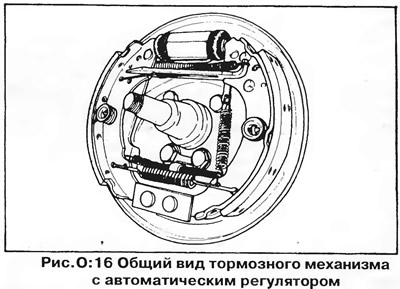
2. Remove the brake shoe struts. To remove the strut, press on the strut cup and remove it by…


3. Disconnect the lower ends of the pads from the support and unhook the lower tension spring from the pads.

4. Disconnect the spring from the lower end of the adjuster wedge and from the front brake shoe. Disconnect the upper return spring from the front end of the adjuster spacer and the rear brake shoe. Remove the front brake shoe from the brake shield.

5. Remove the rear brake shoe from the brake shield and disconnect the handbrake cable from the lever on the shoe.

6. Place a rubber ring on the wheel brake cylinder to press the pistons together.

7. Clamp the adjuster spacer in a vice and detach the spring from its end, then separate the spacer, adjuster wedge and front brake shoe from each other.

8. Check the condition of the wheel cylinder, brake drum and springs.

9. Clean the brake shield and brake drum from dust. Apply a small amount of high-melting grease to the support on the brake shield and the ends of the brake shoes, as well as to the wedge of the adjuster, the ends of the adjuster spacer and the axle of the handbrake lever.

10. Attach the handbrake cable to the lever on the rear shoe. To hook the end of the cable onto the lever, pull back the cable return spring.

11. Assemble the spacer and the adjuster wedge with the front brake shoe as shown in Figures O:17 and O:18. Insert the wedge with the thicker part towards the brake shield.
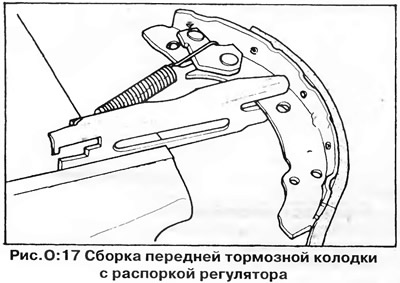
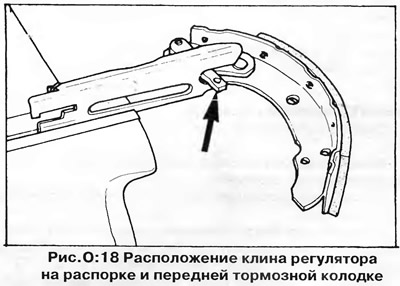
11. Assemble the spacer and the adjuster wedge with the front brake shoe as shown in Figures O:17…


11. Assemble the spacer and the adjuster wedge with the front brake shoe as shown in Figures O:17…


12. Install the brake shoes and return springs on the brake shield in the reverse order of removal. Make sure that the springs, brake shoes, spacer and adjuster wedge are positioned correctly. Secure the shoes with posts with springs and cups.

13. Install the brake drum and adjust the hub bearings (see chapter "Rear suspension").

14. Press the brake pedal firmly several times to set the brake shoes to the working position. Adjust the handbrake cable (see chapter "Car maintenance work").

15. After replacing the pads on both brakes, install the wheels, lower the vehicle to the ground and tighten the wheel mounting bolts to the torque specified in the section "Technical data".

This article is available at russian, bulgarian, belarusian, ukrainian, serbian, croatian, romanian, polish, slovak, hungarian
The text has been checked: Tarasov Ivan

Share information:

Previous articles
Front Brake Calipers (VW Mk II)
Front brake calipers (Girling)
Front brake calipers (Teves)
Bleeding the brake system (removing air)
Hydraulic brake system
Tools and equipment
Next articles
Rear brake cylinders
Master brake cylinder
Brake servo booster
Brake pressure regulator
Handbrake
Possible malfunctions of the brake system


Similar articles from other manuals for VW cars:
Replacing rear brake pads Passat B2 (1981-1988)
Rear drum brake mechanism Polo 4 (2001-2009)
Adjusting brake pads on two wheels Touareg 1 (2002-2006)
Removal and installation rear brake pads CII41 Tiguan 1 (2007-2015)
Replacing rear brake pads Sharan 1 (1995-2000)
Rear drum brake, brake lining control Transporter T3 (1979-1992)
Removal and installation rear brake pads Caddy 3 (2003-2010)
Link to this page in different formats


Visitor comments


No comments yet


How much will 48 + 40 =


Golf 5 
  • General information
  • User manual
  • Maintenance
  • Troubleshooting
  • Power unit
  • Engine repair
  • Cooling and ventilation system
  • Fuel system
  • Ignition system
  • Transmission
  • Clutch
  • Mechanical gearbox
  • Automatic gearbox
  • Chassis
  • Brake system
  • Car suspension
  • Steering
  • Body
  • Interior (internal elements)
  • Exterior (external elements)
  • Doors and covers
  • Electrical equipment
  • Power devices
  • Washers and wipers
  • Lighting and appliances
  • Electrical circuits
Golf 4 
  • General information
  • User manual
  • Weekly checks
  • Maintenance
  • Power unit
  • Petrol engines
  • Diesel engines
  • Cooling system
  • Fuel system (petrol)
  • Control system (petrol)
  • Fuel system (diesel)
  • Exhaust system
  • Transmission
  • Clutch
  • Car gearbox
  • Drive shafts
  • Chassis
  • Car suspension
  • Steering
  • Wheels and tires
  • Brake system
  • Body
  • Exterior (external elements)
  • Interior (internal elements)
  • Ventilation and heating
  • Car doors and sunroof
  • Washers and glass cleaners
  • Electrical equipment
  • Power devices
  • Lighting and appliances
  • Electrical circuits
Golf 3 
  • Petrol engine
  • Engine repair
  • Lubrication system
  • Cooling system
  • Ignition system
  • Diesel engine
  • Engine repair
  • Diesel injection system
  • Pre-glow system
  • Transmission
  • Clutch
  • Gearbox and drive shafts
  • Chassis
  • Steering
  • Wheels and suspension
  • Brake system
  • Electrical equipment
  • Lighting and appliances
  • Electrical circuits
Golf 2 
  • General information
  • Introduction to guide
  • User manual
  • Petrol engines 1.3 l
  • Engine repair
  • Lubrication system
  • Cooling system
  • Carburetors
  • Supply system
  • Ignition system
  • Petrol engines 1.6/1.8 l
  • Engine repair
  • Supply system
  • Ignition system
  • Diesel engines
  • Engine repair
  • Lubrication system
  • Cooling system
  • Power and exhaust system
  • Transmission
  • Clutch
  • 4-speed gearbox 084
  • 5-speed gearbox 085
  • 4-speed gearbox 020/4R
  • 5-speed gearbox 020/4T
  • Automatic gearbox
  • Drive shafts
  • Chassis
  • Steering
  • Car suspension
  • Brake system
  • Body
  • Body elements
  • Doors, locks and windows
  • Electrical equipment
  • Equipment and devices
  • Power devices
Golf 2 (petrol) 
  • General information
  • Characteristics
  • Car care
  • Maintenance
  • Power unit
  • Engine repair
  • Engine 1.05/1.30
  • Engine 1.60/1.80
  • Cooling and lubrication system
  • Power and exhaust system
  • Transmission
  • Clutch
  • Car gearbox
  • Drive shafts
  • Chassis
  • Brake system
  • Steering
  • Suspension
  • Body
  • Body and equipment
  • Electrical equipment
  • Lighting and appliances
  • Electrical circuits
Golf 1 (petrol) 
  • General information
  • Characteristics
  • User manual
  • Maintenance
  • Power unit
  • Engine adjustment
  • Engine 1.1/1.3
  • Engine 1.5/1.6/1.8
  • Engine electrical equipment
  • Cooling system
  • Fuel system
  • Transmission
  • Clutch and manual gearbox
  • Automatic gearbox
  • Chassis
  • Steering
  • Front suspension
  • Rear suspension
  • Brake system
  • Electrical equipment
  • Lighting and appliances
  • Electrical circuits
  • Body
  • Body and equipment
  • Optional equipment
Golf 1 (diesel) 
  • General information
  • Specifications
  • Maintenance
  • Power unit
  • Engine repair
  • Exhaust and turbocharger
  • Cooling system
  • Fuel system
  • Fuel injection system
  • Transmission
  • Clutch and drive shafts
  • Car gearbox
  • Chassis
  • Suspension and wheels
  • Steering
  • Brake system
  • Wheels and tires
  • Body
  • Heating and ventilation
  • Exterior (external elements)
  • Interior (internal elements)
  • Doors and windows
  • Electrical equipment
  • Equipment and devices
  • Lighting system
  • Power devices
  • Electrical circuits
VWmanual.ru © 2016-2026 | Mobile version | News and articles | Sitemap: EN BG BY UA RS HR RO PL SK HU | Write message | Site search
Passat B2 • Passat B3 • Passat B4 • Passat B5 • Passat B6 • Golf 1, diesel • Golf 1, petrol • Golf 2, petrol • Golf 2 • Golf 3 • Golf 4 • Golf 5 • Polo 3 • Polo 4 • Touareg 1 • Tiguan 1 • Sharan 1 • Transporter T3 • Transporter T4 • LT 28 • LT 2D • Beetle • Caddy 3 •
Our website uses cookies to ensure functionality and convenience.