



Replacing the pads
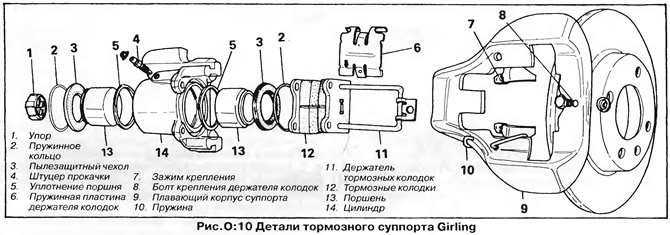
Basically, the repair of the Girling caliper is carried out in the same way as described above for the Teves caliper, but the removal and installation of the brake pads is carried out as follows:
1. Press the spring plate of the pad holder on the caliper.
[The article is posted on the portal: www.VWmanual.ru]
2. Remove the bolt securing the pad holder to the caliper and remove the holder (drawing O:8).
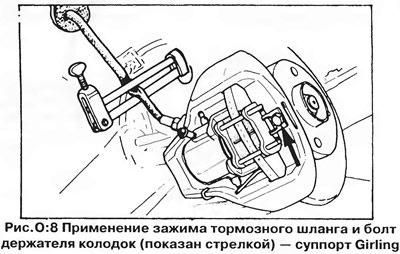
3. Remove the brake pads from the caliper.
4. Press the pistons into the cylinder. As the pistons are pressed in, the fluid level in the master cylinder reservoir rises, so if necessary, pump out some fluid to avoid overfilling the reservoir.
5. Install the new brake pads into the caliper and make sure they move freely in its cavity.
6. Insert the holder pins into the holes of the pads and the caliper cylinder and secure the holder with a bolt.
7. Install the spring plate onto the pad holder. The arrow stamped on the plate should point downwards, in the direction of forward rotation of the brake disc.
Replacing the caliper (girling support)
Removal and installation of the Girling caliper is basically the same as described above for the Teves caliper.
On the latest models, the thread in the caliper for the brake hose has been changed from right to left. The hose with the left thread is shorter and can be identified by the groove machined around the hexagon on the nipple.
Only left-hand threaded calipers are supplied as spare parts, so when replacing a caliper you will need the appropriate brake hose.
Replacing seals (girling support)
1. Remove the cylinder from the floating caliper body (the caliper is removed from the car).
2. Remove the spring rings and rubber boots from the pistons. Apply compressed air to the cylinder through the brake hose connection hole and push out the pistons.
3. Remove the two sealing rings from the grooves in the cylinder using a plastic needle. Be careful not to damage the cylinder.
4. Wash the pistons and cylinder in methyl alcohol or clean brake fluid. Do not use gasoline or kerosene for washing.
5. If the pistons and cylinder are in good condition, assemble the caliper as follows:
6. Lubricate the pistons, sealing rings and cylinder with clean brake fluid.
7. Install new sealing rings into the cylinder grooves.
8. Insert the pistons with the bottoms inward from opposite ends of the cylinder, then press them in completely using a vice with soft jaws.
9. Install dust boots onto the top of each piston and cylinder lip and secure them with snap rings.
10. Make sure that the spring and mounting clamps are correctly positioned on the floating caliper body.
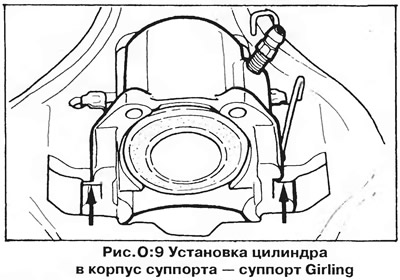
11. Install the nylon stop on the floating housing protrusion and assemble the cylinder with the caliper housing (drawing O:9). Press the cylinder into the caliper body until it stops.
Visitor comments