



Contents: Replacing the pads ↓ Removal the caliper (Teves) ↓ Installing a caliper (Teves) ↓ Replacing the seal (teves support) ↓
Replacing the pads
Replace brake pads when they are worn to the minimum permissible thickness (7mm including metal base of the shoe) or if they are the cause of brake failure.
To maintain consistent braking, replace all four brake pads on both front brakes at the same time, even if only one pad needs replacing.
CAUTION: If the removed brake pads are to be reused, mark their position before removal - reversing the brake pads is not permitted as this will result in uneven braking.
1. Loosen the front wheel mounting bolts, lift and place the front of the vehicle on supports (see chapter "Basic rules for carrying out work"). Remove the front wheels.
2. Remove the clamp from the brake shoe mounting pins and knock out the pins.
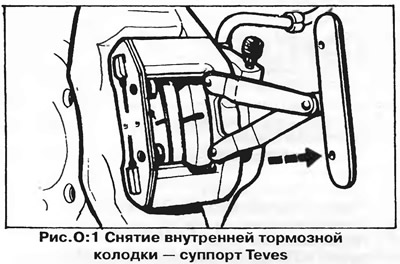
3. Remove the inner brake pad from the caliper. Special tool (drawing O:1), inserted into the finger holes will make this operation much easier, but you can also use pliers in combination with a screwdriver.
4. The outer brake pad is secured by a protrusion on the floating caliper body, and to remove it, you need to press the caliper body outward.
5. Clean the inner surfaces of the caliper from dirt and dust.
6. Inspect the rubber piston dust boot for cracks or fluid leaks. Replace a torn boot or repair the caliper cylinder if there is a fluid leak (see further in the text).
7. Press the piston into the cylinder.
8. When the piston is pressed into the cylinder, the fluid level in the master cylinder reservoir rises, so to avoid overflowing the reservoir, pump out some fluid from the reservoir.
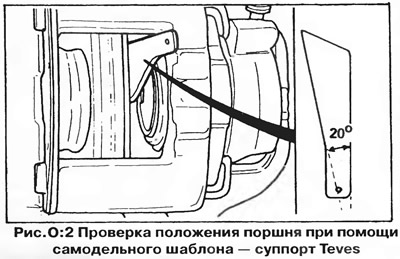
9 Check the position of the cutout on the caliper piston using the template shown in Figure O:2; the template can be made of cardboard. Press the template against the upper guide surface of the caliper, if necessary, turn the piston accordingly and set it in the correct position.
10. Make sure that the friction surfaces of the brake disc are free of grease, oil and brake fluid.
11. New brake pads must match the caliper in type and size.
12. Install the brake pads into the caliper. The pads should move freely in the caliper cavity.
13. Install a new pressure spring on the brake shoes and insert the shoe mounting pins. If the pins are secured with a spring clip, they are inserted from the outside. There is a hole for the spring clip on the inside end of such a pin. The pin should be inserted into place without force. It is recommended to install a new clip each time.
Non-clamp calipers have pins with spring bushings on the outer ends - these pins are inserted from the inside of the caliper and need to be driven completely into place using a hammer and a suitable punch.
14. Press the brake pedal several times to establish the normal operating clearance between the pads and the disc.
15. Install the wheels, lower the vehicle to the ground and check the fluid level in the brake master cylinder reservoir. Tighten the wheel mounting bolts to the torque specified in Section "Technical data".
Removal the caliper (Teves)
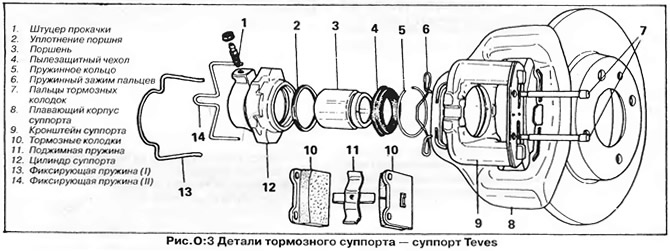
1. Remove the brake pads from the caliper as described above.
2. If the caliper is to be disassembled, gently press the brake pedal to use the piston to push the caliper bracket out of the floating housing and make it easier to remove the piston later.
3. Remove the two bolts securing the caliper bracket to the steering knuckle and remove the caliper from the brake disc. The spring washers installed on the caliper mounting bolts can be discarded - they do not need to be installed during assembly.
4. If the caliper needs to be removed completely, clamp the brake hose and unscrew the hose nipple from the caliper. Plug the disconnected end of the brake hose to prevent dirt from entering.
5. If the support is removed to gain access to other components (for example, for repair of suspension parts), hang it nearby (for example on a suspension spring), without disconnecting the brake hose. Make sure that the hose is not stretched.
Installing a caliper (Teves)
1. Connect the hose to the caliper.
2. Install the caliper on the steering knuckle and secure it with two bolts, (spring washers are not installed under the bolt heads). Tighten the caliper mounting bolts to the torque specified in the section "Technical data".
3. Secure the brake hose to the bracket on the telescopic suspension strut.
4. Install the brake pads as described previously.
5. If a brake hose was disconnected, bleed the corresponding brake circuit.
6. Install the wheel, lower the vehicle to the ground and tighten the wheel mounting bolts to the torque specified in section "Technical data".
Replacing the seal (teves support)
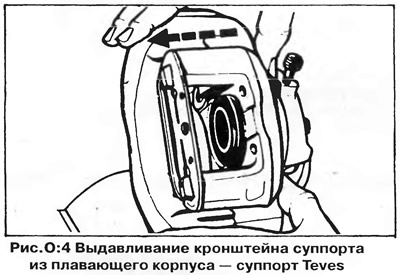
1. Press the caliper bracket out of the floating housing as shown in Figure O:4 (the caliper is removed from the car).
2. Install the floating housing as shown in Figure O:5 and knock out the cylinder from it with a brass drift. Place a wooden shim under the piston in the housing to prevent damage to the piston when removing the cylinder.
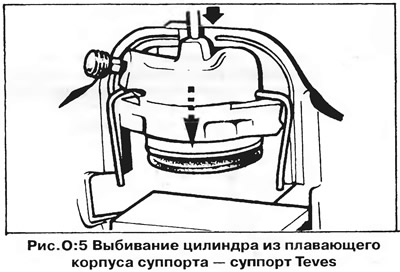
3. Remove the rubber piston boot. Blow compressed air into the cylinder through the brake hose connection hole and remove the piston from the cylinder.
4. Remove the sealing ring from the groove in the cylinder using a suitable blunt instrument, such as a plastic needle or a small screwdriver. Be careful not to damage the cylinder.
5. Wash the piston and cylinder with clean brake fluid or methyl alcohol. Do not use gasoline or kerosene for washing.
6. If the piston and cylinder are in good condition, assemble the caliper as follows:
7. Lubricate the piston, O-ring and cylinder bore with clean brake fluid.
8. Install the new seal ring into the cylinder groove.
9. Insert the piston into the cylinder with the bottom first, then press it all the way in using a vice with soft jaws.
10. Install the dust cover on the top of the piston and cylinder and secure it with the snap ring.
11. Install the retaining spring into the groove on the cylinder body. The curved end of the spring should be directed towards the forward rotation of the brake disc. Press the cylinder into the floating body of the caliper using a brass drift (drawing O:6).
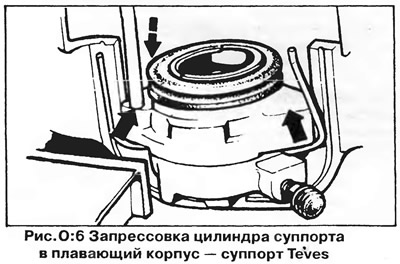
12. Install the caliper bracket onto the ends of the retainer spring, then insert the caliper bracket into the floating housing so that the grooves in the bracket align with the ribs on the floating housing.
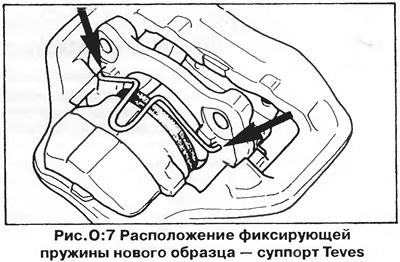
13. Some calipers have a new type of retaining spring (drawing O:7) - in this case, the spring must be inserted into the caliper bracket before installing the floating housing.
[The original article is available on the website: vwmanual.ru]
Visitor comments