English Русский
Български
Беларускі
Український
Српски
Hrvatski
Română
Polski
Slovenský
Magyar
  |  Articles  |  Sitemap  |  Contacts  |    |
Car maintenance Ford Car maintenance Hyundai Car maintenance Chevrolet Car maintenance BMW Car maintenance Audi Car maintenance Opel Car maintenance AvtoVAZ
VWmanual.ru


Main   Passat   Golf   Polo   Touareg   Tiguan   Sharan   Transporter   Others  
Golf 1 (1974-1984, diesel) Golf 1 (1974-1984, petrol) Golf 2 (1984-1993, petrol) Golf 2 (1984-1993) Golf 3 (1991-1997) Golf 4 (1997-2004) Golf 5 (2003-2008)

Brake system (VW Golf 1)

  • Main
  • Golf
  • Golf 1
  • General information
  • Maintenance
  • Brake system
            0


Contents: Front Disc Brake Pads - Checking ↓ Rear drum brake shoes (figure A:21) ↓ Hoses, Tubes and Seals ↓ Adjusting the rear brakes ↓ Adjusting the handbrake ↓

Front Disc Brake Pads - Checking


The approximate thickness of the brake pads can be determined without removing the wheels, since they are visible through the holes in the wheel disks. A more complete check is carried out in the following order:
  • 1. Loosen the front wheel bolts, raise the front of the vehicle and remove the wheels.
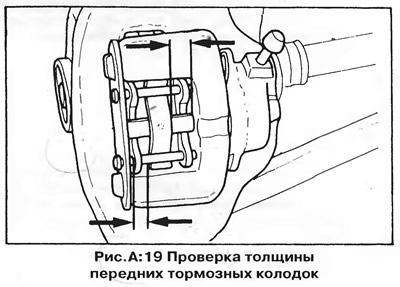
  • 2. Check the thickness of the pads, which are clearly visible through the window in the caliper (figure A:19).

2. Check the thickness of the pads, which are clearly visible through the window in the caliper…


Minimum permissible thickness of the pad (together with a metal base) is 7 mm. If the thickness of at least one pad approaches the minimum, all four pads should be replaced. It can be considered that the pads wear out approximately 1 mm over 800 km of travel.

Check that the brake pads are not contaminated with brake fluid. If there are signs of fluid leakage, remove the pads for a more thorough inspection (see chapter "Brake system").

NOTE: If any one pad requires replacement, replace all four front brake pads at the same time to maintain uniform braking.


Replacement of pads is described in detail in the chapter "BRAKING SYSTEM". After inspection/visibility of the pads, install the wheels and lower the car to the ground. Tighten the wheel bolts.

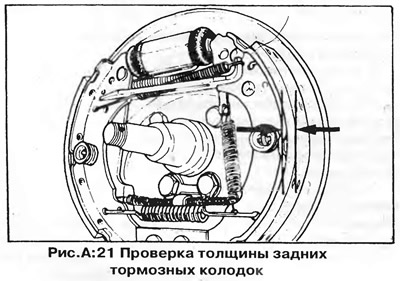
Rear drum brake shoes (figure A:21)


Rear drum brake shoes (figure A:21)


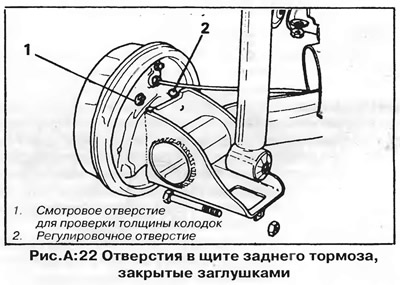
Although the Golf, Jetta and Scirocco rear brake backing plates have inspection holes covered with rubber plugs, it is recommended to remove the brake drums for a more thorough inspection of the pads.

When inspecting the rear brakes, it may turn out that some parts require replacement. Repair of brake mechanisms is described in the chapter "Brake system".

1. Loosen the wheel bolts, raise the rear of the vehicle and remove the rear wheels.

2. Release the handbrake and remove the brake drum - see chapter "Brake system".

3. Clean the brake pads with a wire brush, being careful not to inhale the dust that is created. The pads should be replaced if their thickness approaches the maximum permissible value, i.e. 5 mm for riveted pads or 3.5 mm if the pads are glued (figure A:21). All four pads must be replaced at the same time to maintain uniform braking. If the pads are contaminated with oil or brake fluid, the source of contamination must be immediately identified and eliminated, and the contaminated pads must be replaced


Check the rear wheel brake cylinders by lifting the dust covers with a screwdriver. If there are traces of brake fluid under the covers, the brake cylinder should be replaced or repaired (replace seals).

Before installing the brake drum, check the operation of the automatic adjustment mechanism (if available). If the automatic regulator does not work, repair it.

Hoses, Tubes and Seals


Regularly inspect the hoses and tubes of the brake system to promptly identify areas of corrosion of the tubes, as well as cracks, abrasions of the hoses and other damage. If questionable parts or brake fluid leaks are found, immediately eliminate the malfunctions (see chapter "Brake system").

Carefully inspect the master and wheel brake cylinders. Since brake fluid acts as a lubricant, minor leakage of fluid through the cylinder seals is permissible, but the amount of leaked fluid should be minimal. If a large amount of fluid leaks through a seal, it is recommended to immediately replace all seals in the brake system units - see chapter "Brake system".

Adjusting the rear brakes


On vehicles not equipped with automatic rear brake adjustment, the rear brakes must be adjusted as the brake pads wear. To do this, raise the rear of the vehicle off the ground and remove the rear wheels. Release the handbrake and make sure the handbrake cables do not stick and the wheels rotate freely.

Remove the plug from the adjustment hole in the brake shield (2, Figure A:22). The rear brake adjustment nut is visible through the hole. Use a flat-head screwdriver to turn the nut to adjust the rear brake pads.

Remove the plug from the adjustment hole in the brake shield (2, Figure A:22). The rear brake…


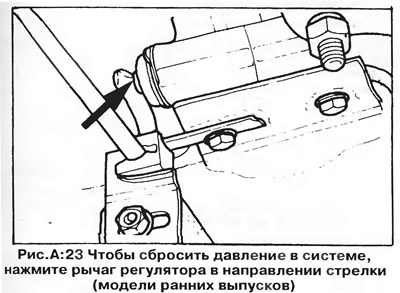
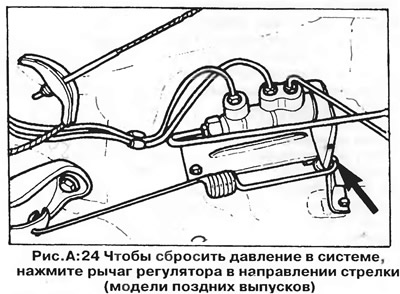
NOTE: If the vehicle is equipped with a load-sensing rear brake pressure regulator, the residual pressure in the brake system must be released before adjusting the pads. To do this, press the regulator lever in the direction shown by the arrow in Figures A:23 and A:24.


NOTE: If the vehicle is equipped with a load-sensing rear brake pressure regulator, the residual…


NOTE: If the vehicle is equipped with a load-sensing rear brake pressure regulator, the residual…


Turn the toothed adjustment nut downwards with a screwdriver until the wheel is locked, then turn it back just enough so that the wheel can turn freely again.

After adjusting both brakes, press the brake pedal several times and check the adjustment again. Close the adjustment holes with plugs.

Adjusting the handbrake


The operation of the handbrake should be checked periodically. Raise the car with a jack, check the condition and reliability of the handbrake cable, as well as the ease of its movement in the casing and guides.

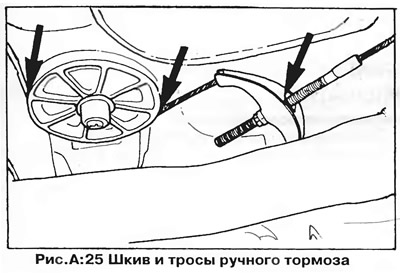
Clean and lubricate the cable with aerosol lubricant. Lubricate the equalizer, cable pulley, and the areas of the cable where it enters the guides. Lubricate the pulley axle and check for ease of rotation (figure A:25).

Clean and lubricate the cable with aerosol lubricant. Lubricate the equalizer, cable pulley, and…


Usually, during operation, the handbrake cable does not require adjustment, since its slack is taken up when adjusting the rear brakes (automatically or manually). However, if the cable is loose due to stretching, it can be adjusted as follows:

Adjust the rear brakes as described above, then tighten the handbrake.

NOTE: Apply the handbrake by lifting the handle three clicks of the release mechanism if the vehicle has manually adjustable rear brakes, or four clicks if the vehicle has automatically adjustable rear brakes.


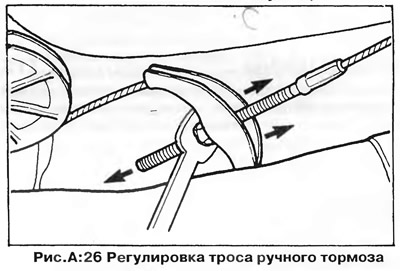
With the handbrake lever in this position, tighten the adjusting nut on the cable equalizer (figure A:26) so that the rear wheels can be turned with force by hand. Release the handbrake lever and check the ease of rotation of the rear wheels.

With the handbrake lever in this position, tighten the adjusting nut on the cable equalizer (figure…

This article is available at russian, bulgarian, belarusian, ukrainian, serbian, croatian, romanian, polish, slovak, hungarian
The text has been checked: Tarasov Ivan

Share information:

Previous articles
Oil in manual and automatic transmission
Clutch adjustment
Drive belt
Checking the battery
Brake fluid
Cooling system
Next articles
Wheels and tires
Exhaust system
Lighting and fixtures
Windscreen wipers and washers
Lubrication works


Similar articles from other manuals for VW cars:
Bleeding the brake system Passat B3 (1988-1993)
Parking brake system actuator lever Polo 3 (1995-2003)
Checking the brake system Touareg 1 (2002-2006)
General information about the brake system Tiguan 1 (2007-2015)
Brake system — general information Sharan 1 (1995-2000)
Technical data of the brake system Transporter T4 (1990-2003)
Visual inspection of the brake system for leaks and damage Caddy 3 (2003-2010)
Link to this page in different formats


Visitor comments


No comments yet


How much will 33 + 19 =


Golf 5 
  • General information
  • User manual
  • Maintenance
  • Troubleshooting
  • Power unit
  • Engine repair
  • Cooling and ventilation system
  • Fuel system
  • Ignition system
  • Transmission
  • Clutch
  • Mechanical gearbox
  • Automatic gearbox
  • Chassis
  • Brake system
  • Car suspension
  • Steering
  • Body
  • Interior (internal elements)
  • Exterior (external elements)
  • Doors and covers
  • Electrical equipment
  • Power devices
  • Washers and wipers
  • Lighting and appliances
  • Electrical circuits
Golf 4 
  • General information
  • User manual
  • Weekly checks
  • Maintenance
  • Power unit
  • Petrol engines
  • Diesel engines
  • Cooling system
  • Fuel system (petrol)
  • Control system (petrol)
  • Fuel system (diesel)
  • Exhaust system
  • Transmission
  • Clutch
  • Car gearbox
  • Drive shafts
  • Chassis
  • Car suspension
  • Steering
  • Wheels and tires
  • Brake system
  • Body
  • Exterior (external elements)
  • Interior (internal elements)
  • Ventilation and heating
  • Car doors and sunroof
  • Washers and glass cleaners
  • Electrical equipment
  • Power devices
  • Lighting and appliances
  • Electrical circuits
Golf 3 
  • Petrol engine
  • Engine repair
  • Lubrication system
  • Cooling system
  • Ignition system
  • Diesel engine
  • Engine repair
  • Diesel injection system
  • Pre-glow system
  • Transmission
  • Clutch
  • Gearbox and drive shafts
  • Chassis
  • Steering
  • Wheels and suspension
  • Brake system
  • Electrical equipment
  • Lighting and appliances
  • Electrical circuits
Golf 2 
  • General information
  • Introduction to guide
  • User manual
  • Petrol engines 1.3 l
  • Engine repair
  • Lubrication system
  • Cooling system
  • Carburetors
  • Supply system
  • Ignition system
  • Petrol engines 1.6/1.8 l
  • Engine repair
  • Supply system
  • Ignition system
  • Diesel engines
  • Engine repair
  • Lubrication system
  • Cooling system
  • Power and exhaust system
  • Transmission
  • Clutch
  • 4-speed gearbox 084
  • 5-speed gearbox 085
  • 4-speed gearbox 020/4R
  • 5-speed gearbox 020/4T
  • Automatic gearbox
  • Drive shafts
  • Chassis
  • Steering
  • Car suspension
  • Brake system
  • Body
  • Body elements
  • Doors, locks and windows
  • Electrical equipment
  • Equipment and devices
  • Power devices
Golf 2 (petrol) 
  • General information
  • Characteristics
  • Car care
  • Maintenance
  • Power unit
  • Engine repair
  • Engine 1.05/1.30
  • Engine 1.60/1.80
  • Cooling and lubrication system
  • Power and exhaust system
  • Transmission
  • Clutch
  • Car gearbox
  • Drive shafts
  • Chassis
  • Brake system
  • Steering
  • Suspension
  • Body
  • Body and equipment
  • Electrical equipment
  • Lighting and appliances
  • Electrical circuits
Golf 1 (petrol) 
  • General information
  • Characteristics
  • User manual
  • Maintenance
  • Power unit
  • Engine adjustment
  • Engine 1.1/1.3
  • Engine 1.5/1.6/1.8
  • Engine electrical equipment
  • Cooling system
  • Fuel system
  • Transmission
  • Clutch and manual gearbox
  • Automatic gearbox
  • Chassis
  • Steering
  • Front suspension
  • Rear suspension
  • Brake system
  • Electrical equipment
  • Lighting and appliances
  • Electrical circuits
  • Body
  • Body and equipment
  • Optional equipment
Golf 1 (diesel) 
  • General information
  • Specifications
  • Maintenance
  • Power unit
  • Engine repair
  • Exhaust and turbocharger
  • Cooling system
  • Fuel system
  • Fuel injection system
  • Transmission
  • Clutch and drive shafts
  • Car gearbox
  • Chassis
  • Suspension and wheels
  • Steering
  • Brake system
  • Wheels and tires
  • Body
  • Heating and ventilation
  • Exterior (external elements)
  • Interior (internal elements)
  • Doors and windows
  • Electrical equipment
  • Equipment and devices
  • Lighting system
  • Power devices
  • Electrical circuits
VWmanual.ru © 2016-2026 | Mobile version | News and articles | Sitemap: EN BG BY UA RS HR RO PL SK HU | Write message | Site search
Passat B2 • Passat B3 • Passat B4 • Passat B5 • Passat B6 • Golf 1, diesel • Golf 1, petrol • Golf 2, petrol • Golf 2 • Golf 3 • Golf 4 • Golf 5 • Polo 3 • Polo 4 • Touareg 1 • Tiguan 1 • Sharan 1 • Transporter T3 • Transporter T4 • LT 28 • LT 2D • Beetle • Caddy 3 •
Our website uses cookies to ensure functionality and convenience.