



Contents: Oil in a manual transmission ↓ Automatic transmission oil ↓ Automatic Transmission Oil Change ↓
Oil in a manual transmission
The gearbox and final drive have a common lubrication system. Check the oil level in the following order:
1. Before checking the oil level in the gearbox, the car should stand for some time without moving on a flat horizontal surface.
2. Clean the surface around the filler plug (B, Figure A:20). Unscrew the Allen key plug - you will need a Allen key for this - and insert your finger into the hole to check the oil level, which should be at the bottom of the hole.
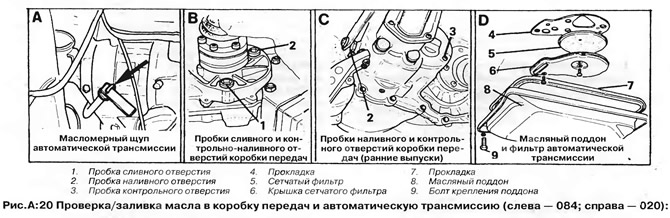
NOTE: Early models have a special inspection hole (C, figure A:20), intended only for checking the oil level. In this case, oil should be poured only through a separate filling hole.
3. If the oil level is below the lower edge of the inspection and filling hole, oil should be added. The type of oil used in the gearbox is specified in the section "Technical data".
NOTE: A significant drop in the gearbox oil level can only occur due to a leak. If there is insufficient oil, be sure to identify and eliminate the cause of the leak to prevent the gearbox from failing due to lack of oil.
Automatic transmission oil
The automatic transmission and final drive have separate lubrication systems. The oil in the final drive does not require replacement, and its level is checked in the same way as described above for the manual transmission. Check the oil level in the automatic transmission in the following order:
1. Warm up the transmission to operating temperature (40–60°C).
2. With the engine idling, apply the handbrake and set the transmission mode shift lever (selector lever) into neutral, remove the dipstick from the transmission and wipe it dry with a lint-free cloth.
3. Insert the dipstick back into the transmission and remove it again. The oil level should be between the MIN and MAX marks.
4. If the oil level is insufficient, add oil through the dipstick guide tube using a narrow funnel or syringe. The automatic transmission uses ATF Dextron type oil.
NOTE: Remember that too little oil will cause the transmission to fail quickly, while too much oil will cause foaming and oil leaks. The transmission can only operate satisfactorily with the correct oil level.
Automatic Transmission Oil Change
The automatic transmission oil should be changed every 50,000 km or every three years. The final drive oil does not need to be changed.
On early models, the automatic transmission pan had a drain hole covered with a plug. If there is no drain hole, carefully loosen the pan screws and tilt the pan to drain the oil. Remove the pan and strainer (D, figure A:20) and rinse them. Replace the screen and tray with a new gasket. It is important that all parts are absolutely clean. If there is a drain hole, tighten the plug.
Fill the transmission with 2.5 liters of ATF Dextron type oil through the dipstick tube. Start the engine and, holding the car in place, move the selector lever to each position in turn.
Set the lever to neutral, remove the dipstick and check the oil level (with the engine idling) If necessary, add oil to bring the level between the MIN and MAX marks. Drive a short distance to warm up the transmission, then check the oil level again and bring it up to the MAX mark.
CAUTION: Do not start the engine if there is no oil in the transmission.
Visitor comments