
English Русский
Български
Беларускі
Український
Српски
Hrvatski
Română
Polski
Slovenský
Magyar
  |  Articles  |  Sitemap  |  Contacts  |    |
Car maintenance Ford Car maintenance Hyundai Car maintenance Chevrolet Car maintenance BMW Car maintenance Audi Car maintenance Opel Car maintenance AvtoVAZ
VWmanual.ru


Main   Passat   Golf   Polo   Touareg   Tiguan   Sharan   Transporter   Others  
Golf 1 (1974-1984, diesel) Golf 1 (1974-1984, petrol) Golf 2 (1984-1993, petrol) Golf 2 (1984-1993) Golf 3 (1991-1997) Golf 4 (1997-2004) Golf 5 (2003-2008)

Drive belt (VW Golf 1)

  • Main
  • Golf
  • Golf 1
  • General information
  • Maintenance
  • Drive belt
            0


The generator is driven from the crankshaft pulley by means of a V-belt.

When inspecting a V-belt, pay attention to cracks in the rubber, especially on the inner surface of the belt, and to the fit of the belt in the pulley grooves: a worn belt is usually deeply embedded in the groove, and its outer edges may be frayed.

It is important that the belt is properly tensioned. If the tension is too low, the belt slips, which leads to increased wear and tear and inefficient operation of the units; too much belt tension causes accelerated wear of the bearings.

To check the belt tension, press your thumb into the middle of its longest section (figure A:16). The belt deflection should be approximately 10 mm. If it is necessary to tighten the belt, loosen the generator mounting bolts (are shown by arrows in Figure A:17), then push the generator away from the engine by inserting the lever (hammer handle) between the generator and the cylinder block, and tighten the bolts. Check the belt tension and readjust if necessary. Avoid over-tensioning the belt.
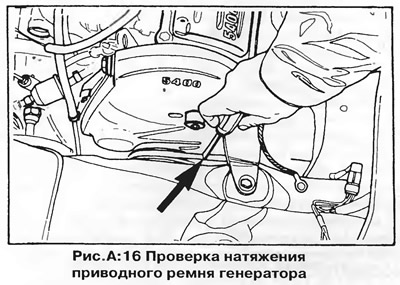
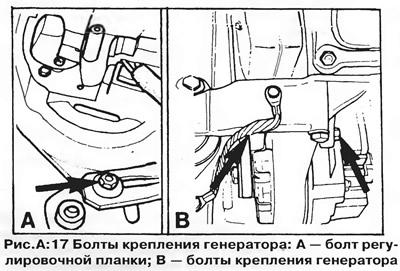
To check the belt tension, press your thumb into the middle of its longest section (figure A:16).…


To check the belt tension, press your thumb into the middle of its longest section (figure A:16).…


Replacement


Check the belt condition periodically and replace it if delamination, tears, cracks, abrasions or visible signs of wear are detected.


The original text can be found at (VWMANUAL.ru)

To replace the belt, loosen the alternator mounting bolts, move the alternator, loosening the belt, and remove the belt from the pulleys. Install a new belt and adjust its tension. Let the engine run at high speed for 5 minutes, then check the belt tension. Do not attempt to pull the new belt onto the pulleys with a lever without loosening the alternator mounting - this can damage the pulleys and belt.

NOTE: After installing a new belt, check and adjust its tension after 150-200 km to compensate for stretching.

This article is available at russian, bulgarian, belarusian, ukrainian, serbian, croatian, romanian, polish, slovak, hungarian
The text has been checked: Tarasov Ivan

Share information:

Previous articles
Checking the battery
Brake fluid
Cooling system
Fuel filters
Air filter
Engine oil and filter
Next articles
Clutch adjustment
Oil in manual and automatic transmission
Brake system
Wheels and tires
Exhaust system
Lighting and fixtures


Similar articles from other manuals for VW cars:
V-belt/toothed belt drive Passat B3 (1988-1993)
Timing belt drive with double pulley injection pump Polo 3 (1995-2003)
Checking the belt drive pulleys for misalignment (4.2L petrol… Touareg 1 (2002-2006)
Cylinder Block — Belt Drive Side Tiguan 1 (2007-2015)
Removal the toothed drive belt Sharan 1 (1995-2000)
Windscreen wiper drive device Transporter T4 (1990-2003)
Power steering pump — drive belt tensioner LT 28 (1975-1991)
Link to this page in different formats


Visitor comments


No comments yet


How much will 35 + 45 =


Golf 5 
  • General information
  • User manual
  • Maintenance
  • Troubleshooting
  • Power unit
  • Engine repair
  • Cooling and ventilation system
  • Fuel system
  • Ignition system
  • Transmission
  • Clutch
  • Mechanical gearbox
  • Automatic gearbox
  • Chassis
  • Brake system
  • Car suspension
  • Steering
  • Body
  • Interior (internal elements)
  • Exterior (external elements)
  • Doors and covers
  • Electrical equipment
  • Power devices
  • Washers and wipers
  • Lighting and appliances
  • Electrical circuits
Golf 4 
  • General information
  • User manual
  • Weekly checks
  • Maintenance
  • Power unit
  • Petrol engines
  • Diesel engines
  • Cooling system
  • Fuel system (petrol)
  • Control system (petrol)
  • Fuel system (diesel)
  • Exhaust system
  • Transmission
  • Clutch
  • Car gearbox
  • Drive shafts
  • Chassis
  • Car suspension
  • Steering
  • Wheels and tires
  • Brake system
  • Body
  • Exterior (external elements)
  • Interior (internal elements)
  • Ventilation and heating
  • Car doors and sunroof
  • Washers and glass cleaners
  • Electrical equipment
  • Power devices
  • Lighting and appliances
  • Electrical circuits
Golf 3 
  • Petrol engine
  • Engine repair
  • Lubrication system
  • Cooling system
  • Ignition system
  • Diesel engine
  • Engine repair
  • Diesel injection system
  • Pre-glow system
  • Transmission
  • Clutch
  • Gearbox and drive shafts
  • Chassis
  • Steering
  • Wheels and suspension
  • Brake system
  • Electrical equipment
  • Lighting and appliances
  • Electrical circuits
Golf 2 
  • General information
  • Introduction to guide
  • User manual
  • Petrol engines 1.3 l
  • Engine repair
  • Lubrication system
  • Cooling system
  • Carburetors
  • Supply system
  • Ignition system
  • Petrol engines 1.6/1.8 l
  • Engine repair
  • Supply system
  • Ignition system
  • Diesel engines
  • Engine repair
  • Lubrication system
  • Cooling system
  • Power and exhaust system
  • Transmission
  • Clutch
  • 4-speed gearbox 084
  • 5-speed gearbox 085
  • 4-speed gearbox 020/4R
  • 5-speed gearbox 020/4T
  • Automatic gearbox
  • Drive shafts
  • Chassis
  • Steering
  • Car suspension
  • Brake system
  • Body
  • Body elements
  • Doors, locks and windows
  • Electrical equipment
  • Equipment and devices
  • Power devices
Golf 2 (petrol) 
  • General information
  • Characteristics
  • Car care
  • Maintenance
  • Power unit
  • Engine repair
  • Engine 1.05/1.30
  • Engine 1.60/1.80
  • Cooling and lubrication system
  • Power and exhaust system
  • Transmission
  • Clutch
  • Car gearbox
  • Drive shafts
  • Chassis
  • Brake system
  • Steering
  • Suspension
  • Body
  • Body and equipment
  • Electrical equipment
  • Lighting and appliances
  • Electrical circuits
Golf 1 (petrol) 
  • General information
  • Characteristics
  • User manual
  • Maintenance
  • Power unit
  • Engine adjustment
  • Engine 1.1/1.3
  • Engine 1.5/1.6/1.8
  • Engine electrical equipment
  • Cooling system
  • Fuel system
  • Transmission
  • Clutch and manual gearbox
  • Automatic gearbox
  • Chassis
  • Steering
  • Front suspension
  • Rear suspension
  • Brake system
  • Electrical equipment
  • Lighting and appliances
  • Electrical circuits
  • Body
  • Body and equipment
  • Optional equipment
Golf 1 (diesel) 
  • General information
  • Specifications
  • Maintenance
  • Power unit
  • Engine repair
  • Exhaust and turbocharger
  • Cooling system
  • Fuel system
  • Fuel injection system
  • Transmission
  • Clutch and drive shafts
  • Car gearbox
  • Chassis
  • Suspension and wheels
  • Steering
  • Brake system
  • Wheels and tires
  • Body
  • Heating and ventilation
  • Exterior (external elements)
  • Interior (internal elements)
  • Doors and windows
  • Electrical equipment
  • Equipment and devices
  • Lighting system
  • Power devices
  • Electrical circuits
VWmanual.ru © 2016-2026 | Mobile version | News and articles | Sitemap: EN BG BY UA RS HR RO PL SK HU | Write message | Site search
Passat B2 • Passat B3 • Passat B4 • Passat B5 • Passat B6 • Golf 1, diesel • Golf 1, petrol • Golf 2, petrol • Golf 2 • Golf 3 • Golf 4 • Golf 5 • Polo 3 • Polo 4 • Touareg 1 • Tiguan 1 • Sharan 1 • Transporter T3 • Transporter T4 • LT 28 • LT 2D • Beetle • Caddy 3 •
Our website uses cookies to ensure functionality and convenience.