



Contents: ABS warning light and brake system…↓ ESP and ASR warning light ↓ Brake system warning light ↓ Brake pad wear indicator light ↓ Removal and installation ABS system…↓ Removal and installation the speed…↓ Installation ↓ Removal and installation ABS…↓ Removal and installation the speed…↓
The electrical/electronic components of the ABS system are shown in Fig. 6.62.
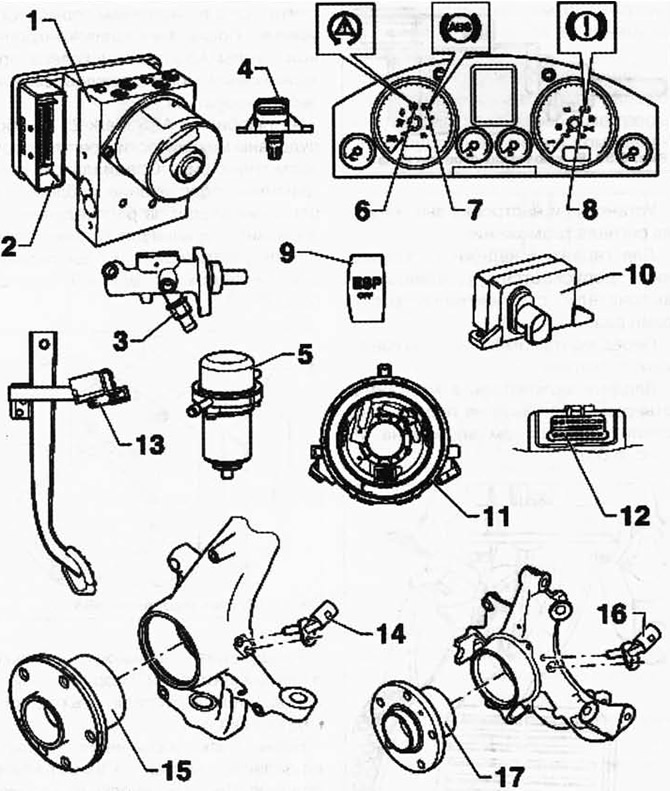
Fig. 6.62. Electrical/electronic components:
1 - ABS hydraulic unit; 2 - ABS control unit; 3 - brake system pressure sensor; 4 - brake boost pressure sensor; 5 - brake vacuum pump; 6 - ESP and ASR control lamp; 7 - ABS indicator light; 8 - brake system indicator lamp; 9 - ASR and ESP systems key; 10 - ESP sensor block; 11 - steering wheel angle sensor; 12 - diagnostic connector; 13 - Brake light switch and brake pedal sensor; 14 - Front right speed sensor/front left speed sensor; 15 - Wheel bearing/wheel hub assembly; 16 - Rear right speed sensor/rear left speed sensor; 17 - wheel bearing/wheel hub assembly.
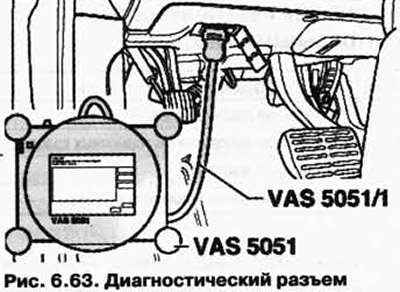
Indication of faults by control lamps
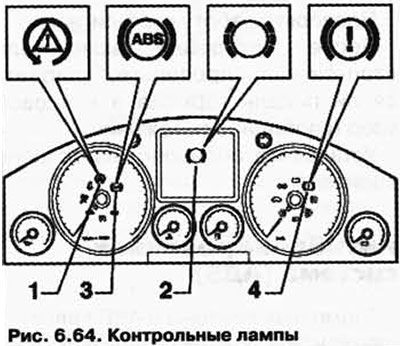
| Pos. | Designation (Fig. 6.64) |
| 1 | ESP and ASR warning light |
| 2 | Brake pad wear indicator light |
| 3 | ABS warning light |
| 4 | Brake system warning light |
If the ABS 3 warning lamp does not go out after the ignition is turned on and the check cycle is completed, the causes of the malfunction may be as follows:
- voltage less than 10 V;
- there is an ABS malfunction.
If ABS b is defective, the anti-lock braking system remains disabled, but the braking system itself remains operational;
- after the last engine start there was a temporary failure of the speed sensor.
In this case, the ABS warning lamp automatically goes out when the engine is restarted and the vehicle is driven at a speed above 2.75 km/h;
- the connection from the instrument cluster to the ABS control unit is broken;
- ABS warning light is faulty.
ABS warning light and brake system warning light
If the ABS warning light goes out and the brake system warning light comes on, the following may be the causes of the malfunction:
- the brake fluid level is too low.
After turning on the ignition, three warning signals are heard.
- wiring fault to brake system indicator lamp K118
If the ABS 3 indicator lamp and the brake system 4 indicator lamp are on, there is a fault with the ABS system. If there is a fault with the ABS, the change in braking force should be taken into account.
CAUTION: After the ABS warning light and brake system warning light come on, the rear wheels may lock prematurely when braking.
ESP and ASR warning light
If the ESP and ASR warning lamp does not go out after the ignition is turned on and the check cycle is completed, the causes of the malfunction may be as follows:
- there is a fault that only affects the ASR/ESP. The ABS/EDS and EBV vehicle safety systems remain fully functional. Query the fault memory;
- short circuit to positive in ASR/ESP button;
- short circuit to ground of ESP and ASR indicator lamp control;
- connection from the instrument cluster to terminal 31 of the ABS control unit is interrupted;
- the ASR/ESP system was disabled by the ASR/ESP button.
If the ESP and ASR indicator lamp flashes while driving, the ASR or ESP systems are in control mode.
Brake system warning light
If the brake system indicator lamp does not go out after the ignition is turned on, this may be due to the following reasons:
- parking brake engaged;
- the brake warning light switch is faulty or incorrectly adjusted;
- there is a wiring error. Perform an electrical check.
The parking brake contact switch informs the ABS control unit whether the parking brake is applied or not. When the parking brake is applied, ESP regulation is negatively affected.
Brake pad wear indicator light
If the brake pad wear indicator lamp does not go out within 3 seconds after the ignition is turned on or lights up while driving, the following faults may be the cause:
- the brake linings may be worn out.
Check the brake pads on the front and rear wheels. Replace the pads if they are worn out;
- there is a fault in the wiring.
Removal and installation ABS system components on the front and rear axles
The ABS components on the front axle are shown in Fig. 6.65.
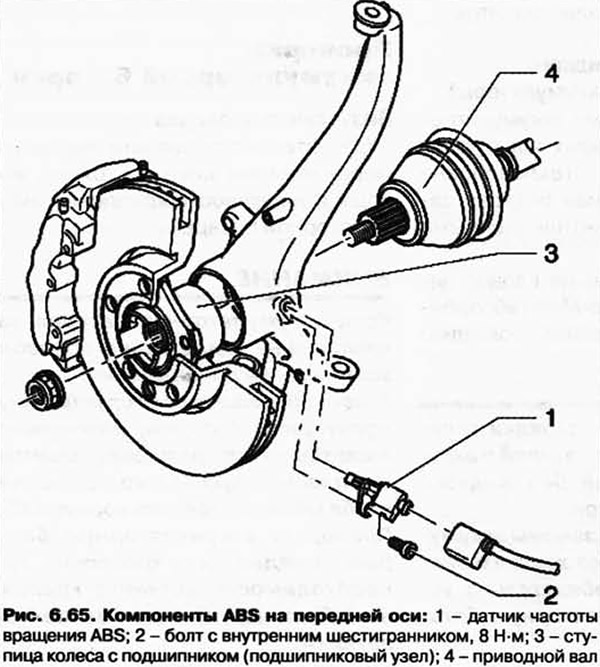
Removal and installation the speed sensor on the front axle
Raise the car.
Disconnect plug connection 1 of the speed sensor cable and the speed sensor (Fig. 6.66).
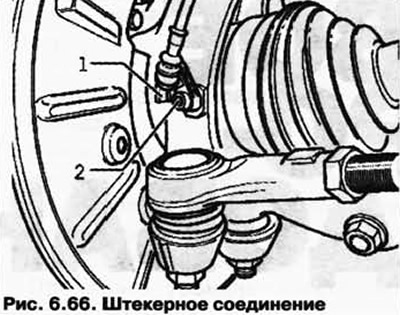
Remove bolt 2 from the wheel bearing housing.
Remove the ABS speed sensor from the wheel bearing housing.
Installation
Before installing the speed sensor, clean the hole and apply a small amount of plastic grease around the entire diameter.
Insert the speed sensor into the hole in the wheel bearing housing and tighten the bolt to 8 Nm.
Connect the RPM sensor to the sensor cable.
Removal and installation ABS components on the rear axle
The ABS components on the rear axle are shown in Fig. 6.67.
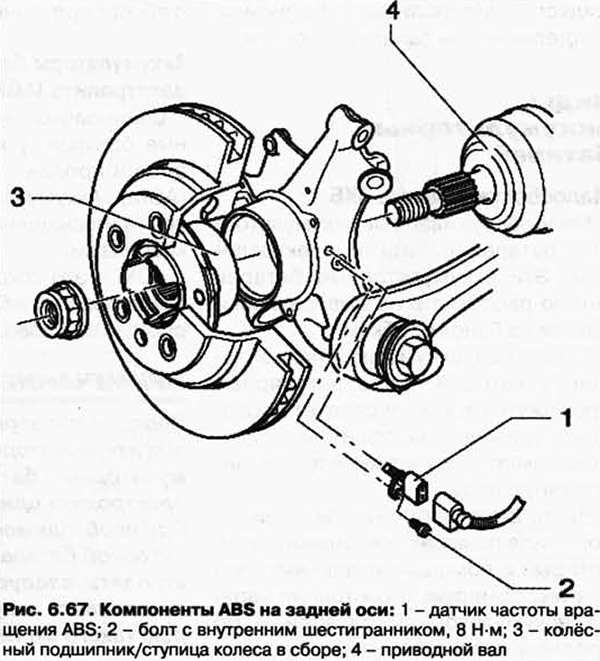
Removal and installation the speed sensor on the rear axle
Raise the car.
Disconnect plug connection 1 of the speed sensor cable and the speed sensor (Fig. 6.68).
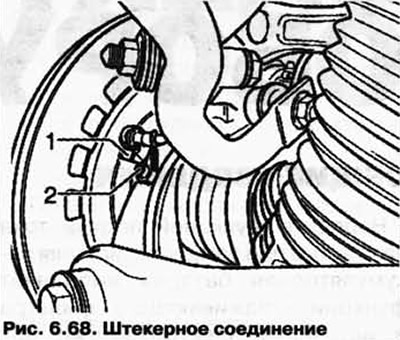
Remove bolt 2 from the wheel bearing housing.
Remove the ABS speed sensor from the wheel bearing housing.
Before installing the speed sensor, clean the hole and apply a small amount of plastic grease around the entire diameter.
Insert the speed sensor into the hole in the wheel bearing housing and tighten the bolt to 8 Nm.
Connect the RPM sensor to the sensor cable.
Visitor comments