



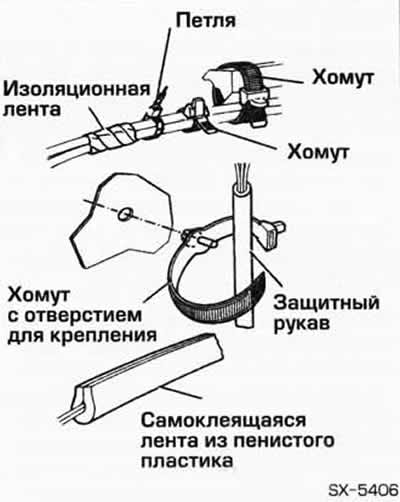
Wires that need to be laid when installing additional components in addition to the wires installed in the vehicle as standard should, if possible, always be laid along the existing wire harnesses, using the existing cable ties and rubber attachments.
If necessary, to prevent noise during driving and avoid chafing, newly laid wires must be additionally secured with insulating tape, polymer mass, tape clamps for fastening wires, etc. In this case, special attention must be paid to the fact that there is a distance of at least 10 mm between the brake system pipes and newly secured wires, and a distance of at least 25 mm between the brake system pipes and wires that swing together with the engine or with other parts of the car.
After drilling holes in the body, the edges of the holes should be cleaned of burrs, primed and varnished. The chips that inevitably form during drilling must be completely removed from the body.
When performing any work that affects the electrical wiring system, to prevent the risk of short circuits and overloading of the wires, it is necessary to disconnect the ground (-) wire from the battery with the ignition off and hang it to the side.
Caution: If the battery is disconnected, the fault code memory and electrical devices such as the radio and clock are de-energized and the stored fault codes are correspondingly erased. Special instructions on this topic are provided in Chapter "Removal and installation the battery".
Before installing additional electrical appliances, it is necessary to check whether the existing alternator can handle the increased load. If necessary, it is necessary to provide for the installation of a generator with increased capacity.
(View the original on the website vwmanual.ru)
Visitor comments