



Contents: Heated rear door and windshield glass ↓ Air circulation and supply…↓ Air conditioning ↓ Economical operation of the air…↓ Malfunction of the air conditioner ↓ General instructions ↓
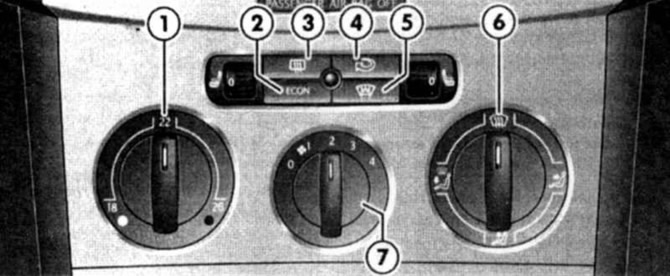
Fig. 1.64. Manual heating controls: 1 – temperature controller; 2 – Economy mode switch; 3 – Rear window heating switch; 4 – air circulation mode switch; 5 – additional heater or windshield heating switch; 6 – Air distribution control switch; 7 – fan speed controller
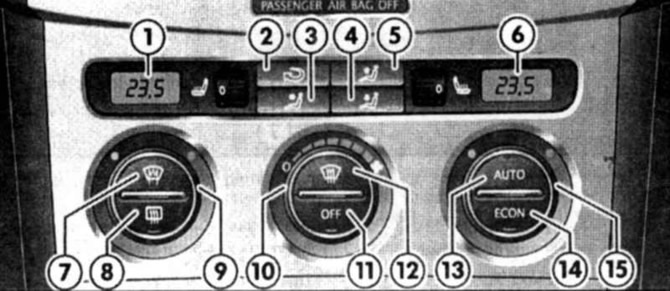
Fig. 1.65. Automatic heating control units: 1.6 – indicator of the set air temperature in the left/right part of the cabin; 2 – air circulation mode switch; 3 – switch for air supply to the face; 4 – foot air supply switch; 5 – diffuse air supply switch; 7 – Windshield blower or heating switch; 8 – Rear window heating switch; 9, 15 – temperature regulator in the left/right part of the cabin; 10 – fan speed controller; 11 – Switch (ON/OFF) of the HVAC system, additional heater; 12 – Windshield or HVAC system defroster switch (ON/OFF); 13 – Automatic mode switch; 14 – Economy mode switch
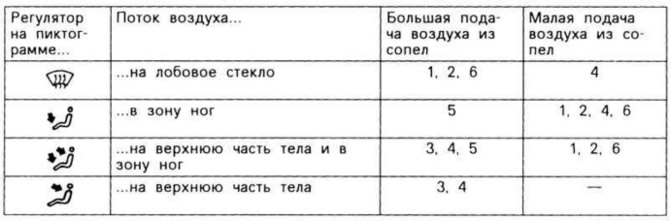
Fig. 1.66. Air supply diagram for the car interior
The VW Passat B6 can be equipped with either a manual or automatic HVAC system. Air conditioning is also not installed on all models. The location of the HVAC controls is shown in Figures 1.64–65.
Air is drawn in through the windshield fairing grille and enters the passenger compartment, passing through the filter and, if the heater is on, through its radiator. Air is supplied to the passenger compartment by deflectors, which allow the direction and intensity of the air flow to be adjusted. The intensity is adjusted by rotary controls located next to the deflectors. The system achieves maximum efficiency when the deflectors are fully open. If necessary, the supply of outside air can be switched off, for example, to prevent unpleasant odors from entering the passenger compartment or to quickly heat/cool the air in the passenger compartment. The recirculation mode switch is used for this purpose. However, when the recirculation mode is on, the air in the passenger compartment quickly becomes stale and the windows may fog up – this mode should not be used for too long.
The HVAC system only operates when the engine and fan are running. The heating system operates at its maximum efficiency when the engine is warm.
Heated rear door and windshield glass
The glass heating works only when the engine is running and is switched on/off using the corresponding switch with a built-in K/L. The heating switches off automatically 10 minutes after switching on, or by pressing the switch again.
Air circulation and supply ventilation modes
When the air circulation mode is turned on (K/L in the corresponding switch is lit) the air in the car's interior circulates in a closed circuit. Air from outside the car is not supplied to the interior. The circulation mode should be used when driving on dusty roads or in heavy traffic to prevent dust, unpleasant odors, and exhaust gases from entering the interior. In addition, the circulation mode allows for a significant reduction in interior temperature when using the air conditioning.
Caution: Do not turn on the air circulation mode for a long time, as this will cause the air in the car to become stale and condensation to appear on the windows.
Supply ventilation mode (K/L in the circulation switch does not light) is a normal operating mode of the HVAC system.
Note: The recirculation mode is automatically switched off when the windshield defroster is selected and is switched off when reversing or when the windshield is washed to prevent air containing the unpleasant smell of washer fluid from entering the passenger compartment.
Note: Do not smoke in the car with the circulation mode on, as tobacco smoke particles will settle on the air conditioning evaporator, making it difficult to get rid of the unpleasant smell in the car.
Air conditioning
The air conditioner complements the heating and ventilation system and provides cooling of the air in the car interior.
The refrigeration unit operates only when the engine is running, the outside air temperature is above +5°C and the fan is switched on to one of the steps 1–4 of switch B.
When the refrigeration unit is switched on, not only the air temperature but also its humidity decreases in the passenger compartment. Thanks to this, even with high humidity outside, even in the cold season, the driver and passengers feel better, and fogging of the windows is prevented.
Economical operation of the air conditioner
When the air conditioner is operating, its compressor is driven by the engine, and therefore the nature of the use of the unit affects fuel consumption. In order to reduce the operating time of the air conditioner as much as possible, it is necessary to take into account the following recommendations:
- if the interior of a parked vehicle has become very hot due to solar radiation, it is recommended to open the windows or doors for a short time to ventilate the vehicle;
- make sure that when the air conditioner is running, no warm outside air enters the car, for example, through an open window;
- if the desired air temperature inside the car can be achieved without turning on the air conditioner, it is better to select the mode of supplying fresh air inside the car.
Malfunction of the air conditioner
If the cooling capacity of the air conditioner has decreased, you must turn it off and contact a specialist.
If there are any problems with the air conditioner, this may be due to the following reasons:
- outside air temperature below +5°C;
- the fuse has blown;
The fuse should be checked and replaced if necessary. If the cause of the malfunction is not a blown fuse, the air conditioner should be turned off and specialists should be contacted.
- the air conditioner has temporarily shut down due to the coolant temperature being too high.
General instructions
If the air conditioner has not been turned on for a long time, an unpleasant smell may appear when it is turned on due to the accumulation of various types of deposits on the evaporator. To avoid the unpleasant smell, you should turn on the air conditioner - also in the cold season - at least once a month at the highest fan speed. In this case, open one of the windows for a short time.
It is recommended not to smoke in the car when the air recirculation mode is on, since particles contained in tobacco smoke settle in the air conditioner evaporator. This leads to the fact that the air supplied to the cabin will have a smell of tobacco smoke for a long time, which can be eliminated with great difficulty, spending a significant amount of money on replacing the evaporator.
At high temperatures and high humidity of the outside air, condensate may drip from the evaporator and form a puddle under the car. This is normal and does not indicate a leak in the system.
To ensure that the heating, ventilation and air conditioning systems operate reliably, the fresh air intake opening located in front of the windshield must be kept free of ice, snow and leaves.
Visitor comments