



The grilles on the dashboard allow you to regulate the direction and flow of air flowing through them.
The general control panel for ventilation, heating and air conditioning in the passenger compartment is located in the center of the dashboard. Depending on the version and equipment of the car (presence or absence of air conditioning, automatic or manual control mode) the system control panel has one design or another.
Warning: For safety reasons, it is important that all vehicle windows are clear of ice, snow and fog. Only then can a good view of the road conditions be guaranteed. Therefore, the driver must be well acquainted with the operation of the ventilation and heating systems and with the techniques for cleaning the windows.
Heating and ventilation controls
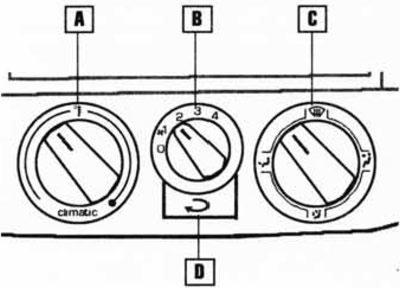
- A - Temperature regulator
- B - Air flow regulator
- C - Air distributor
- D - Air recirculation in the cabin
(The original information is posted on the resource: «vwmanual.ru»)
Air temperature regulation
To regulate the temperature of the air entering the passenger compartment, turn the regulator A. Clockwise - increase the temperature, counterclockwise - decrease the temperature.
Air speed regulation
The regulator controls the speed of the system fan. In position O, the fan is off. To increase the air speed, turn the regulator clockwise.
Air distribution in the cabin
The air distributor is connected to the system's dampers and allows you to control the air supply to the various ventilation grilles. The distributor has four positions, indicated by symbols:
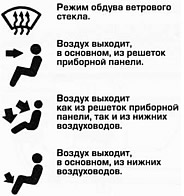
Cabin air recirculation control
When the recirculation mode is turned on, the passenger compartment is isolated from the outside air, which allows you to get rid of outside dust or unpleasant odors. Working in the recirculation mode allows you to speed up the heating of the air in the passenger compartment. However, it is not recommended to use the recirculation mode for a long time and, as soon as possible, you should return to the system operating mode with an inflow of outside air.
After turning off the recirculation mode, the system operates as usual - outside air enters the cabin.
For safety reasons, the recirculation mode is not activated if the air distribution control in the passenger compartment is in the position
 .
.
Below are recommendations on how to adjust the heating and ventilation system in typical situations.
Defrosting the windshield and side windows
- Turn regulator A clockwise until it stops.
- Set regulator B to position 3.
- Set switch C to position .
- Close the vents in the center of the dashboard.
- Adjust the deflectors on the edges of the dashboard so that air from them flows onto the side windows.
In case of fogging of the windshield and side windows
- Turn regulator A towards heating depending on the air temperature.
- Set regulator B to position 2 or 3.
- Set switch C to position .
- Close the vents in the center of the dashboard.
- Adjust the deflectors on the edges of the dashboard so that air from them flows onto the side windows.
Quick warm-up of the cabin
- Turn regulator A clockwise until it stops.
- Set regulator B to position 3.
- Set switch C to position
 .
. - Close the vents in the center of the dashboard.
- Open the deflectors on the edges of the dashboard partially if necessary.
- Turn on the recirculation mode by pressing the D key.
Warning: Do not use the recirculation mode for a long time, as fresh air will not enter the cabin and the windows may fog up.
- If the windows are fogged up, turn switch C to position .
In this switch position, the recirculation mode does not work.
Ventilation mode
- Turn regulator A counterclockwise until it stops.
- Set regulator B to the desired position.
- Set switch C to position .
- If the windshield fogs up, set switch C to position .
- Open the vents in the center and at the edges of the dashboard.
- If desired, switch C can be set to a different position.
General remarks
To ensure the ventilation and heating system operates, make sure the air intake grilles in front of the windshield are free of ice, snow, leaves and other debris.
To prevent the windshield from fogging up, set the regulator B to the lowest air flow position when driving at low speeds, and set the switch C to position
.
Air from the cabin exits through the vents under the rear windows. Keep this in mind and do not block the vents.
Climatic air conditioning system controls
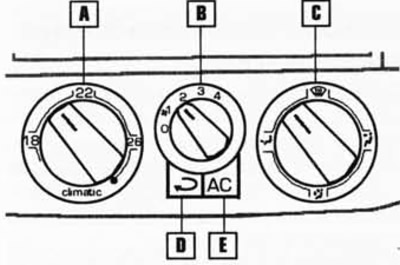
- A - Temperature regulator
- B - Air flow regulator
- C - Air distributor
- D - Air recirculation in the cabin
- E - Air Conditioner Switch
The Climatic air conditioning system expands the capabilities of the heating and ventilation system so that the air in the cabin can be not only heated but also cooled.
Climatic maintains the selected air temperature in the cabin automatically. The air conditioner in the cabin is designed to operate in any weather conditions. In summer, it serves to cool the air in the cabin, and in winter, it removes moisture from the air entering the cabin and eliminates fogging of the windows.
Warning: For safety reasons, it is important that all vehicle windows are clear of ice, snow and fog. Only then can a good view of the road conditions be guaranteed. Therefore, the driver must be well acquainted with the operation of the ventilation and heating systems and with the techniques for cleaning the windows.
General remarks
If the air conditioner has not been used for a long time, unwanted deposits may have accumulated in its evaporator, which have a bad smell. To prevent this from happening, turn on the air conditioner at least once a month.
Do not smoke in the cabin when the air conditioner is in recirculation mode, as tobacco smoke settles in the evaporator and causes unpleasant odors. They can only be eliminated by replacing the evaporator.
At high ambient temperatures and humidity, the air is saturated with water vapor. Condensation from the evaporator may leak out and form a puddle under the car. This is a normal process and does not indicate a malfunction.
Economical use of air conditioning
During air cooling, the air conditioner compressor loads the engine with additional power, which affects its efficiency. To reduce the operating time of the air conditioner, we recommend following these rules:
- If your car has been parked in the sun and the temperature inside is too high, open the windows or doors to let the warm air out.
- When using the air conditioner, make sure that warm air from outside does not enter the interior, for example through an open window.
- If the desired temperature in the cabin can be achieved without air conditioning, do not turn it on.
Air temperature regulation
To regulate the temperature of the air entering the cabin, rotate the regulator A. Clockwise - increase the temperature, counterclockwise - decrease the temperature. When the air conditioner is on, rotating the regulator counterclockwise increases the air cooling. The numbers on the regulator correspond to the air temperature in the cabin. In the extreme positions of the regulator, the temperature in the cabin remains uncontrollable.
Note: If switch C is set to position
Air conditioner switch
The air conditioner only switches on when the engine is running, if the outside air temperature is above +5°C and if the fan control is set between 1 and 4.
To turn on the air conditioner, press button E. To turn it off, press the same button again.
Warning: Do not use the recirculation mode for a long time, as fresh air will not enter the cabin and the windows may fog up.
Visitor comments