



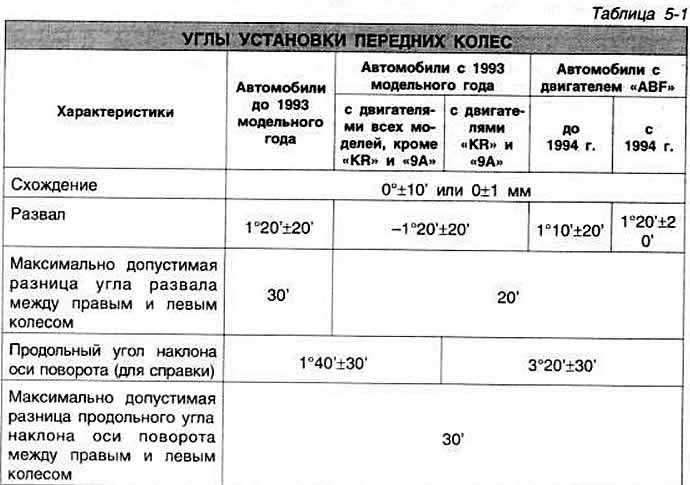
When checking and adjusting the wheel alignment angles, it is necessary to:
- place the vehicle in running order on a level surface;
- make sure that the size, wear and pressure of the tires are the same on both wheels;
- make sure that the rubber mounts of the front suspension are in good condition and that there is no large play in the ball joints and bearings;
- if necessary, eliminate the end runout of the wheel rims.
The wheel camber angles are adjusted by replacing the bolts that secure the telescopic strut to the steering knuckle with bolts of a smaller diameter.
Make sure that the camber adjustment is not due to damage to any part of the front suspension.
(The original can be viewed on the portal: vwmanual.ru)
Replace the upper 12 mm telescopic strut mounting bolt with a 11 mm VAG bolt. Adjust the wheel camber angle by moving the mounting bolt in the strut and steering knuckle holes, which changes the camber angle by approximately 1°. If replacing the upper bolt does not produce the desired camber angle, replace the lower mounting bolt and repeat the adjustment. To adjust the front wheel toe-in, set the steering wheel to the straight-ahead position. Check and, if necessary, adjust the wheel toe-in.
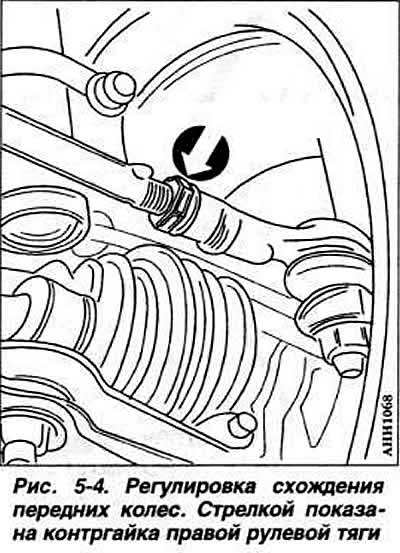
Loosen the lock nut of the right steering rod (Fig. 5-4) and rotate the steering rod to achieve the desired toe-in angle, making sure that the protective cover of the ball joint does not twist.
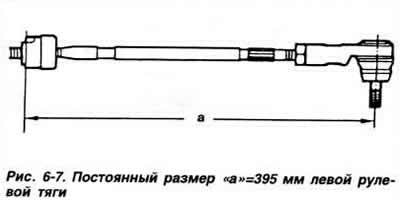
Do not adjust the toe-in using the left steering rod, since the dimension a=395 mm must remain constant (Fig. 6-7).
Visitor comments