



Manual adjustment of front seats
Adjustment controls 2 through 4 (Fig. 1.89) for the right front seat are arranged in mirror image.
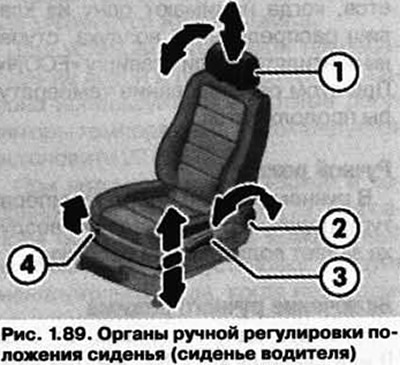
Headrest adjustment
Grasp the sides of the headrest and slide it.
Adjusting the seat backrest tilt
Move away from the back and rotate the flywheel.
Seat height adjustment
Move the lever (if necessary, multiple times) from the initial position up or down. In this case, the seat will rise or fall.
Seat adjustment in the longitudinal direction
Pull the handle up and move the seat forward or backward.
WARNING: Never adjust the front seats while driving. When adjusting, you assume an unnatural position on the seat. Adjust the front seats only when the car is stationary.
WARNING: To reduce the risk of injury during emergency braking or a collision, never drive with the seatback reclined too far back - risk of injury! The greatest protective effect of the seat belts is achieved when the front seatbacks are in a position close to the upright position and the driver and front passenger are wearing the seat belts correctly. The more the seatback is reclined, the greater the risk of serious injury if the seat belt is not worn correctly and the driver is not sitting properly.
WARNING: Be careful when adjusting the seat height and lengthwise. Injury may occur if adjustments are not made carefully.
Electrically adjustable front seats
The regulators are shaped like individual seat elements when viewed from the side. The cushion and back follow the movements of the corresponding regulators.
To adjust the seat position to your body type, move the appropriate regulator (Fig. 1.90).
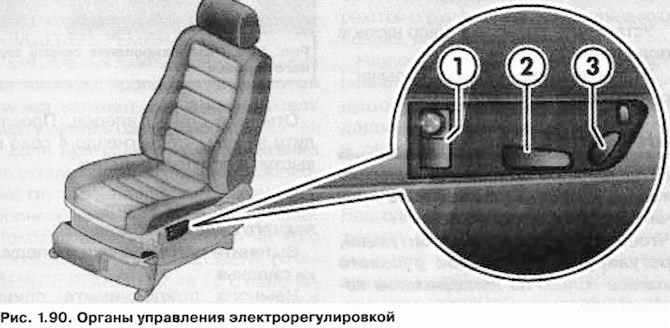
Adjust the lumbar support. When adjusted, the part of the seat back in the lumbar area becomes more or less convex. This allows you to achieve good spinal support taking into account your individual characteristics.
Adjust the seat cushion height and lengthwise.
Adjust the seat backrest angle.
WARNING: To reduce the risk of injury during emergency braking or a collision, never ride with the seatback reclined too far back. The greatest protective effect of the seat belts is achieved when the seatbacks are in a position close to the upright position and the driver and front passenger are wearing the seat belts correctly. The more the seatback is reclined, the greater the chance of serious injury if the seat belt is not worn correctly.
Memorizing adjustments for seat, seat belt height, mirrors and steering wheel
The memory buttons are used to store and recall three different combinations of seat position, seat belt height, mirrors and steering wheel adjustments.
To enter into memory, first press the "SET" key and then one of the memory keys 1, 2 or 3 (Fig. 1.91).
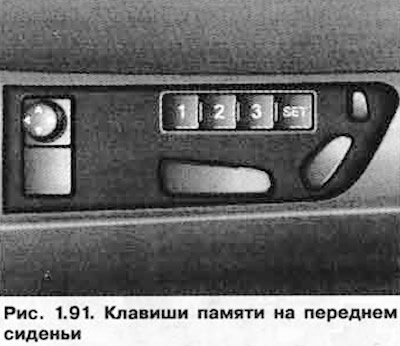
Saving adjustments for forward movement
Turn on the ignition. Reverse gear should not be engaged.
Adjust the driver's seat position, seat belt height, all mirrors and steering wheel.
Press the "SET" key.
Press and hold one of the memory keys for ten seconds. The entry into memory will be confirmed by a sound signal similar to the strike of a gong.
Turn off the ignition.
Memorizing the adjustment for the right outside mirror when reversing
Turn on the ignition.
Engage reverse gear.
Adjust the right outside mirror so that you can clearly see the curb on the right.
Press the same memory key that you pressed when storing the forward adjustments. The memory will be confirmed by a gong-like sound.
Calling adjustments
With the key inserted into the ignition, lightly touch the corresponding memory button. For the driver, this is only possible when the car is stationary.
To recall adjustments while the vehicle is moving, hold down the memory button until the memorized adjustments are set.
For the front passenger, adjustments for the seat and seat belt height can be made using the memory keys.
For the driver, additional settings for the mirrors and steering wheel are stored in the memory. The driver's seat settings can be coordinated with the radio key. This is useful when a particular radio key is used predominantly by the same person.
Coordination of adjustments for the driver's seat with the radio key
Each radio key can be matched with the stored seat settings so that the seat is automatically set to a specific position.
Matching radio keys with memory keys
First press the "SET" key.
Then press the memory key under which the driver's seat adjustments that you would like to match with a specific radio key were entered.
Press and hold the radio key release button
 approximately one second. All three of these actions must be completed within ten seconds.
Calling adjustments
Press the radio key release button once.
Open the driver's door. The driver's seat will move to the set position. If the easy entry function is activated, the seat will move to the set position only when the ignition key is inserted and the driver's door is closed.
Erasing the radio key matching with the memory key
Press the corresponding memory key.
Then press and hold the radio key lock button for about two seconds
 .
.
The driver's seat adjustments can be matched to the radio key. This is useful if a particular radio key is used predominantly by the same person. The matching of a radio key to a particular memory key is retained until this radio key is matched to another memory key or this memory key is matched to another radio key.
NOTE: Each new adjustment erases all old adjustments under the corresponding memory key.
The original article is available at [VWmanual.ru]
Visitor comments