
English Русский
Български
Беларускі
Український
Српски
Hrvatski
Română
Polski
Slovenský
Magyar
  |  Articles  |  Sitemap  |  Contacts  |    |
Car maintenance Ford Car maintenance Hyundai Car maintenance Chevrolet Car maintenance BMW Car maintenance Audi Car maintenance Opel Car maintenance AvtoVAZ
VWmanual.ru


Main   Passat   Golf   Polo   Touareg   Tiguan   Sharan   Transporter   Others  
Golf 1 (1974-1984, diesel) Golf 1 (1974-1984, petrol) Golf 2 (1984-1993, petrol) Golf 2 (1984-1993) Golf 3 (1991-1997) Golf 4 (1997-2004) Golf 5 (2003-2008)

Adjusting the front wheel alignment angles (VW Golf 2)

  • Main
  • Golf
  • Golf 2
  • Chassis
  • Steering
  • Adjusting the front wheel alignment angles
            0


Contents: Wheel alignment ↓ Wheel alignment ↓ Angle of longitudinal inclination of…↓ Wheel turning angle ↓
Adjustment of the front wheel alignment angles is performed on a loaded vehicle. Before starting adjustments, make sure that there is no play in the steering rod ends and in the lever joints. An optical measuring device is used for measurement, although a mechanical device is quite sufficient. The measurement methods on different equipment differ from each other, so only general instructions for taking measurements are given below.

Wheel alignment


The front wheel alignment is adjusted only by the right steering rod, even if an adjustable rod is installed on the left side. During the measurement, according to the instructions, the wheel should be free. The front wheel alignment should be (0±0.1) mm. When the alignment is adjusted, it is necessary to set the steering wheel spoke to a horizontal position. The need to set the steering wheel position occurs because only the length of one steering rod is adjusted. Remove the pad from the steering wheel, remove the steering wheel and set it to a horizontal position. Tighten the steering wheel mounting nut to a torque of 50 Nm. Tighten the nut of the ball end pin of the rod to the same torque. If the rubber boot gets twisted when screwing in the rod, release the wire clamp, adjust the boot and fix the clamp again.

Wheel alignment


In older Golf II/Jetta II models, it was possible to adjust the camber of the wheels. This was done using the upper bolt that secured the steering knuckle to the spring strut. This bolt with an eccentric allowed the camber angle to be changed by 2°. If the measured value of the wheel angle is not within the range of -50'...+10' or the difference in the angles of the left and right sides exceeds 30', adjustments must be made. Loosen the lower bolt that secures the steering knuckle to the spring strut. Loosen the eccentric bolt nut (figure 390). Turn the eccentric bolt until the correct camber angle is achieved.
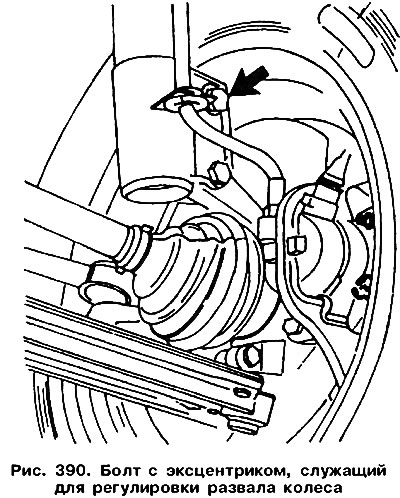


In older Golf II/Jetta II models, it was possible to adjust the camber of the wheels. This was done…


Tighten both nuts to 80 Nm and check the angle again.

After adjusting the wheel alignment, the wheel alignment should be checked and, if necessary, adjusted.

In later production cars (with 1.3 l engines) the wheel camber is not adjustable for design reasons. However, if a change in the camber angle is detected that is not caused by the suspension condition, the bolt must be replaced with another one that is 1 mm thinner (catalog number 100766.01). First, replace the upper bolt of the steering knuckle. If this does not give the expected result, the lower bolt must also be replaced. This method can correct the wheel camber by 1°. The wheel camber angle should always be in the range of -60'...0°, and the difference between the left and right sides should not exceed 30'.

Angle of longitudinal inclination of kingpin


The value of the longitudinal inclination angle of the kingpin of the steering knuckle should be 1°30'±30'. The angle is not subject to adjustment. The difference between the right and left sides should not exceed 1°.

Wheel turning angle


The wheel turning angle is not adjustable. The maximum outer wheel turning angle is 39°, the inner one is 33.3°. If they differ from the required value, this means that the front suspension elements are deformed.

This article is available at russian, bulgarian, belarusian, ukrainian, serbian, croatian, romanian, polish, slovak, hungarian
The text has been checked: Kolesnikov Artem

Share information:

Previous articles
Replacing the steering rod on the steering gear installed on the vehicle
Replacing the steering rod on a removed steering gear
Replacing the intermediate shaft
Replacing a Steering Column with a Solid Shaft
Twin-shaft steering column banners
Adjusting the play in the steering mechanism
Next articles
Replacing the power steering gear
Steering rod banners (with hydraulic booster)
Replacing the fluid in the power steering
Adjusting the play in the steering mechanism (with power steering)
Adjusting the V-belt tension


Similar articles from other manuals for VW cars:
Adjusting the front wheel alignment angles Passat B2 (1981-1988)
Front wheel alignment adjustment Polo 3 (1995-2003)
Adjusting the front seats Touareg 1 (2002-2006)
Repair of shock absorber of adaptive chassis control system DCC… Tiguan 1 (2007-2015)
Adjusting the front wheel alignment angles Sharan 1 (1995-2000)
Checking and adjusting the front wheel alignment Transporter T3 (1979-1992)
Checking and adjusting the front wheel alignment (torsion bar… Beetle (1960-1986)
Link to this page in different formats


Visitor comments


No comments yet


How much will 20 + 25 =


Golf 5 
  • General information
  • User manual
  • Maintenance
  • Troubleshooting
  • Power unit
  • Engine repair
  • Cooling and ventilation system
  • Fuel system
  • Ignition system
  • Transmission
  • Clutch
  • Mechanical gearbox
  • Automatic gearbox
  • Chassis
  • Brake system
  • Car suspension
  • Steering
  • Body
  • Interior (internal elements)
  • Exterior (external elements)
  • Doors and covers
  • Electrical equipment
  • Power devices
  • Washers and wipers
  • Lighting and appliances
  • Electrical circuits
Golf 4 
  • General information
  • User manual
  • Weekly checks
  • Maintenance
  • Power unit
  • Petrol engines
  • Diesel engines
  • Cooling system
  • Fuel system (petrol)
  • Control system (petrol)
  • Fuel system (diesel)
  • Exhaust system
  • Transmission
  • Clutch
  • Car gearbox
  • Drive shafts
  • Chassis
  • Car suspension
  • Steering
  • Wheels and tires
  • Brake system
  • Body
  • Exterior (external elements)
  • Interior (internal elements)
  • Ventilation and heating
  • Car doors and sunroof
  • Washers and glass cleaners
  • Electrical equipment
  • Power devices
  • Lighting and appliances
  • Electrical circuits
Golf 3 
  • Petrol engine
  • Engine repair
  • Lubrication system
  • Cooling system
  • Ignition system
  • Diesel engine
  • Engine repair
  • Diesel injection system
  • Pre-glow system
  • Transmission
  • Clutch
  • Gearbox and drive shafts
  • Chassis
  • Steering
  • Wheels and suspension
  • Brake system
  • Electrical equipment
  • Lighting and appliances
  • Electrical circuits
Golf 2 
  • General information
  • Introduction to guide
  • User manual
  • Petrol engines 1.3 l
  • Engine repair
  • Lubrication system
  • Cooling system
  • Carburetors
  • Supply system
  • Ignition system
  • Petrol engines 1.6/1.8 l
  • Engine repair
  • Supply system
  • Ignition system
  • Diesel engines
  • Engine repair
  • Lubrication system
  • Cooling system
  • Power and exhaust system
  • Transmission
  • Clutch
  • 4-speed gearbox 084
  • 5-speed gearbox 085
  • 4-speed gearbox 020/4R
  • 5-speed gearbox 020/4T
  • Automatic gearbox
  • Drive shafts
  • Chassis
  • Steering
  • Car suspension
  • Brake system
  • Body
  • Body elements
  • Doors, locks and windows
  • Electrical equipment
  • Equipment and devices
  • Power devices
Golf 2 (petrol) 
  • General information
  • Characteristics
  • Car care
  • Maintenance
  • Power unit
  • Engine repair
  • Engine 1.05/1.30
  • Engine 1.60/1.80
  • Cooling and lubrication system
  • Power and exhaust system
  • Transmission
  • Clutch
  • Car gearbox
  • Drive shafts
  • Chassis
  • Brake system
  • Steering
  • Suspension
  • Body
  • Body and equipment
  • Electrical equipment
  • Lighting and appliances
  • Electrical circuits
Golf 1 (petrol) 
  • General information
  • Characteristics
  • User manual
  • Maintenance
  • Power unit
  • Engine adjustment
  • Engine 1.1/1.3
  • Engine 1.5/1.6/1.8
  • Engine electrical equipment
  • Cooling system
  • Fuel system
  • Transmission
  • Clutch and manual gearbox
  • Automatic gearbox
  • Chassis
  • Steering
  • Front suspension
  • Rear suspension
  • Brake system
  • Electrical equipment
  • Lighting and appliances
  • Electrical circuits
  • Body
  • Body and equipment
  • Optional equipment
Golf 1 (diesel) 
  • General information
  • Specifications
  • Maintenance
  • Power unit
  • Engine repair
  • Exhaust and turbocharger
  • Cooling system
  • Fuel system
  • Fuel injection system
  • Transmission
  • Clutch and drive shafts
  • Car gearbox
  • Chassis
  • Suspension and wheels
  • Steering
  • Brake system
  • Wheels and tires
  • Body
  • Heating and ventilation
  • Exterior (external elements)
  • Interior (internal elements)
  • Doors and windows
  • Electrical equipment
  • Equipment and devices
  • Lighting system
  • Power devices
  • Electrical circuits
VWmanual.ru © 2016-2026 | Mobile version | News and articles | Sitemap: EN BG BY UA RS HR RO PL SK HU | Write message | Site search
Passat B2 • Passat B3 • Passat B4 • Passat B5 • Passat B6 • Golf 1, diesel • Golf 1, petrol • Golf 2, petrol • Golf 2 • Golf 3 • Golf 4 • Golf 5 • Polo 3 • Polo 4 • Touareg 1 • Tiguan 1 • Sharan 1 • Transporter T3 • Transporter T4 • LT 28 • LT 2D • Beetle • Caddy 3 •
Our website uses cookies to ensure functionality and convenience.