



Contents: Checking the supply voltage ↓ Checking the load current ↓ Finding a faulty glow plug ↓ Glow plugs with burnt pin ↓ Examination ↓ Checking glow plugs ↓
Instructions for the turbocharged diesel engine are given at the end of the section.
Caution: A defective preheating system causes difficulties when starting a cold engine, especially at ambient temperatures below +10°C.
Checking the supply voltage
Prerequisites for checking: The engine is cold (has ambient temperature), the battery is charged (voltage not less than 12 V).
Connect the voltage indicator to the glow plug of cylinder 4 and to ground (-).
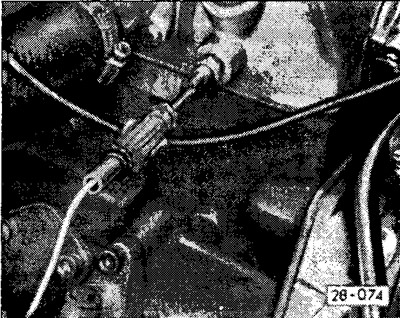
Turn the ignition key to the "Vorgluhen" position - Preheating (ignition on).
If the indicator does not show voltage, then it is necessary to check the plate fuse (80 A) of the glow plugs for damage (microcracks), the strength of the installation and the quality of the contact. If necessary, clean the contacts, tighten the fastening or replace the fuse. The blade fuse is located in the fuse box.
Checking the load current
To check the load current of an individual glow plug, the workshop uses an ammeter with a DC clamp, such as the VAG-1315A. The clamp is connected to an insulated cable, and the current value is measured via induction.
If there is a clamp, connect it to the glow plug supply wire.
Turn on the ignition, warm up the glow plugs, start the engine and let it idle.
During subsequent heating of the glow plugs (up to 120 s), determine the value of the load current with the engine running:
Each glow plug draws approximately 8 A. If the measured load current is approximately 32 A, the glow plugs are OK.
- At 32 A current all spark plugs are OK
- At a current of 24 A, 1 spark plug is faulty
- At a current of 16 A, 2 spark plugs are faulty
- At a current of 8 A, 3 spark plugs are faulty
- At 0 A current all spark plugs are faulty
Note: When current flows through a glow plug, its functionality cannot be reliably confirmed. Current-carrying glow plugs may also be faulty,
Finding a faulty glow plug
Remove all injectors, see below.
Remove the heat shield seals.
Turn on the ignition and "Vorgluhen".
Observe through the nozzle holes which glow plugs are hot or, on the contrary, have a defect.
Glow plugs with burnt pin
Burnt glow plug pins are often the result of faulty injector nozzles. This type of damage cannot be attributed to defects inside or outside the glow plug.
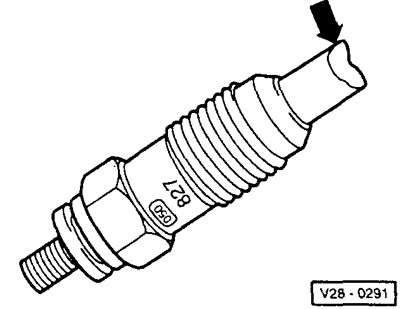
If such a spark plug (arrow) is found in the event of a claim, it is not enough to simply replace such a spark plug. It is necessary to check the injector nozzles for injection pressure and tightness(workshop work).
Turbocharged diesel engine
Prerequisites for verification:
- The battery is charged, the battery voltage is not less than 11.5 V.
- The diesel injection system control unit is OK.
- The ignition is off.
Examination
Check the glow plug blade fuse for damage (thin cracks), the strength of the installation and the quality of the contact. If necessary, clean the contacts, tighten the fastening or replace the fuse. The blade fuse is located in the fuse box.
Disconnect the coolant temperature sensor plug. This simulates a cold engine condition. The temperature sensor is located on top of the coolant connection pipe on the left side of the cylinder head.
Disconnect the glow plug connectors.
Connect a voltmeter between the glow plug plug and the vehicle ground.
Turn on the ignition. Within about 20 seconds, the voltmeter should show battery voltage. Check all connections in the same way.
If there is no voltage, check the electrical wires according to the electrical diagram.
Checking glow plugs
Ignition off. Disconnect glow plug connectors.
Connect a test lamp with semiconductor diodes to the positive terminal of the battery (+) and connect it in series to each glow plug.
If the indicator light comes on, the glow plug is OK.
If the indicator lamp does not light, replace the glow plug. Tightening torque: 15 Nm.
Connect the glow plug connectors.
Visitor comments