



Contents: Viscosity and grades of motor oil ↓ Important note ↓ Petrol engines ↓ Diesel engines ↓ Properties of motor oils ↓ Instructions ↓ Checking the oil level ↓ Topping up oil ↓ Oil change ↓ Motor oil additives ↓
Viscosity and grades of motor oil
At the factory, high-quality all-season oil is poured into the car engine, which is suitable for any time of year in any climate zone, except for areas with particularly cold climates.
The oil classification below can be considered either separately or in combination with the classification of oils according to other systems. The viscosity class of the oil should be selected in accordance with the diagram provided. If the outside temperature goes beyond the specified limits for a short time, the oil does not need to be changed.
Important note
Motor oil production technology is constantly evolving, so this instruction is current at the time of publication. In the future, oils superior in quality to those described may appear on the market, and the use of these oils may be preferable.
Petrol engines
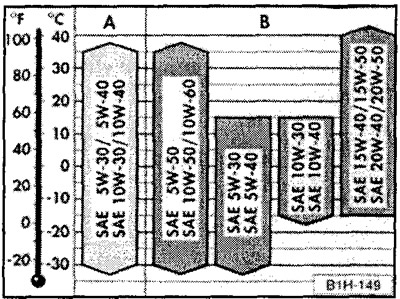
- A - All-season oils with improved antifriction properties, specification VW 500 00 (1)
- B - All-season oils, specification VW501 01 (1)
- B - All-season oils, specification API-SF (2) or SG (2)
(1) Not later than 10.91. (2) These oils may only be used if a more suitable engine oil is not available.
Diesel engines
- A - All-season oils with improved antifriction properties, specification VW 500 00 (1) (for turbodiesels - only VW specification 505 00)
- B - All-season oils, specification VW 505 00 (1) (suitable without restrictions for all diesel engines)
All-season oils, API-CD specification (for turbodiesels - only if there is no more suitable oil).
All-season oils, specification VW 501 01(1) (for turbo engines - only VW specification 505 00).
Properties of motor oils
All-season oils according to VW specifications 501 01 and 505 00 are the cheapest and have the following qualities:
- Suitable for use at any time of year in temperate climate zones
- Excellent cleaning properties
- Reliable lubrication at all temperatures and engine operating modes
- Does not lose its original properties over time
All-season oils with improved antifriction properties according to the VW 500 00 standard also have the following advantages:
- Can be used at any time of year at almost any temperature
- Reduces engine energy losses due to internal friction
- Ensure reliable cold engine starting even at very low temperatures
Instructions
Seasonal oils cannot be used all year round due to their limited viscosity. These oils are only suitable for use in extreme climate zones.
When using SAE 5 W-30 all-season oil, prolonged engine operation at high speeds and under heavy load should be avoided. These restrictions do not apply to all-season oils with improved antifriction properties.
Checking the oil level
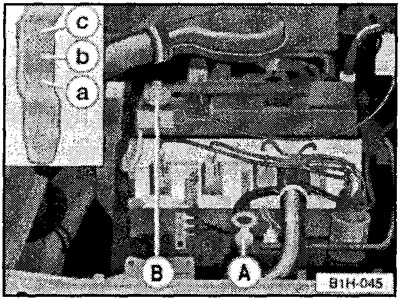
The engine constantly consumes oil during operation. Oil consumption can be up to 1.0 l/1000 km. Therefore, the oil level should be checked regularly, preferably at each refueling and before long trips.
The location of the dipstick (A) is shown in the figure.
When measuring the oil level, the car should be on a level horizontal surface. Wait a few minutes after stopping the engine to allow the oil to drain back into the engine oil pan.
Then remove the dipstick, wipe it with a clean cloth and reinsert it until it stops.
Remove the dipstick again and check the oil level:
- a - oil must be added. Enough so that the oil level rises to zone (b).
- b - oil can be added. After adding oil, its level can be in zone (c).
- c - the oil level is sufficient, you cannot add more.
Under particularly severe engine operating conditions (for example, when driving long distances on motorways in summer, driving with a trailer or: on steep climbs), try to keep the oil level as high as possible but not more than zone (c).
Note: If a round dipstick without bends is installed, the upper and lower edges of the dots on its end indicate the MAX and MIN marks. The oil level should be between these marks. If it has dropped below the MIN mark, oil should be added, but under no circumstances above the MAX mark!
Topping up oil
Unscrew plug B from the neck on the valve cover and add oil in portions of no more than 0.5 l, while constantly monitoring its level with a dipstick.
The oil level should never be above zone C - otherwise, oil can be sucked through the crankcase ventilation into the cylinders, which will lead to carbon deposits, oiling of the spark plugs and increased oil consumption. In addition, in cars with a catalytic converter, oil entering the exhaust system can damage the catalytic converter.
(The original text can be found on the portal: VWManual)
Caution: When topping up, do not allow oil to come into contact with hot engine parts - risk of fire.
Close the oil filler cap tightly and insert the dipstick until it stops.
Oil change
The oil should be changed according to the schedule specified in the service plan.
Caution: Keep used oil out of reach of children until disposal. Do not allow oil to flow into drains or onto the ground. Due to disposal issues, it is best to have the oil and filters changed at a service station.
Motor oil additives
Although there are many different motor oil additives on the market, Volkswagen manufacturers do not recommend their use. Warranty service does not cover engine damage caused by the use of such additives.
Visitor comments