



Contents: Adjusting the throttle opening ↓ Adjusting the throttle cable ↓ Adjusting engine idle speed ↓ Engine crankshaft speed control at…↓ Adjustment of CO in exhaust gases ↓ Checking the performance of the fuel…↓ Adjusting the position of the air…↓ Pressure check ↓ Checking the fuel pressure in the…↓ Checking the control pressure on a…↓ Checking the control pressure on a…↓ Checking the residual pressure ↓ Checking injection nozzles ↓ Checking the starting injector and…↓ Checking the supply voltage of the…↓ Checking the control pressure…↓ Checking the additional air supply…↓ Removal and installation the…↓ Removal and installation injectors ↓
Adjusting the throttle opening
Note: The throttle opening is adjusted at the factory and cannot be changed during operation. However, if the stop screw is accidentally turned, the adjustment is restored as follows.
Loosen the lock nut of the throttle opening stop screw (see fig.) and unscrew the screw until it barely moves away from the stop. Then screw in the stop screw until it touches the stop, then tighten it another half turn.
Tighten the stop screw lock nut.
Check the engine idle speed and adjust it if necessary.
Adjusting the throttle cable
Carefully check the cable for any bent or twisted sections.
Press the accelerator pedal all the way down and measure the gap between the throttle control lever and the stop, which should be no more than 1 mm.
Warning: If you find even one bend in the throttle cable, replace the cable.
Adjusting engine idle speed
Adjustment of the engine idle speed is performed on an engine warmed up to normal operating temperature with the ignition timing set correctly, with a working ignition system, and with a clean air filter element.
Check if the throttle opening is adjusted correctly.
Make sure that the power consumers are switched off.
Engine crankshaft speed control at idle
Connect the tachometer according to the operating instructions.
Turn on the high beam headlights.
Start the engine and increase the crankshaft speed to 3000 rpm, after 30 seconds reduce the engine speed to idle, i.e. to 800-900 rpm.
Note: If the injector fuel lines have been disconnected or replaced before adjusting the engine idle speed, run the engine several times at 3000 rpm and at idle speed.
If necessary, set the idle speed of the crankshaft within 800-900 rpm using adjusting screw 1 (see photo), located on the throttle body.
Adjustment of CO in exhaust gases
Note: When adjusting the CO content, do not push or pull the adjusting screw. After inserting the socket wrench into the screw head, do not press the accelerator pedal to avoid damaging the adjusting screw.
Connect the gas analyzer according to the operating instructions.
Disconnect the engine crankcase ventilation hoses.
Remove the plug of the mixture quality adjustment screw located on the fuel dispenser-distributor (see photo).
Using a socket wrench, turn the mixture quality adjustment screw until the CO content is within 1.0-2.0%.
When the screw is turned clockwise, the CO content in the exhaust gases increases, and vice versa.
If it is necessary to turn the adjusting screw several times in one direction or another to achieve the desired CO content, then after each adjustment it is necessary to remove the key and lightly press the accelerator pedal.
After adjustment, install a new plug on the mixture quality adjustment screw.
After adjusting the engine idle speed, connect the engine crankcase ventilation hoses.
Checking the performance of the fuel pump
Disconnect the drain hose from the supply pressure regulator on the fuel dispenser and lower its end into a measuring cup.
Disconnect the high tension wire from the ignition coil.
Turn on the starter for about 30 seconds and measure the amount of fuel that flows out into the measuring cup, which should be at least 900 cm².
Note: Replace the fuel line seals each time the fuel pump is removed. If the fuel pump does not work, first check the 16 A fuse in the fuse box.
Every 15,000 km of run, replace: fuel filter. When installing a new filter, point the arrow on its body in the direction of fuel circulation in the system. Never blow out the fuel filter with compressed air.
Adjusting the position of the air flow meter pressure disc
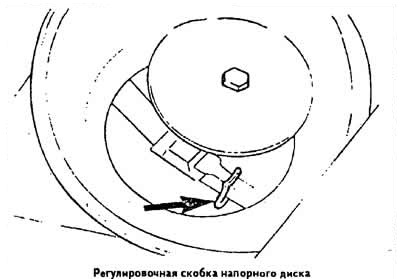
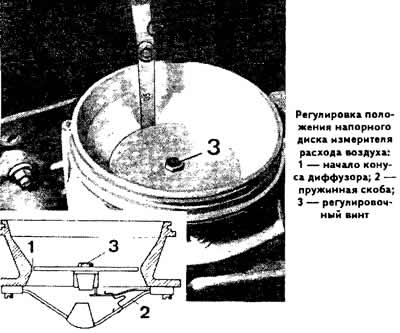
Make sure that with the engine not running, the pressure disc is level with or no more than 0.5 mm below the beginning of the expanding cone of the air flow meter diffuser.
If necessary, adjust the position of the air flow meter pressure disk by bending the spring of bracket 2 (see photo), after first removing the lower housing of the mixture regulator.
Note: If the air flow meter pressure plate is positioned above the specified level, backfiring will occur during misfires. If the pressure plate is positioned too low, both cold and hot engine starting will be difficult.
Check the centering of the pressure disc by placing a 0.10 mm thick gasket in sequence at four points around the circumference.
If the pressure disk is in the wrong position, loosen adjusting screw 3 and center the pressure disk, then tighten screw 3 to a torque of 0.5 kgf·m.
Adjust engine idle speed.
Pressure check
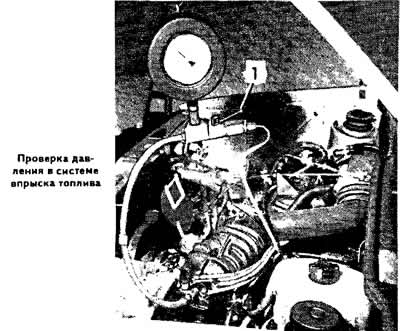
To check the pressure, use a VW 1318 pressure gauge with a fitting and a tap that provides measurement of both the flow pressure and the inlet pressure.
Connect the pressure gauge hoses between the dispenser-distributor and the control pressure supply pipeline coming from the control pressure regulator.
Remove air locks from the pressure gauge hoses. To do this, start the engine, set the pressure gauge valve to the position for monitoring the flow pressure and lower the pressure gauge so that it hangs freely on the hoses.
Checking the fuel pressure in the system
Check the performance of the fuel pump and the condition of the air filter element.
Set lever 1 (see photo) of the pressure gauge to the "open" position, placing the lever in line with the fitting.
Make sure the connector is connected to the control pressure regulator.
Start the engine and let it idle.
Measure the fuel pressure in the system using a pressure gauge; it should be within 4.7-5.4 kg/cm².
If the pressure does not fit within the specified limits, replace the fuel distributor. You can also try to eliminate the causes of deviation of the fuel pressure from the required one.
The reasons for insufficient fuel pressure in the system may be:
- leaks in fuel lines and their connections;
- insufficient fuel pump performance;
- insufficient fuel supply pressure.
The cause of increased fuel supply pressure is a violation of the fuel pressure regulator adjustment or jamming of its plunger.
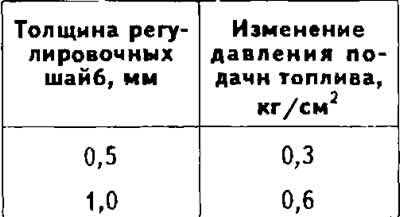
The fuel pressure in the system is regulated by selecting the thickness of the adjusting washers installed on the plunger of the fuel pressure regulator.
Checking the control pressure on a cold engine
Set valve 1 of the pressure gauge to the "closed" position, placing it perpendicular to the fitting.
Disconnect the connector from the control pressure regulator. Disconnect the connector from the additional air supply valve.
Start the engine at idle speed.
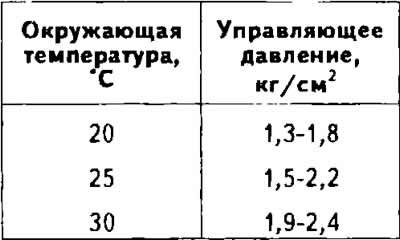
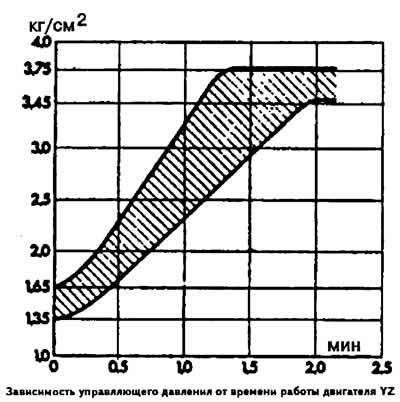
Determine the control pressure using the pressure gauge depending on the ambient temperature (see table).
If the control pressure is not within the specified limits, replace the control pressure regulator.
Checking the control pressure on a warm engine
Control pressure on a cold engine
Warm up the engine (oil temperature 50-70°C).
Set the pressure gauge valve to the "open" position.
Connect the block to the control pressure regulator, to the additional air valve.
Start the engine at idle speed. The control pressure should increase to 4.05-4.35 kg/cm after 1.3-2.5 minutes.
If the control pressure is not within the specified limits, replace the control pressure regulator.
Checking the residual pressure
Warm up the engine (oil temperature 50-70°C).
Stop the engine.
Set the pressure gauge valve to the "open" position.
Start the engine and let it idle until the pressure on the pressure gauge reaches 4.7-5.4 kg/cm².
Turn off the ignition. After 10 minutes, the residual pressure in the system should be 2.6 kg/cm².
If the pressure drops sharply, set the pressure gauge valve to the "closed" position.
Start the engine and let it idle until the pressure gauge shows 4.7-5.4 kg/cm².
Turn off the ignition. After 10 minutes, the pressure in the system should be within 2.6 kg/cm².
The control pressure regulator must be replaced if the pressure decreases when the pressure gauge valve is open, but does not decrease when the valve is closed.
Checking the fuel pressure when the engine is turned off
Warm up the engine (oil temperature 50-70°C).
Install the pressure gauge as described above.
Set the pressure gauge valve to the "closed" position.
Measure the fuel pressure in the system, which should be in the range of 4.7-5.4 kg/cm².
Turn off the ignition.
Measure the fuel pressure in the system at the moment the ignition is turned off, which should drop to 3.0 kg/cm².
Checking injection nozzles
Unscrew the nozzle from the socket and screw in a spare nozzle instead.
Lower the nozzle into the measuring cup.
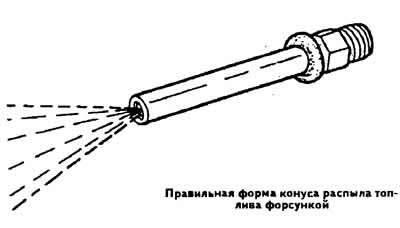
Start the engine, let it run at a crankshaft speed of about 2000 rpm and check that the fuel injected by the injector has the shape of a regular cone.
Stop the engine. Not a single drop of fuel should appear from the injector nozzle.
Check other injectors in the same way.
You can more accurately check the technical condition of the injectors using a stand that includes a hand pump and a pressure gauge.
Connect the tested injector to the stand according to the operating instructions and check the fuel injection pressure. A properly functioning injector should inject fuel at a pressure of 3.0-4.1 kg/cm².
Check the injector for leaks. To do this, use the stand pump to create a pressure 0.5 kg/cm² lower than the injector fuel injection pressure and maintain it for 15 seconds, during which not a single drop of fuel should leak from the injector nozzle.
Press the pump lever of the stand with a frequency of one stroke per second. In this case, fuel should be sprayed from the nozzle with a humming sound in the form of a cone at an angle of approximately 35°.
If the injector does not meet at least one of the above requirements, it must be replaced.
Checking the starting injector and thermal time relay
Disconnect the connector from the starting injector and connect a test lamp to it.
(The text is copied from this portal vwmanual)
Disconnect the high voltage wire from the ignition coil.
Turn on the starter. On a cold engine (at a coolant temperature below 30°C), the indicator lamp should light for 1-8 s.
Note: If the test is performed at a higher temperature than that marked on the thermal time relay housing, the control lamp will not light.
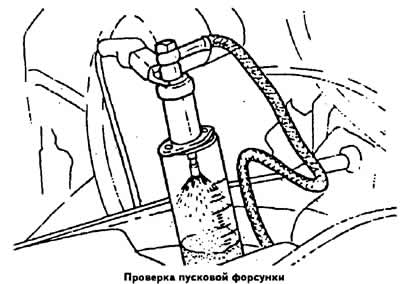
Check the quality of fuel atomization by the starting injector. To do this, remove the starting injector without disconnecting the block and fuel line from it, and place it in a measuring cup.
Turn on the starter for 1-8 s: the starting nozzle should spray fuel in the shape of a regular cone.
Checking the supply voltage of the thermal time relay
Note: The check is carried out when the coolant temperature is below 30°C.
Disconnect the high-voltage wire from the ignition distributor sensor and connect it to the body ground via an extension cord.
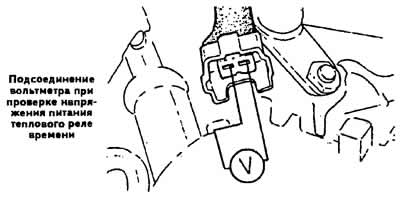
Disconnect the connector from the starting injector and connect a voltmeter to the terminals (see fig.).
Turn on the starter and check the voltage using a voltmeter, which should be 11.5 V.
Checking the control pressure regulator
Warm up the engine (oil temperature 50-70°C).
Disconnect the connector from the control pressure regulator and connect a voltmeter to the connector.
Turn on the ignition and use a voltmeter to determine the supply voltage of the regulator, which should be at least 11.5 V.
Connect an ohmmeter to the terminals of the regulator and check the resistance of its thermal winding, which should be within 16-22 Ohms.
If the ohmmeter shows infinity, this indicates a break in the thermal winding and the control pressure regulator must be replaced.
Checking the additional air supply valve
On a cold engine (at a coolant temperature below 30°C), disconnect the block from the additional air supply valve.
Disconnect the hose from the intake manifold that goes to the additional air supply valve.
Connect the tachometer according to the operating instructions.
Start the engine and let it idle.
Close the opening of the hose leading to the additional air supply valve. The engine crankshaft speed should decrease.
Attach the hose to the intake manifold, connect the connector to the additional air supply valve and warm up the engine.
Disconnect the hose leading to the additional air supply valve from the intake manifold again and close its opening. The engine speed should not change. If the engine speed changes, replace the additional air supply valve.
Removal and installation the metering unit with air flow meter
Removal
Relieve the pressure in the fuel injection line by disconnecting the hose from the control pressure fitting on the fuel pressure regulator.
Disconnect the fuel lines of the injectors from the distributor.
Remove the air duct connecting the air flow meter to the throttle body.
Unscrew the bolts securing the air flow meter assembly to the air filter housing and remove the air flow meter and distributor.
If necessary, disconnect the metering unit from the air flow meter by unscrewing the three bolts on the metering unit. Be careful not to drop the metering plunger.
Installation
Install the air flow metering unit with the air flow meter on the air filter housing.
Tighten the mounting bolts.
Connect the fuel lines to the distributor, replacing the gaskets.
Attach the connecting air duct to the air flow meter.
Connect the control pressure line to the fuel pressure regulator, installing new gaskets.
Adjust engine idle speed.
Removal and installation injectors
Release the fuel injector lines from the holders.
Remove the flange securing the injectors to the engine.
Remove the injectors with fuel lines.
Unscrew the pipeline fitting from the nozzle.
Remove the injector.
When installing the injectors, replace the gaskets and moisten the seals on the ends of the injectors with gasoline. Install the injectors in the reverse order of removal.
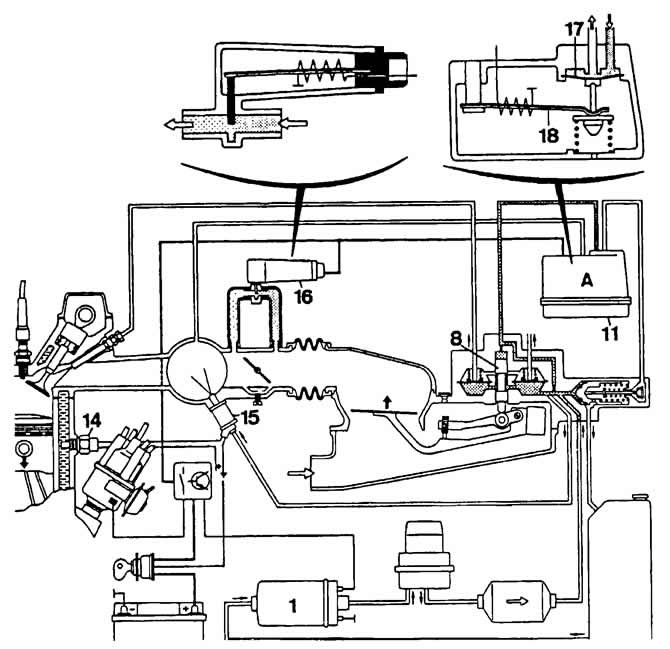
Scheme of operation of the K-Jetronic injection system when starting a cold engine:
1 - fuel pump;
8 — distributing plunger of the dispenser-distributor;
11 — control pressure regulator;
14 - coolant temperature sensor;
15 - starting nozzle;
16 — additional air supply valve;
17 — diaphragm valve for regulating control pressure;
18 — bimetallic spring for controlling the control pressure adjustment valve.
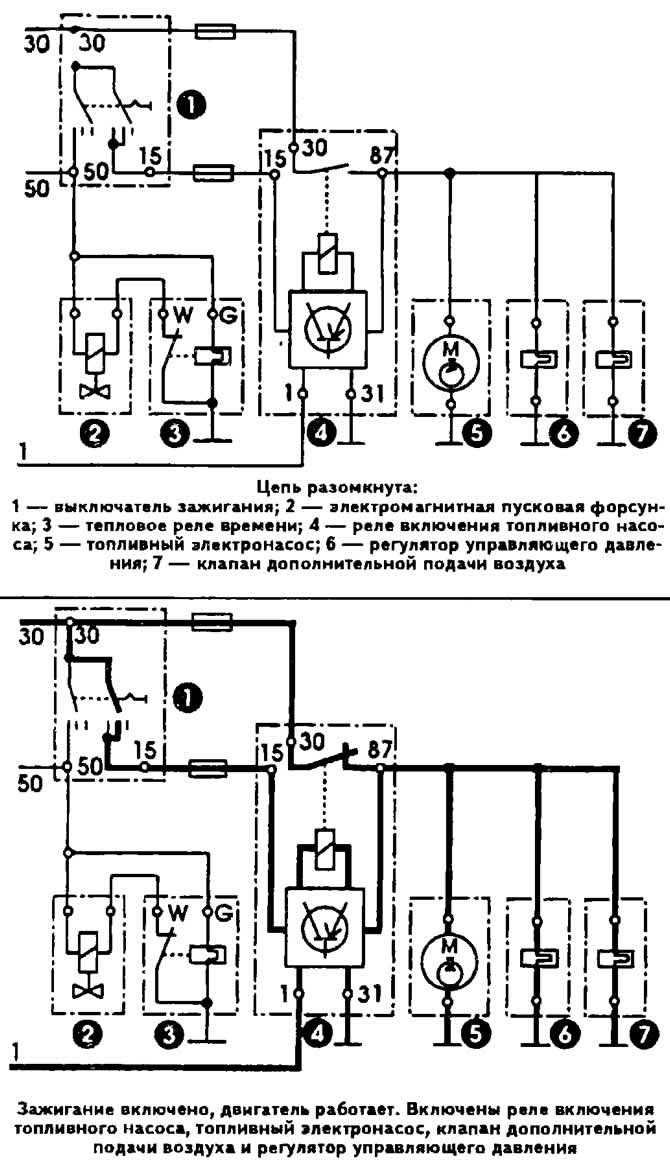
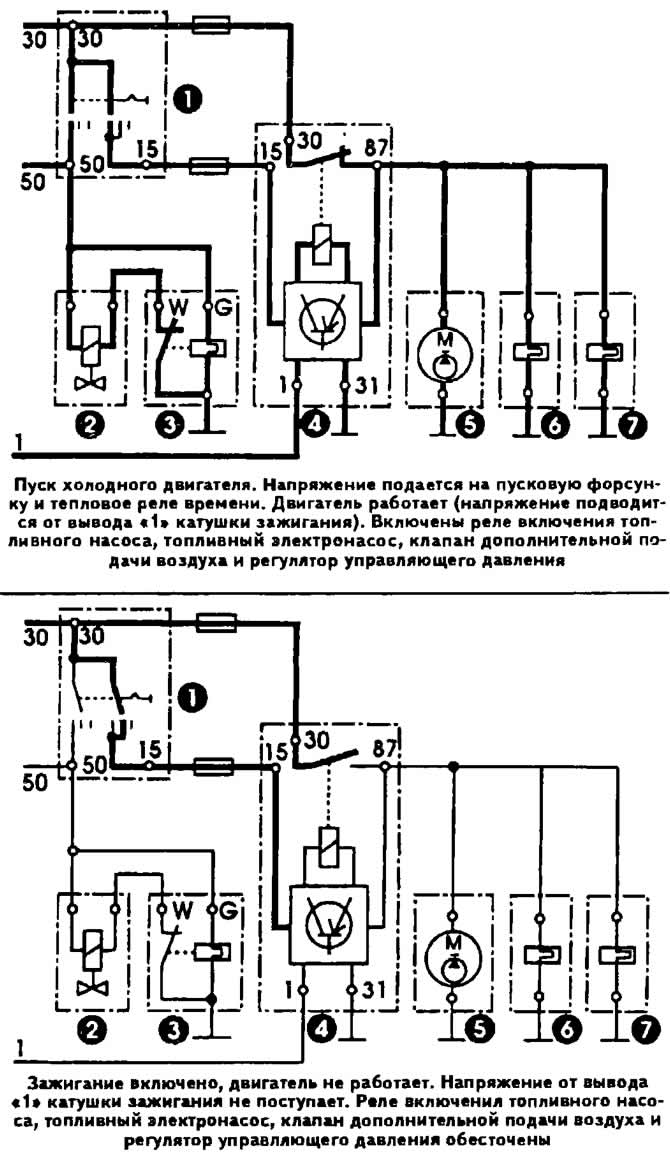
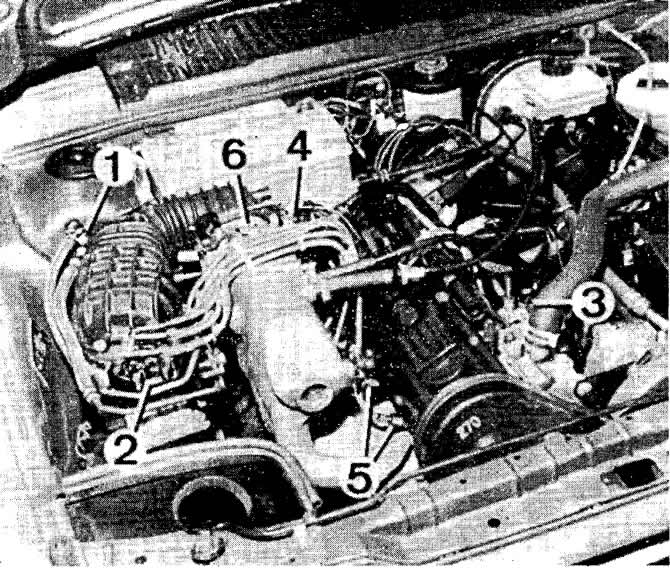
Location of fuel injection system components:
1 - fuel filter;
2 — fuel dispenser-distributor and air flow meter unit;
3 — control pressure regulator;
4 - starting nozzle;
5 - injectors;
6 — throttle body.
Visitor comments