



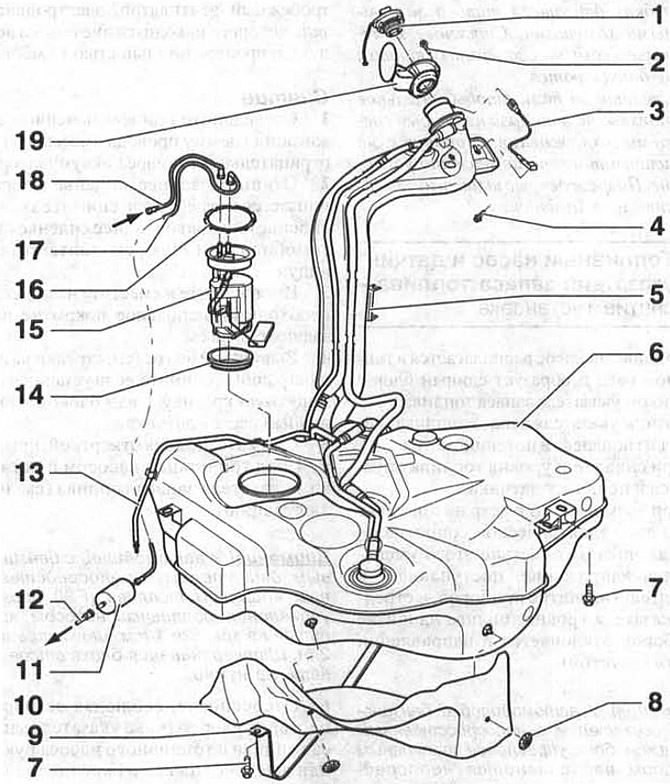
1.0. Fuel tank, fuel pump and fuel filter. The illustration shows the fuel tank of a Golf with a petrol engine and front-wheel drive
1 - fuel tank filler cap. If damaged, the gasket should be replaced with a new one
2 - bolt. Tightening torque 1.5 Nm
3 - connection to "ground" (-). Check the tightness of the terminal fit
4 - bolt Tightening torque 10 Nm
5 - guide
6 - fuel tank. When dismantling the tank, it should be supported with a garage jack. In case of replacing the tank with a new one, air should be removed from the fuel system
7 - bolt Tightening torque 25 Nm. Tightening torque for Touran vehicles with diesel engine is 20 Nm + 90° turn (1/4 turn)
8 - washer
9 - Fuel tank mounting strap. Observe the installation position
10 - protective shield
11 - Fuel filter. Installation position: the arrow on the filter housing shows the direction of fuel flow from the tank to the engine. After installing a new fuel filter, air must be removed from the system
12 - Fuel supply line. Connected to the fuel distribution line in the engine compartment. Make sure the fuel line is firmly seated
13 - ventilation pipe. It is fastened to the side of the fuel tank with clamps. Make sure that the fastening is secure
14 - gland. If damaged, the gland should be replaced. When installed, it is fixed to the mounting site without wetting. Wetting is only necessary when installing the flange
15 - Feed pump and fuel gauge sensor. The pump has a sieve that must be cleaned. Observe the correct installation position of the pump and sensor, following the arrows on the fuel tank.
16 - union nut. Tightening torques: Golf cars - 110 Nm; touran cars - 80 Nm
17 - black fuel supply line. Attached to the side of the tank. Make sure it is securely fastened
18 - blue fuel return line. Attached to the side of the tank. Make sure it is securely fastened
19 - filling neck with rubber bushing
The original article is available at: www.VWmanual.ru
The fuel tank of Golf cars holds about 55 liters (touran cars have about 60 liters).
The tank is located on the bottom of the body in front of the rear axle. The current fuel supply is indicated to the driver by an indicator device on the instrument panel. The fuel tank is ventilated by an exhaust ventilation system. Harmful to the environment gasoline vapors, removed by ventilation from the tank, are captured by the adsorber and from there sent to the engine for subsequent combustion.
Fuel economy
Driving style largely determines fuel consumption. Here are some tips on how to use the accelerator pedal correctly:
- a) move off immediately after starting the engine, even in frosty weather;
- b) turn off the engine when stopping or parking for more than 40 seconds.;
- c) drive in the highest possible gear;
- d) Maintain a steady speed when driving long distances. Avoid high speeds. Assess the road conditions to avoid unnecessary and unnecessary braking;
- d) Do not carry unnecessary cargo. If the roof rack is not in use, remove it;
- e) Maintain the prescribed tire pressure. Do not operate the vehicle with low tire pressure.
Cleanliness and safety rules when working with the fuel system
When working with the fuel supply system, the following cleanliness rules and safety precautions must be carefully observed:
- The connecting joints and the areas around them should be thoroughly cleaned before disconnecting.
- Removed parts should be placed on a clean rag and covered with film or paper. The use of rags with lint is not allowed!
The fuel system is under pressure. Before disconnecting the fuel system hoses, wrap the hose joint with a rag and only then carefully remove the hose, releasing the pressure.
Caution! In vehicles with direct fuel injection engines, pressure can only be released in the part of the system where relatively low pressure is created (up to 4-6 bar). To relieve pressure in the part where high pressure is built up (up to 120 bar), requires special equipment that is only available in workshops. The high-pressure fuel system includes the high-pressure pump, high-pressure lines and fuel injectors. In diesel engines, the temperature of the fuel and fuel lines can reach +100°C in some cases. Allow the fuel to cool before disconnecting the fuel lines.
No open flames or sparks near the workplace! No smoking! The workplace must be equipped with a fire extinguisher! Ensure good ventilation of the workplace. Fuel vapors are toxic.
When performing work, wear protective glasses and use gloves.
Carefully cover or seal any exposed or dismantled parts or components unless further work is to be carried out immediately.
Remove spare parts from packaging immediately before installation. Install only clean parts.
If possible, do not work with compressed air when the fuel system is open. If possible, do not move the vehicle.
Do not use silicone-based sealant. Silicone particles are sucked into the engine but do not burn and can damage the lambda probes.
Fasten fuel hoses to engine pipes using clamping clamps only. Tightening clamps or clamps with a clamping screw are not allowed.
Make sure that diesel fuel does not come into contact with the cooling system hoses. Remove any fuel that comes into contact with the hoses immediately. Replace damaged hoses immediately.
Visitor comments