



Engine oil operating conditions
Depending on the operating conditions, completely different requirements are imposed on engine oils. At the same time, it is quite difficult to accurately determine the effect of various operating conditions on the lubricant. In engines that run for a long time at high engine speeds or at full load, the oil temperature reaches high values. Under the influence of high temperatures and atmospheric oxygen, the oil begins to oxidize. Oxidation products thicken the oil and can be deposited as lacquer films on piston tops, piston ring grooves and valve stems. The latter can lead to coking of the valve discs.
Oil dilution in gasoline engines
If an over-rich air-fuel mixture enters the cylinders, if the engine rarely or never runs at maximum power, if the engine temperature is below operating temperature (city driving), resulting in incomplete combustion. Soot, oil deposits and other products, unburned fuel itself and moisture condensation lead to the formation of sludge, acids and asphalt. Unburned fuel settles on the walls of the cylinders and flows into the crankcase, while the oil film from the surface of the cylinders and pistons is washed off. The result is reduced lubrication of piston and cylinder running surfaces and oil thinning, which degrades the oil's lubricity depending on its fuel content.
If the dilution is too strong, it is necessary, if possible, to undertake an early oil change. Since during extreme trips (with a hot engine) part of the gasoline evaporates from the oil, then it is necessary to control the condition of the oil more often, first of all, in winter (more cold starts - higher proportion of gasoline in oil).
Engine oil viscosity
The viscosity of an oil is understood as its fluidity. Under the influence of temperature, the oil tends to change its fluidity. When heat is applied, the oil becomes liquid. As a result, the bearing capacity and strength of the oil film are reduced. When cold, the oil becomes thicker and less fluid, and its viscosity and internal friction increase. This property requires the use of an oil with a viscosity that changes as little as possible with temperature changes. When the engine is cold, the oil should still be so thin that it does not overly impede the operation of the starter and, after starting the engine, reach all rubbing surfaces as soon as possible.
The fluidity or viscosity of an oil is equivalent to its internal friction and is indicated in accordance with the SAE classification (Society of Automotive Engineers), for example, SAE 30, SAE 10, etc. The higher the number in the oil designation, the more viscous it is. However, the viscosity of the oil does not allow us to draw a conclusion about its lubricating properties.
All-weather oil
All-weather oils are provided for VW PASSAT engines. This has the advantage that the oil does not have to be changed at the start of the new season (summer Winter). All-weather oils are produced on the basis of low-viscosity seasonal oil (e.g. 15W). Thanks to the so-called thickener, the oil is stabilized when hot, so that the required lubricity is achieved in each operating mode. If a multigrade oil is used, modern oils with a wide viscosity range should be used (e.g. 15W-40,15W-50). Designation «W» in the SAE classification indicates the suitability of the oil for operation in winter.
Low friction oil
Low-friction oils are multi-grade oils, which, among other additives, contain friction modifier additives, due to which friction in engine components is reduced and fuel savings of up to two percent can be achieved. Low friction oils have a low viscosity (e.g. 10W-30). The base oil for them is synthetic oil. When buying low-friction oil, you need to pay attention to the fact that it is approved for use by VW / AUDI.
Applications/viscosity classes
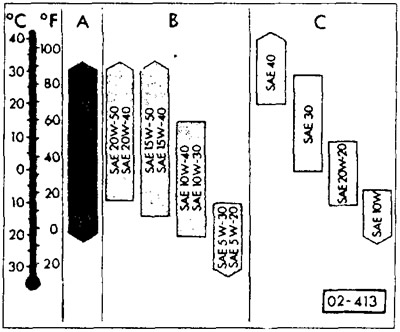
A - heavy-duty engine oils and low-friction oils. In accordance with VW 500 00 and 505 00 standards.
B - all-weather oils. In accordance with the VW 501 01 standard, 5 W oils are only for gasoline engines.
C - seasonal oils.
Since the areas of application of adjacent SAE classes overlap, short fluctuations in the ambient temperature may not be taken into account. It is allowed to mix oils of different viscosity grades with each other if it is necessary to replenish the oil level, and the ambient temperature no longer corresponds to the viscosity grade of the oil in the engine.
Additives - no matter what kind - must not be added to either fuel or lubricating oil.
Engine oil specification
For modern engines, in principle, only HD-Oil heavy-duty engine oils are allowed to be used (Heavy-Duty-Oil). These oils contain chemical additives that significantly improve their lubricating properties. Additives improve corrosion protection, have antioxidant properties, prevent the formation of sludge in the engine crankcase, improve the viscosity, cleaning and dissolving properties of the oil. Cleaning and solvent additives not only reduce the formation of deposits in the engine, but at the same time have the ability to dissolve deposits and keep them and other oil contaminants in a finely dispersed form in suspension, which allows all contaminants to be drained with the oil when changing the oil.
, The quality of engine oil is indicated by the American API system (American Petroleum Institute). The characteristic of the oil is given, depending on the circumstances, in two letters. The first letter indicates the scope: S (Service) - oil is used in gasoline engines; WITH (Commercial) — oil is applied in diesel engines. The second letter indicates the quality in alphabetical order. According to the API specification, SG oil for gasoline engines and CD oil for diesel engines are of the highest quality. Attention: Engine oils with the designation CD, which are designated by the oil manufacturer as oils for diesel engines, are not suitable for gasoline engines. However, there are oils that are suitable for both gasoline and diesel engines. In this case, both specifications are indicated on the oil packaging (e.g. SF/CD).
VW has set its own standards for oils. Only oils that meet these standards should be used. The VW standard is indicated on the oil packaging. If in doubt, you can inquire about approved oils from the seller.
Gasoline engines require multigrade oils meeting the VW 501 01 standard. Low-friction oil according to the VW 500 00 standard can also be used. Multigrade oils (VW 501 01), are usually inexpensive. If an oil of this specification is not available, API-SF or SG specification oil can be used temporarily.
Naturally Aspirated Diesel Engine Oil Specification (65/68 hp): VW 501 01, VW 505 00, API-CD or heavy duty engine oils that simultaneously meet VW 500 00 and 505 00 standards. If there is no oil corresponding to the specified VW standards, an all-season API-CF specification oil can be used to replenish the level.
Oil consumption
In the case of an internal combustion engine, oil consumption refers to the amount of oil that is consumed as a result of the combustion process. Under no circumstances should oil consumption be equated with oil loss, which occurs due to leaks in the oil pan, cylinder head cover, etc.
Normal oil consumption occurs due to its combustion in the cylinder, as well as due to the removal of combustion products and wear particles. In addition, the oil ages under the influence of high temperatures and pressures, which it is constantly subjected to in the engine.
In addition, oil consumption is influenced by external operating conditions, driving mode, as well as manufacturing tolerances. The highest oil consumption should be no more than 1.5 l/1000 km.
Of course, the oil level must be replenished if it drops to the mark «Nachfull» (then a maximum of 1 liter is required for replenishment).
Visitor comments