



Contents: Checking the hydraulic switch at…↓ Checking the hydraulic switch at…↓ Checking oil pressure ↓
The 0.3 bar hydraulic switch has brown insulation. On all 4-cylinder engines it is located on the flywheel side of the cylinder head. On 6-cylinder engines it is located next to the 1.4 bar hydraulic switch on the oil filter flange. Additional 1.8 bar hydraulic switch on 4-cylinder petrol engines (white insulation) and, accordingly, a hydraulic switch at 0.9 bar in diesel engines (gray insulation) installed on the oil filter flange.
Check the oil level.
Check the electrical wires of both hydraulic switches according to the electrical diagram.
Checking the hydraulic switch at 0.3/0.25 bar
Turn the hydraulic switch to 0.3 bar (brown insulation), having first disconnected the electrical wire from it.
Note: From approx. 3/96 on petrol engines with a displacement of 1.8/2.0 l (except 16-valve) instead of a 0.3 bar switch, a 0.25 bar hydraulic switch with blue insulation is installed.
Instead of the hydraulic switch, screw in a suitable pressure gauge.
If a VW measuring device is used, screw the hydraulic switch into the measuring device.
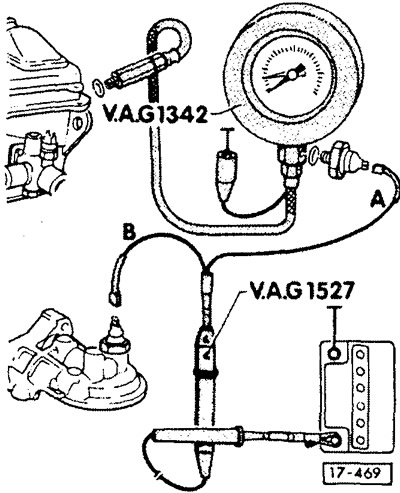
Note: The described test can only be performed if the hydraulic switch can be screwed into the pressure gauge. Otherwise, only the 1.8/1.4 and 0.9 bar hydraulic switches can be tested.
Connect the measuring device to ground using an auxiliary wire.
Connect the plug contact of the hydraulic switch for 0.3/0.25 bar with auxiliary wire "A" through the voltage indicator to the positive terminal of the battery. In this case, voltage should be shown and the control lamp or LED should light.
Start the engine and slowly increase the crankshaft speed.
As soon as the pressure gauge shows a pressure of 0.15-0.45 bar (for 0.3 bar switch) or 0.15-0.35 bar (for 0.25 bar switch), the voltage should switch off and the voltage indicator control lamp should go out. Otherwise, replace the 0.3/0.25 bar hydraulic switch.
Checking the hydraulic switch at 1.8/1.4/0.9 bar
Disconnect the electrical wire from the hydraulic switch.
Connect the plug contact of the switch with auxiliary wire "B" (6-cylinder engine: VW 1594) via a voltage indicator with the positive pole of the battery. When the engine is not running, there should be no voltage, otherwise the hydraulic switch should be replaced.
Start the engine and slowly increase the crankshaft speed.
When the control pressure is reached, voltage should appear and the control lamp should light.
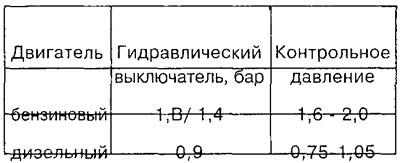
Checking oil pressure
Start the engine and increase the crankshaft speed to 2000 1/min. At an oil temperature of +80°C, the oil pressure should be at least 2.0 bar.
Insufficient oil pressure indicates worn crankshaft bearings.
Insert the hydraulic switch with the sealing ring and tighten to 25 Nm.
Visitor comments