



This provides the following benefits:
- a) engine self-diagnosis, which allows you to quickly detect a malfunction. The system registers emerging malfunctions and if the engine is not operating satisfactorily, it is recommended to contact a workshop, where a special tester will be used to read the registered error codes. These malfunctions can then be purposefully eliminated;
- b) precise dosing of injected fuel. This ensures a reduction in the content of harmful substances in the exhaust gases and reduces fuel consumption, while maintaining good dynamic qualities of the car;
- c) there is no need to regulate the idle speed, as well as the set speed at which the regulator begins to limit the fuel supply.
All engine management system components are designed for long service life and require virtually no repairs.
As part of the maintenance, it is only necessary to change the replaceable filter element of the air filter and the fuel filter.
Adjustments and repairs that affect the operation of a diesel engine are only possible with the help of expensive control and measuring devices, so they should be entrusted to workshops that have the appropriate equipment.
How a diesel engine works
In diesel engines, clean air is sucked into the cylinders and is strongly compressed there. Because of this, the temperature in the cylinders becomes higher than the ignition temperature of diesel fuel. At the moment when the piston is almost at the top dead center, diesel fuel is injected into the air, compressed and heated to about +600°C. The fuel ignites spontaneously, so spark plugs are not needed.
When the engine is cold, compression alone does not achieve the ignition temperature of the fuel.
In this case, the engine must be preheated. For this purpose, each combustion chamber has a glow plug that heats the combustion chamber. The duration of the warm-up depends on the ambient air temperature and is regulated by the engine control unit via the preheating relay.
Caution! Due to the good cold starting ability of the direct fuel injection engine, its preheating is only necessary at air temperatures below 0°C.
The engines that are equipped with Golf/Touran cars have a direct injection system via a "pump-nozzle" unit.
Unlike conventional direct injection, where one high-pressure fuel pump creates pressure to open all the injectors, diesel engines using this scheme have each cylinder with its own injection pump. This injection pump, distribution valve and injector form a single unit, which is called a "pump-injector" (see illustration 1.0).
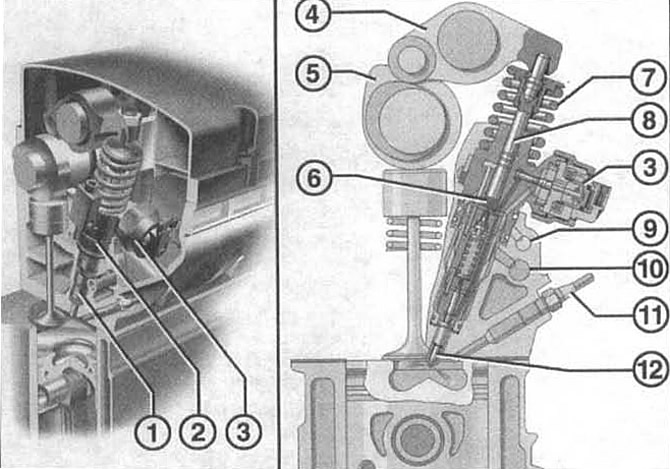
1.0. "Pump-injector" unit
1 - fuel injector
2 - high pressure pump
3 - electromagnetic valve
4 - roller rocker
5 - camshaft cam for intake valves
6 - high pressure chamber
7 - spring
8 - pump piston
9 - fuel return channel
10 - fuel supply channel
11 - glow plug
12 - injector needle
Diesel fuel is drawn from the tank by an electric pump and supplied by a mechanical fuel supply pump to each pump-injector.
The fuel injection pump, together with the vacuum pump, is mounted on the cylinder head and is driven by the camshaft. All four fuel injection pumps in the unit "pump-nozzle" are driven by additional cams on the camshaft via roller rocker arms. Due to the high fuel injection pressure, reaching almost 2000 bar, the fuel is strongly atomized at the moment of injection. The amount of injected fuel is precisely determined by the engine control unit and is fed to the unit "pump-nozzle" via electromagnetic distribution valves.
Due to the high pressure in the pump-injector unit, the fuel heats up significantly, which negatively affects the operation of the fuel gauge sensor.
To cool the fuel, the return fuel line has a radiator attached to the bottom of the vehicle.
Before getting into the high-pressure fuel pump or the "pump-injector" unit, the fuel passes through the fuel filter, where contaminants and condensate are retained. Therefore, it is extremely important to replace the fuel filter in due time, as required by the maintenance conditions.
Attention! Work on the fuel system requires compliance with safety measures and the strictest cleanliness.
Visitor comments