



Cars with a gasoline engine have two lambda probes, one of which is installed in front of the additional catalytic converter, and the second one is installed behind the additional catalytic converter.
Diesel vehicles have only one catalytic converter (see illustrations 1.0, 1.0a, 1.0b, 1.0c, 1.0d, 1.0e).
In case of repair, all parts of the exhaust system can be replaced separately.
Attention! The additional and main mufflers are serially produced as a single unit. However, they can be replaced separately. To do this, the connecting pipe should be cut at the designated place. When installing, the pipe of the new muffler is connected using a tubular clamp, the bolts of which are tightened with a force of 25 Nm.
Vehicles with a BLF engine are equipped with only a second lambda probe with a tightening torque of 50 Nm.
Operation of vehicles with a catalytic converter
To avoid damage to the lambda probe and catalytic converter, it is necessary to strictly follow the following recommendations:
Petrol engines
Use unleaded petrol only.
It is not recommended to perform a forced start of the engine by pushing or towing. If necessary, only one attempt is allowed at a distance of no more than 50 meters. In this case, it is best to use an auxiliary battery. Unburned fuel during ignition can cause overheating and destruction of the catalytic converter. If the engine is warm, then forced starting by pushing or towing is generally unacceptable.
If misfires are observed, it is necessary to avoid high engine speeds and immediately eliminate the malfunction.
Install only the spark plug types recommended by the vehicle manufacturer.
Do not perform spark testing with the spark plug cap removed.
Don't compare cylinders (balance test) by switching off the ignition in the combustion chamber of one cylinder. When switching off in this way, including with the help of a stand for checking the engine operation, unburned fuel gets into the catalyst.
Cars with petrol and diesel engines
Do not park the vehicle over dry leaves or grass. The exhaust system in the area of the catalytic converter is very hot and emits heat even after the engine is turned off.
Do not apply underbody anti-corrosion protection to exhaust system components.
Do not modify the exhaust system heat shields.
If the engine is difficult to start, do not operate the starter for too long. When starting the engine, fuel is continuously injected. In such cases, it is necessary to find and eliminate the cause of the malfunction.
Monitor the amount of fuel in the tank and do not allow it to run empty.
When filling and topping up engine oil, pay special attention to not exceeding the maximum oil level mark on the dipstick. Excess oil gets into the catalyst due to incomplete combustion and can damage the noble metal or completely destroy the catalyst.
Catalyst design
The catalyst is designed to reduce the level of harmful substances in exhaust gases.
It consists of a honeycomb ceramic monolith 2 covered with a protective layer (see illustration 1.0zh). The protective layer contains salts of noble metals, which ensure the exhaust gas cleaning process.
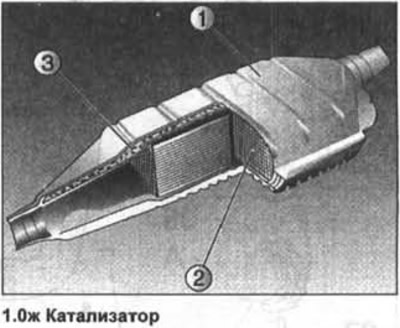
In the body 1 of the catalyst there is a support insulator 3, which compensates for thermal expansion.
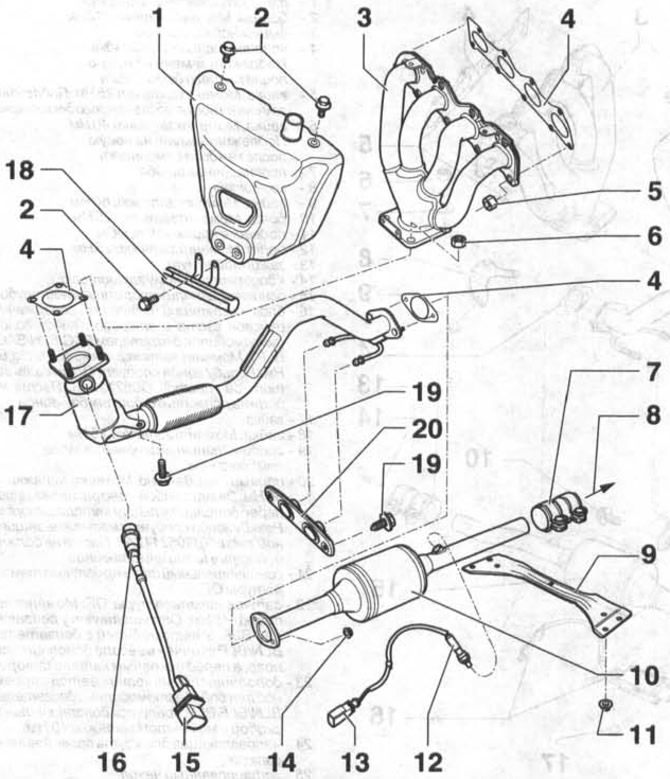
1.0. Exhaust system parts. Cars with 1.4-liter VSA gasoline engine
1 - heat reflective shield
2 - bolts. Tightening torque 10 Nm
3 - exhaust manifold
4 - sealing gasket. Should be replaced with a new one after each dismantling
5 - nut. Tightening torque 25 Nm. To be replaced with a new one after each dismantling
6 - nut. Tightening torque 40 Nm. To be replaced with a new one after each dismantling
7 - clamping clamp. Tightening torque of bolts 25 Nm. Before tightening the bolts of the exhaust pipes, align them and install them without stress. Tighten the bolts/nuts evenly
8 - to additional muffler
9 - support
10 - main catalyst
11 - nut. Tightening torque 23 Nm
12 - the second lambda probe. Tightening torque 55 Nm. The probe thread should be lubricated with protective paste G052112A3. The paste should not get into the lambda probe slot
13 - connecting plug of the second lambda probe. It is located on the right side under the bottom protection
14 - nut. Tightening torque 25 Nm
15 - connecting plug of the first lambda probe
16 - first lambda probe. Tightening torque 55 Nm. This lambda probe is located before the additional catalytic converter. The probe thread should be lubricated with protective paste G052112A3. The paste should not get into the lambda probe slot
17 - additional catalyst with a receiving pipe. Depending on the model, it can be attached with an additional bracket
18 - wire harness guide
19 - bolt. Tightening torque 25 Nm
20 - suspension of the inlet pipe
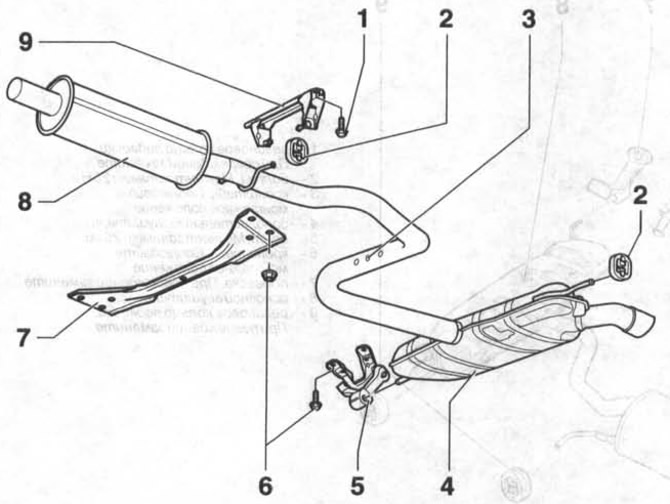
1.0a. Exhaust system parts. Vehicles with 1.4 liter BCA petrol engine
1 - bolt. Tightening torque 25 Nm
2 - rubber suspension ring. Check for damage
3 - the place where the pipe is cut. Marked with notches
4 - main muffler
5 - suspension bracket. If damaged, replace with a new one
6 - support crossbar mounting bolt and nut. Tightening torque 23 Nm
7- support lintel
8 - additional muffler
9 - suspension bracket. Observe the installation position
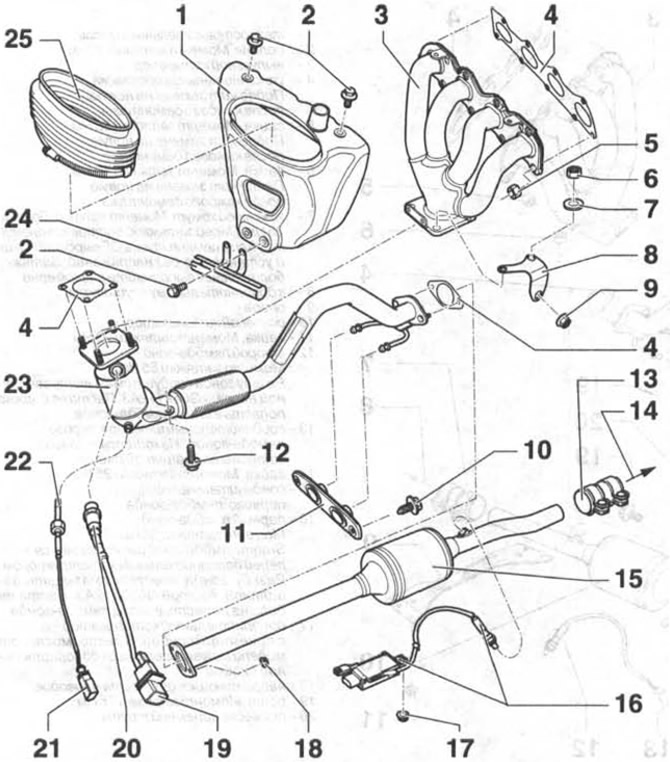
1.0b. Exhaust system parts. Vehicles with 1.4-/1.6-liter FSI petrol engine
1 - heat reflective shield
2 - bolts. Tightening torque 10 Nm
3 - exhaust manifold
4 - sealing gasket. Should be replaced with a new one after each dismantling
5 - nut. Tightening torque 25 Nm. To be replaced with a new one after each dismantling
6 - nut. Tightening torque 40 Nm. To be replaced with a new one after each dismantling
7 - spacer washer B - bracket
9 - nut. Tightening torque 60 Nm
10 - bolt. Tightening torque 25 Nm
11 - suspension of the inlet pipe
12 - bolt. Tightening torque 25 Nm
13 - clamping clamp
14 - to additional muffler
15 - main catalyst with inlet pipe
16 - a block consisting of a nitrogen oxide sensor and a second lambda probe (cars with BKG/BLN/BAG/BLP engine). Tightening torque of the lambda probe is 50 Nm. The probe thread should be lubricated with protective paste G052112A3. The paste should not get into the slot of the lambda probe
17 - nut
18 - nut. Tightening torque 25 Nm
19 - connecting plug of the first lambda probe
20 - first lambda probe. Tightening torque 50 Nm. This lambda probe is located before the additional catalytic converter. The probe thread should be lubricated with protective paste G052112A3. The paste should not get into the lambda probe slot
21 - connecting plug of the exhaust gas temperature sensor
22 - exhaust gas temperature sensor. Tightening torque 45 Nm. Not available for BLF engines. For vehicles with BLN/BLP engines, it is screwed in before the main catalytic converter rather than near the additional one
23 - additional catalytic converter with downpipe. For vehicles with BLN/BLF/BLP engine, it is secured with an additional bracket with a tightening torque of 40 Nm
24 - Generator wiring harness guide
25 - corrugated cover
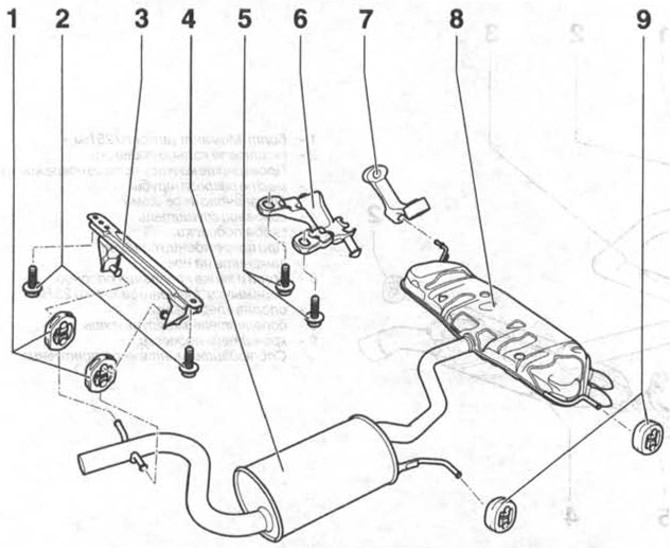
1.0v. Exhaust system parts. Cars with 1.4-/1.6-liter FSI petrol engine
1 - rubber suspension ring. Replace if damaged
2 - bolts. Tightening torque 25 Nm
3 - bracket. Observe the mounting position
4 - additional muffler
5 - bolt. Tightening torque 25 Nm
6 - Bracket. Observe the mounting position
7 - suspension. Replace if damaged
8 - main muffler
9 - rubber suspension ring. Replace if damaged
The original text can be found at: vwmanual.ru
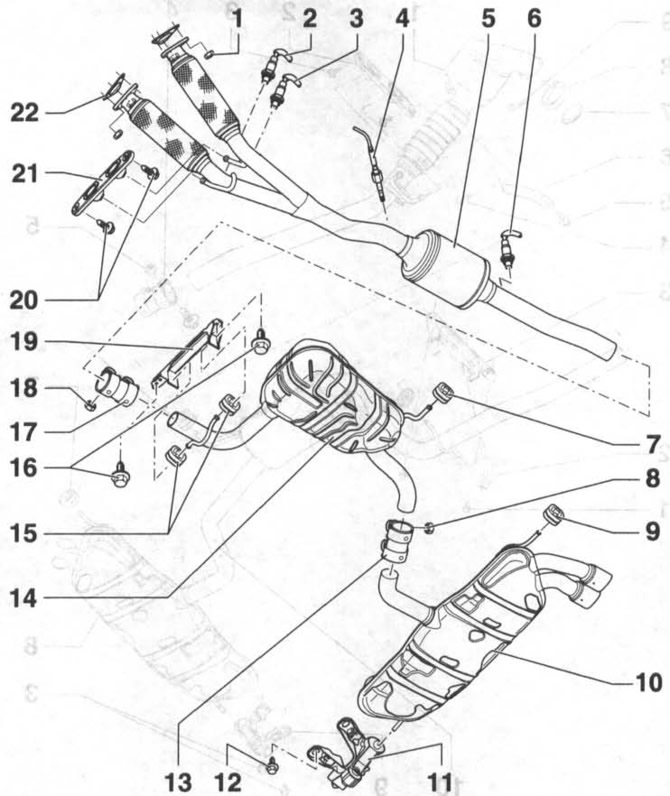
1.0g. Exhaust system parts. Vehicles with 2.0-liter FSI petrol engine
1 - nut. Tightening torque 25 Nm. If damaged, replace. The threads of the exhaust manifold pins should be lubricated with heat-resistant paste
2 - second lambda probe (cars with AXW/BLR/BLX engine) Tightening torque 55 Nm. This lambda probe is located behind the catalytic converter. The probe connector is black. The probe thread should be lubricated with protective paste G052112A3. The paste should not get into the lambda probe slot
3 - second lambda probe (cars with AXW/BLR/BIX engine). Tightening torque 55 Nm. This lambda probe is located behind the catalytic converter. The probe connector is brown. The probe thread should be lubricated with protective paste G052112A3. The paste should not get into the lambda probe slot.
4 - Exhaust gas temperature sensor for vehicles with AXW/BLX engines. Tightening torque 45 Nm. BLY engines have a lambda probe. Tightening torque 55 Nm. The probe connector is brown. The probe thread should be lubricated with protective paste G052112A3. The paste should not get into the lambda probe slot.
5 - Nitrogen oxide storage catalyst for vehicles with AXW/BLX engines. For BLR/BLY engines, a conventional catalyst is located here, attached to the exhaust pipe with a connecting element. The connecting element of the exhaust pipe must not be bent at an angle greater than 10°, because it will be damaged in this case.
6 - nitrogen oxide sensor (cars with AXW/BLX engine). The sensor tightening torque is 60 Nm. The sensor thread should be lubricated with protective paste G052112A3. In BLR/BLY engines, there is a third lambda probe behind the catalytic converter. The probe tightening torque is 55 Nm. The sensor thread should be lubricated with protective paste G052112A3. The paste should not get into the lambda probe slot.
7 - suspension ring. Should be replaced if damaged
8 - nut. Tightening torque 25 Nm
9 - suspension ring. Should be replaced if damaged
10 - muffler. Attention! Additional and main mufflers are serially produced as a single unit. However, they can be replaced separately.
11 - suspension bracket. Should be replaced if damaged
12 - bolt. Tightening torque 25 Nm
13 - clamp. Necessary for connecting the pipes of the additional and main mufflers when replacing one of them. The clamp bolts should be tightened evenly
14 - main muffler. Additional and main mufflers are serially produced as a single unit
15 - suspension ring. Should be replaced if damaged
16 - bolts. Tightening torque 25 Nm
17 - clamping clamp
18 - nut. Tightening torque 25 Nm
19 - suspension bracket
20 - bolt. Tightening torque 25 Nm
21 - suspension bracket. Should be replaced if damaged
22 - sealing gasket. To be replaced after each dismantling
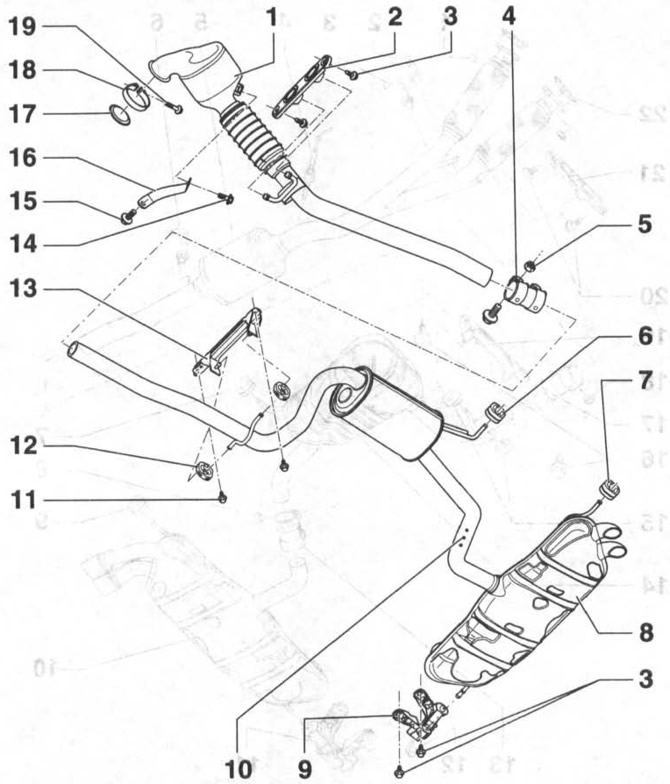
1.0d. Exhaust system parts. Vehicles with 4-valve diesel engine with a volume of 1.9-/2.0 liters
1 - inlet pipe with catalytic converter
2 - suspension bracket. Should be replaced if damaged
3 - bolt. Tightening torque 25 Nm
4 - clamping clamp
5 - nut. Tightening torque 25 Nm
6 - additional muffler suspension ring To be replaced if damaged
7 - main muffler suspension ring. Should be replaced if damaged
8 - additional and main mufflers. In case of replacement they can be installed separately
9 - suspension bracket with ring
10 - the place where the pipe is cut. Marked with notches
11 - bolt. Tightening torque 25 Nm
12 - suspension ring. Should be replaced if damaged
13 - suspension bracket
14 - bolt. Tightening torque 40 Nm
15 - bolt. Tightening torque 40 Nm
16 - support crossbar
17 - seal. To be replaced after each dismantling. Observe the installation position
18 - clamp
19 - clamp bolt. Tightening torque 7 Nm
Visitor comments