



To separate the pipe connecting them, a pipe cutter is usually used, for example, HAZET 4682. If there is no pipe cutter, then the pipes can be sawed with a hacksaw for metal.
Attention! If the muffler pipe cannot be removed from the clamp, the connecting pipe can be cut, stepping back about 5 cm from the clamp, and then knock out the rest of the pipe with a hammer and chisel, having previously sawed it lengthwise. If you have a welding machine, the connecting clamp can be heated with a torch, which will allow you to remove the muffler pipe without much difficulty.
Warning! When using a welding machine, cover the bottom of the car with aluminum sheets. Fire hazard. Keep a fire extinguisher ready!
1. Place the vehicle on jack stands.
Warning! Jacking up or jacking up a vehicle can pose a risk of injury. Refer to the safety precautions in the chapter "Jacking up a car".
The place where the pipe is disconnected is marked (see arrows in illustration 3.0). The pipe is cut at the middle mark (arrow 2). The side marks, indicated by arrows 1 and 3, serve as orientation so that they can be correctly secured in the connecting clamp 4 later (see illustration).
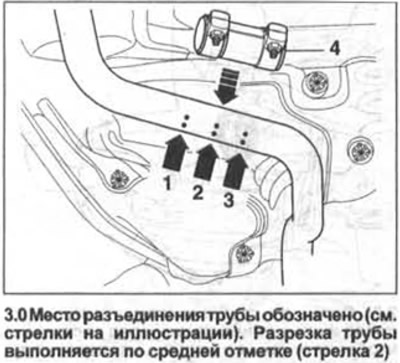
2. Place the pipe cutter chain along the middle mark (arrow 2 in illustration 3.0) on the pipe and secure it. Check that the chain moves easily on the pipe. If the chain is too tight, the pipe cutter may deform the pipe.
3. Release the muffler from the rubber suspension mounts and remove it.
Installation
4. Secure the muffler to the rubber suspension mounts.
To connect the pipes, a clamp is used, supplied as a spare part (see illustration 2.17).
Attention! The old clamp must be replaced with a new one after each dismantling. When purchasing a new clamp, remember that the diameter of the exhaust pipes is not the same for different models. Install the clamp on the pipe joint as shown in illustrations 2.17. In this case, the end of the bolt rod should not protrude beyond the edge of the clamp (see arrow on illustrations 2.17).
The threaded connection of the clamp must face the rear. On vehicles with a 2.0 litre BDK diesel engine, the threaded connection of the clamp must face the left when viewed in the direction of travel.
5. Straighten the exhaust system.
6. Tighten the clamp bolt nuts.
Tightening torques:
- cars with petrol engine - 25 Nm
- diesel vehicles, M8 bolts - 25 Nm
- diesel vehicles, M10 bolts - 40 Nm
7. Lower the car onto its wheels.
Checking the tightness of the exhaust system
8. Start the engine and, while the engine is running, plug the exhaust pipe with a rag or a suitable plug.
9. Check the operation of the exhaust system by ear.
If necessary, apply leak detection spray to the joints between the cylinder head and exhaust manifold, and the exhaust manifold and downpipe.
Make sure that no air bubbles form in the indicated areas.
10. Eliminate any leaks found.
Visitor comments