



Rotor 11 (figure 4.3) together with the excitation winding, it rotates inside the stationary stator winding 13 at a speed double that of the engine. The excitation current flows through the carbon brushes 16 and the copper rings of the rotor to the excitation winding. This creates a magnetic field. Together with the rotation of the rotor, the position of the magnetic field in relation to the stator winding constantly changes. Due to this, an alternating three-phase current is formed in the stator winding, which is replaced by a direct current in the diode rectifier 18. The diodes are fixed to the plate. Depending on the state of charge of the battery, the voltage regulator changes the magnitude of the charging current by switching the excitation current on and off. At the same time, the regulator maintains a constant charging voltage at the application level of 14. V, regardless of the engine rotation speed.
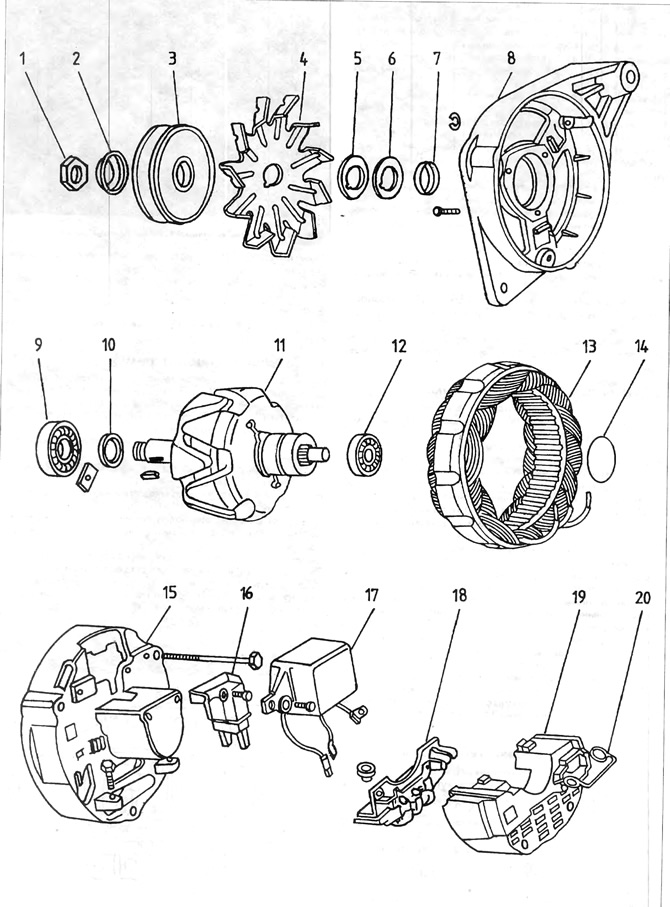
Figure 4.3. Motorola AC generator
1 - pulley nut; 2 - washer, 3 - pulley; 4 - fan; 5, 6 and 7 - washers; 8 - Front bearing cover; 9 - ball bearing; 10 - spacer washer; 11 - rotor; 12 - ball bearing; 13 - stator winding; 14 - O-ring type sealing ring; 15 - back cover; 16 - brush holder; 17 - voltage regulator; 18 - plate with diodes; 19 - plastic cover; 20 - spring latch.
Visitor comments