



The elements are connected to each other, and the conical ends forming the positive and negative poles of the battery are directed to the opposite fingers of the first and last elements. The capacity of the battery is its ability to accumulate an electric charge. It depends on the size and number of plates in one element, the density and temperature of the electrolyte, and also on the strength of the discharge current.
1. The electrolyte level should be checked once a week in summer and once a month in winter.
2. The fluid level should be 5 mm above the plates. If there are markings on the battery case that determine the required electrolyte level, then the electrolyte must be added according to these markings. Add only distilled water.
3. If the electrolyte level is very high, it may splash out of the battery during continuous charging with high current (for example, during long journeys during the day). A very low electrolyte level reduces the battery life, as sulphation of the plates is possible.
4. Knowing the density of the electrolyte together with the voltage value allows you to accurately orient yourself regarding the state of charge of the battery. A hydrometer is used to measure the charge of the battery. The greater the value of the characteristic mass of the sucked-in electrolyte, the more the float emerges. The density of the electrolyte is read on the scale as a characteristic (own) mass (p/ml).
5. The freezing temperature depends on the density of the electrolyte. Density of the electrolyte Freezing temperature
1.10 p/ml 10°C
1.18 p/ml 24°C
1.28 p/ml 57°C
Warning: The battery discharges when not in use. If the battery is not checked and recharged in a timely manner, the plates will become damaged. If the car is parked for several weeks, the battery must be discharged every 4 weeks (for example, a low beam lamp) and charge it again until it shows fully charged.
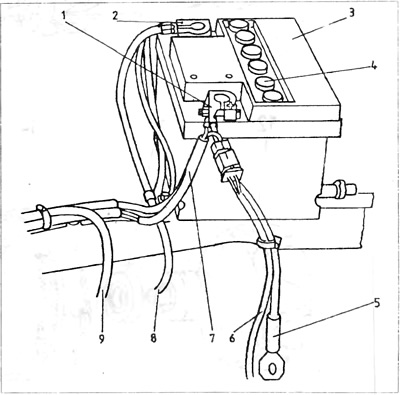
Figure 4.1. Battery
1 - positive battery pole; 2 - negative battery terminal (ground clamp); 3 - battery case, 4 - holes of individual elements; 5 - to the starter; 6 - to the D+ terminal of the generator; 7 - power supply to the fuse box; 8 - wire to ground of gearbox; 9 - front right wire harness.
Visitor comments