



Wheel alignment. Compared to many other cars, this model has slightly further front wheels than rear wheels when stationary. This is called negative toe-in. The friction force between the wheel and the road tends to move the left wheel to the left and the right wheel to the right. The front wheel drive, on the other hand, tends to bring these wheels closer together. When driving on a curved road, the negative toe-in is amplified by the trapezoidal steering system. The wheel inside the curve turns more around than the wheel outside the curve. This is also necessary, since on a curved section, the inner wheels must travel along a smaller radius than the outer wheels.
Wheel alignment - this is the position of the front wheels when viewed from the front. The wheels of the models described have a greater distance from each other at the top, in the wheel well, than at the bottom, at the base. This is a positive camber or camber angle, to use special terms.
Transverse inclination of kingpin - is a slight tilt of the wheel pivot axis. Both swing axles have a smaller distance from each other at the top than at the bottom. The camber of the wheels and the transverse tilt of the kingpin additionally prevent wheel vibration. In addition, they facilitate the rotation of the wheels to the initial position. This means the desire of the front wheels to move independently, figuratively, to a straight position after passing a curved trajectory.
Longitudinal inclination of the steering wheel kingpin - this is the inclined position of the wheel rotation axis in the longitudinal direction. This also helps to stabilize straight-line movement and prevents vibration of the front wheels.
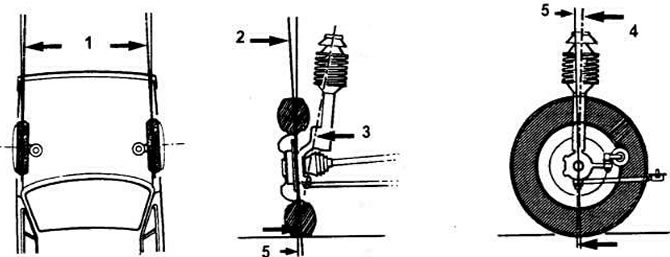
Illustrations are provided for a better visual representation of the concepts being explained: 1 - wheel alignment; 2 - wheel alignment; 3 - transverse inclination of the kingpin; 4 longitudinal inclination of the kingpin; 5 - perpendicular inclination of the kingpin.
The information is posted on this resource VWmanual.ru
Visitor comments