
English Русский
Български
Беларускі
Український
Српски
Hrvatski
Română
Polski
Slovenský
Magyar
  |  Articles  |  Sitemap  |  Contacts  |    |
Car maintenance Ford Car maintenance Hyundai Car maintenance Chevrolet Car maintenance BMW Car maintenance Audi Car maintenance Opel Car maintenance AvtoVAZ
VWmanual.ru


Main   Passat   Golf   Polo   Touareg   Tiguan   Sharan   Transporter   Others  
Golf 1 (1974-1984, diesel) Golf 1 (1974-1984, petrol) Golf 2 (1984-1993, petrol) Golf 2 (1984-1993) Golf 3 (1991-1997) Golf 4 (1997-2004) Golf 5 (2003-2008)

Replacing the rear axle (VW Golf 1)

  • Main
  • Golf
  • Golf 1
  • Chassis
  • Suspension and wheels
  • Replacing the rear axle
            0


The rear axle is attached to the body using two struts. Before unscrewing the lock nuts, the spacer bolts should be treated with a rust solvent. If the spacer bolt breaks off, then this place should be cut off. The remains of the spacer bolt are drilled out with a drill with a diameter of 8 mm. A threaded hole M10 is drilled in the sheet.

For fastening, use a screw M10x40 of accuracy class 10.9. If during disassembly it was discovered that the rear axle support near the body was rusted, this place should be reinforced by welding the corresponding part

Raise the car onto supports.

Disconnect the handbrake cables at the handbrake lever (see chapter "Brakes": only for complete removal of the axle).

Disconnect the brake hoses on the right and left axles.

Unscrew 2 lock nuts on the rear axle struts, loosen the nut, but do not unscrew it completely.

Remove the exhaust system holders.

Lower the car and support the rear axle.

Disconnect the shock absorber struts either at the top of the body or at the bottom of the axle. Completely unscrew the strut nuts.

The original can be seen on the portal (VWmanual.ru)

Raise the car slowly.

When installing, check: the rear axle struts are installed correctly (the angle should be as indicated above). Make adjustments if necessary.

To install the shock absorbers in the body, carefully lower the car.

Tighten the nuts to a torque of 45 Nm.

After assembly, bleed the brake system.
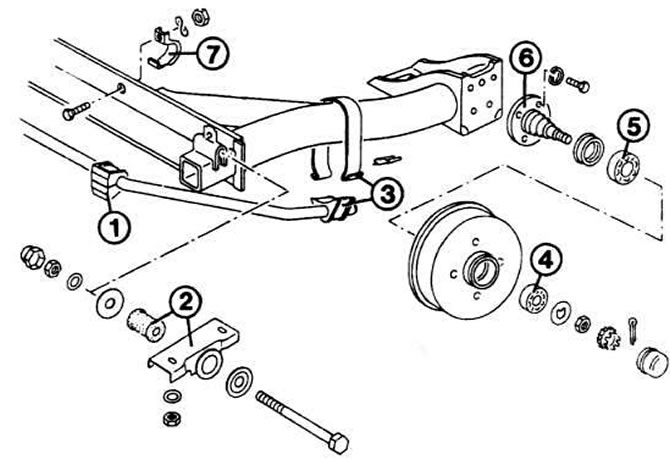
Rear axle details: 1 - rubber stabilizer support; 2 - support stand; 3 - clamp bracket outside; 4 -…

Rear axle details: 1 - rubber stabilizer support; 2 - support stand; 3 - clamp bracket outside; 4 - outer wheel bearing; 5 - inner bearing; 6 - wheel axle.

This article is available at russian, bulgarian, belarusian, ukrainian, serbian, croatian, romanian, polish, slovak, hungarian
The text has been checked: Medvedeva Elena

Share information:

Previous articles
Replacing the rear shock absorber and coil spring
Replacing the rear shock absorber
Measuring angles when installing wheels
Signs of improper wheel installation
Wheel angle adjustment
Replacing the shock absorber and spring
Next articles
Replacing the rear axle strut
Removal wheel bearings
Adjusting the wheel bearing play
Replacing the wheel axle


Similar articles from other manuals for VW cars:
General information about the rear axle Passat B3 (1988-1993)
Rear seats Polo 3 (1995-2003)
Replacing the PTO/Rear Propeller Shaft Flange Seal (Transfer… Touareg 1 (2002-2006)
Removal and installation of rear axle ABS system components… Tiguan 1 (2007-2015)
Replacing rear brake pads Sharan 1 (1995-2000)
Rear Axle — General Description Transporter T3 (1979-1992)
Replacing torsion bars (rear axle with independent suspension) Beetle (1960-1986)
Link to this page in different formats


Visitor comments


No comments yet


How much will 39 + 18 =


Golf 5 
  • General information
  • User manual
  • Maintenance
  • Troubleshooting
  • Power unit
  • Engine repair
  • Cooling and ventilation system
  • Fuel system
  • Ignition system
  • Transmission
  • Clutch
  • Mechanical gearbox
  • Automatic gearbox
  • Chassis
  • Brake system
  • Car suspension
  • Steering
  • Body
  • Interior (internal elements)
  • Exterior (external elements)
  • Doors and covers
  • Electrical equipment
  • Power devices
  • Washers and wipers
  • Lighting and appliances
  • Electrical circuits
Golf 4 
  • General information
  • User manual
  • Weekly checks
  • Maintenance
  • Power unit
  • Petrol engines
  • Diesel engines
  • Cooling system
  • Fuel system (petrol)
  • Control system (petrol)
  • Fuel system (diesel)
  • Exhaust system
  • Transmission
  • Clutch
  • Car gearbox
  • Drive shafts
  • Chassis
  • Car suspension
  • Steering
  • Wheels and tires
  • Brake system
  • Body
  • Exterior (external elements)
  • Interior (internal elements)
  • Ventilation and heating
  • Car doors and sunroof
  • Washers and glass cleaners
  • Electrical equipment
  • Power devices
  • Lighting and appliances
  • Electrical circuits
Golf 3 
  • Petrol engine
  • Engine repair
  • Lubrication system
  • Cooling system
  • Ignition system
  • Diesel engine
  • Engine repair
  • Diesel injection system
  • Pre-glow system
  • Transmission
  • Clutch
  • Gearbox and drive shafts
  • Chassis
  • Steering
  • Wheels and suspension
  • Brake system
  • Electrical equipment
  • Lighting and appliances
  • Electrical circuits
Golf 2 
  • General information
  • Introduction to guide
  • User manual
  • Petrol engines 1.3 l
  • Engine repair
  • Lubrication system
  • Cooling system
  • Carburetors
  • Supply system
  • Ignition system
  • Petrol engines 1.6/1.8 l
  • Engine repair
  • Supply system
  • Ignition system
  • Diesel engines
  • Engine repair
  • Lubrication system
  • Cooling system
  • Power and exhaust system
  • Transmission
  • Clutch
  • 4-speed gearbox 084
  • 5-speed gearbox 085
  • 4-speed gearbox 020/4R
  • 5-speed gearbox 020/4T
  • Automatic gearbox
  • Drive shafts
  • Chassis
  • Steering
  • Car suspension
  • Brake system
  • Body
  • Body elements
  • Doors, locks and windows
  • Electrical equipment
  • Equipment and devices
  • Power devices
Golf 2 (petrol) 
  • General information
  • Characteristics
  • Car care
  • Maintenance
  • Power unit
  • Engine repair
  • Engine 1.05/1.30
  • Engine 1.60/1.80
  • Cooling and lubrication system
  • Power and exhaust system
  • Transmission
  • Clutch
  • Car gearbox
  • Drive shafts
  • Chassis
  • Brake system
  • Steering
  • Suspension
  • Body
  • Body and equipment
  • Electrical equipment
  • Lighting and appliances
  • Electrical circuits
Golf 1 (petrol) 
  • General information
  • Characteristics
  • User manual
  • Maintenance
  • Power unit
  • Engine adjustment
  • Engine 1.1/1.3
  • Engine 1.5/1.6/1.8
  • Engine electrical equipment
  • Cooling system
  • Fuel system
  • Transmission
  • Clutch and manual gearbox
  • Automatic gearbox
  • Chassis
  • Steering
  • Front suspension
  • Rear suspension
  • Brake system
  • Electrical equipment
  • Lighting and appliances
  • Electrical circuits
  • Body
  • Body and equipment
  • Optional equipment
Golf 1 (diesel) 
  • General information
  • Specifications
  • Maintenance
  • Power unit
  • Engine repair
  • Exhaust and turbocharger
  • Cooling system
  • Fuel system
  • Fuel injection system
  • Transmission
  • Clutch and drive shafts
  • Car gearbox
  • Chassis
  • Suspension and wheels
  • Steering
  • Brake system
  • Wheels and tires
  • Body
  • Heating and ventilation
  • Exterior (external elements)
  • Interior (internal elements)
  • Doors and windows
  • Electrical equipment
  • Equipment and devices
  • Lighting system
  • Power devices
  • Electrical circuits
VWmanual.ru © 2016-2026 | Mobile version | News and articles | Sitemap: EN BG BY UA RS HR RO PL SK HU | Write message | Site search
Passat B2 • Passat B3 • Passat B4 • Passat B5 • Passat B6 • Golf 1, diesel • Golf 1, petrol • Golf 2, petrol • Golf 2 • Golf 3 • Golf 4 • Golf 5 • Polo 3 • Polo 4 • Touareg 1 • Tiguan 1 • Sharan 1 • Transporter T3 • Transporter T4 • LT 28 • LT 2D • Beetle • Caddy 3 •
Our website uses cookies to ensure functionality and convenience.