



The coolant consists of 60% water and 40% low-temperature concentrate G12 A8D (low-temperature composition based on ethylene glycol with anti-corrosion additives). This mixture not only ensures the engine cooling system operates at temperatures down to -25°C, but also protects parts from corrosion, especially parts made of light alloys. In addition, this mixture prevents scale formation and significantly increases the boiling point of the coolant.
Therefore, the content of low-temperature concentrate should not be reduced by using water for topping up even in warm seasons and in countries with warm climates. The proportion of low-temperature concentrate should be at least 40%.
If, in severe climate conditions, higher frost resistance of the coolant is required, the proportion of G12 A8D concentrate can be increased, but only to 60% (the freezing point of the coolant in this case will be about -40°C), since with a higher proportion of low-temperature concentrate, the freezing point of the coolant will begin to increase, and, in addition, the heat capacity and thermal conductivity of the coolant will deteriorate.
As a low temperature concentrate, only our G12 A8D formulation or a concentrate with the specification TL-VW 774 D should be used (pay attention to the inscription on the container).
Other concentrates may, above all, be significantly aggressive towards anti-corrosion coatings.
Corrosion of metal parts caused by these concentrators can lead to coolant leakage, which in turn can cause serious damage to the engine.
Only our G12 A8D formulation should be used as a low temperature concentrate.
Warning: When topping up the coolant, please note that under no circumstances should G12 be mixed with other low-temperature concentrates (also with the G11 composition).
[The text is copied from this portal: www.VWManual.ru]
You can determine the G12 composition by the red color of the coolant in the expansion tank. If the coolant in the expansion tank is brown, then the G12 composition is mixed with another low-temperature concentrate! In this case, you must replace the coolant!
Otherwise, serious problems with engine operation may occur!
Checking the coolant level and density
Warning: Never open the engine hood when you see steam coming out of the engine compartment or coolant leaking out – there is a risk of burns! Wait until there is no more steam escaping or coolant leaking.
The expansion tank of the engine cooling system is located in the engine compartment.
The coolant level can only be checked correctly when the engine is off.
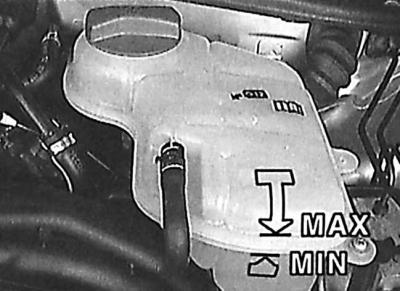
The coolant level when the engine is cold should be between the min and max marks on the expansion tank; when the engine is warm, the level may also be slightly above the max mark.
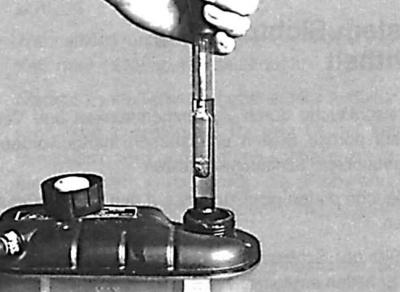
To check the density, you need to use a coolant hydrometer.
Loss of coolant
A significant decrease in the coolant level gives grounds to assume, first of all, a breach of the seal tightness. In this case, the engine cooling system should be checked immediately at a Volkswagen service center. It is absolutely not enough to limit yourself to just topping up the coolant.
In a cooling system with good seals, a decrease in the coolant level can only occur when the liquid boils and is thrown out when the engine overheats.
Topping up the coolant
First, turn off the engine and let it cool down. Then cover the expansion tank cap with a rag and carefully unscrew it counterclockwise.
If under the circumstances you do not have low-temperature concentrate G12 A8D, do not add any other concentrate to the system. In this case, only water can be added, at the first convenient opportunity it is necessary to restore the required composition of the cooling liquid by adding the recommended low-temperature concentrate.
If there is a large loss of coolant, it should be topped up only when the engine has cooled down to avoid engine damage.
Warning: Do not fill the coolant above the max mark: excess liquid will expand and flow out of the cooling system through the safety valve located in the plug.
Warning: Tighten the expansion tank cap securely.
Visitor comments