



Contents: Viscosity and specifications ↓ Qualities of motor oils ↓ Motor oil additives ↓ Mixing the oil ↓
Viscosity of motor oils
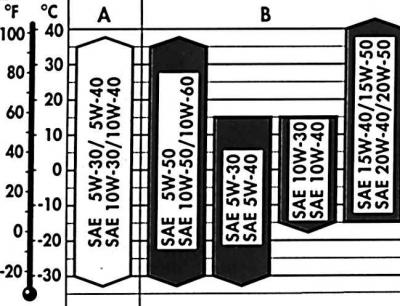
Viscosity and specifications
At the manufacturer's plant, the engine is filled with a special high-quality all-season oil, which is suitable for use at all times of the year, with the exception of particularly cold climate zones.
When adding oil to the engine, you can also add oil of one specification to oil of another specification. The viscosity class of the oil should be selected in accordance with the data in Fig. Viscosity of motor oils. If the air temperature only briefly exceeds the temperature limits given here, the oil should not be changed.
Petrol engines
A – all-season oils with improved antifriction properties, specification VW 500 00.
B – all-season oils, specification VW 501 01;
– all-season oils, API-SF or SG specifications.
Diesel engines
A – all-season oils with improved antifriction properties, specification VW 500 00 (for turbocharged diesel engines only in mixture with specification VW 505 00).
B – all-season oils, specification VW 505 00 (unlimited for all diesel engines);
- all-season oils, API-CD specification (for turbocharged diesel engines only if absolutely necessary for topping up);
- all-season oils, specification VW 501 01 (for turbocharged diesel engines only in mixture with specification VW 505 00).
Qualities of motor oils
All-season oils according to VW standards 501 01 and 505 00 are relatively inexpensive oils with the following qualities:
- year-round use in temperate climate zones;
- excellent cleaning properties;
- good lubricating ability at all temperatures and engine loads;
- high stability of initial properties over a long period of time.
All-season oils with improved anti-friction properties according to the VW 500 00 standard also have additional advantages:
- year-round use at almost all possible outdoor temperatures;
- low engine power losses due to friction;
- facilitating cold engine starting - also at very low temperatures.
Warning: Due to their specific viscosity-temperature properties, monograde oils cannot usually be used all year round. Therefore, these oils should only be used in extreme climate zones.
Warning: When using SAE 5W-30 grade all-season oils, prolonged high-speed engine operation and constant high engine loads should be avoided. These restrictions do not apply to all-season oils with improved antifriction properties.
Motor oil additives
No friction reducing additives should be added to motor oils.
Mixing the oil
This and similar questions interest many car enthusiasts. The answer to the first one is, unfortunately, no, even if these are oils from companies with a "world-famous" name (Shell, Mobil, British Petroleum). Each company produces commercial oils, adding a whole range of additives to the oil base, the chemical composition of which is kept a closely guarded secret. Therefore, many high-quality oils of the same purpose, manufactured according to the requirements regarding the operational and technical properties of the international API classification and the European CCMS-ACEA specification, but according to the technologies of different companies, when mixed are capable of creating low-quality mixtures due to the interaction and mutual destruction of additives, that is, the "incompatibility" of additives. Oils of different companies are interchangeable, the possibility of using such oils is often indicated by engine builders. But this does not mean that they can be mixed. The API classification and the ACEA specification imply mandatory identical testing methods (laboratory, bench - motor, etc.) of oils of different companies. If desired (or necessity) engine makers may introduce additional tests (or more stringent conditions) to these classifications.
The same applies to mixing mineral or synthetic oils (sometimes even from the same company). Synthetic oils can have a hydrocarbon composition (in such cases, oils from the same company can be mixed, which is what the oil manufacturer recommends and for which it is responsible), different chemical composition. Unfortunately, it is not uncommon for oils to deteriorate in quality when mixed. As a result, the engine may "knock" because the mixture of incompatible oils turns into "jelly".
An even more negative answer to the question about the possibility of mixing imported and domestic oils, especially those made with the addition of "domestic" additives. Neither the seller nor the consumer knows the composition of the additives that are in the oils. Some oils of "domestic origin" are produced by "companies" that do not have even basic knowledge of petroleum products. Sometimes such "specialists" use waste oils (even without proper regeneration) to the production of "commercial". At the same time, the corresponding quality. Therefore, advice on the possibility of mixing oils should be given very carefully!
No "cleaners" ("Tokron" and others) are able to increase the octane number of gasoline. For this purpose, special additives are used - antiknock agents, which are added during the production of gasoline at oil refineries, or additives. The cause of detonation (a metallic knock is heard while the engine is running) and glow plug ignition (the engine continues to run when the ignition is off) there may be carbon deposits in the combustion chamber.
The increase in compression in the system "with the introduction of certain additives" occurs not due to viscosity additives, since they do not have them in their composition, but for other reasons.
It is not advisable to reduce oil consumption in an old engine and increase compression in the cylinders by using high-viscosity oils, since this will initially lead to an increase in compression in the cylinders, but not for long. In the future, engine repairs will be more expensive.
The reason for "acoustic noise" in an old engine is its wear. Therefore, it will be cheaper to repair with subsequent use of high-quality oil. It is possible to "reduce" the gaps with additives, but the expediency of this should be understood in order not to harm the engine.
Briefly about "marine oils" and the possibility of their use in "automobile diesel engines". There are different oils. Special marine oils for diesel engines belong to group E, for example, M-16E30, M-16E60, M-20E60, intended for low-speed diesel engines running on high-sulfur high-viscosity fuel - fuel oil. These oils have technical and operational properties (quality indicators), different from the quality indicators of oils for automobile diesel engines, so their use in automobile diesel engines is impossible. There are marine oils of group D, for example, M-10DCL20, M-14DCL20, M-14DCL30, which are used in diesel engines running on high-sulfur fuel. The oils are water-resistant, but have an increased alkaline number and high ash content. For automobile diesel engines, this is increased engine wear, which over time may not pay off with free oil. M-16DR oil for marine diesel engines that run on distillate fuel - diesel fuel with increased viscosity compared to the viscosity of automobile fuel and a sulfur content of up to 0.5%, can be used in automobile diesel engines in the summer (for heavy trucks, not passenger cars).
It is necessary to make it a rule: to use high-quality oil of the same brand corresponding to the engine (by classification) and don't risk mixing it with the same synthetic (or semi-synthetic) oil. The engine will thank you for this with reliable operation. Do not buy oil from hands, as the packaging is easy to counterfeit.
Visitor comments