
English Русский
Български
Беларускі
Український
Српски
Hrvatski
Română
Polski
Slovenský
Magyar
  |  Articles  |  Sitemap  |  Contacts  |    |
Car maintenance Ford Car maintenance Hyundai Car maintenance Chevrolet Car maintenance BMW Car maintenance Audi Car maintenance Opel Car maintenance AvtoVAZ
VWmanual.ru


Main   Passat   Golf   Polo   Touareg   Tiguan   Sharan   Transporter   Others  
Passat B2 (1981-1988) Passat B3 (1988-1993) Passat B4 (1988-1996) Passat B5 (1996-2005) Passat B6 (2005-2010)

Checking/adjusting idle speed and CO content K-Jetronic (VW Passat B3)

  • Main
  • Passat
  • Passat B3
  • Power unit
  • Petrol injection system
  • Checking/adjusting idle speed and CO content K-Jetronic
            0


K-Jetronic, engine with the designation KR


Note: For engines with the KE-Motronic system, designated 9A, the idle speed is only checked, but not adjusted. In addition, before checking, it is necessary to interrogate the memory device of the control unit, for which you should contact a VAG workshop. The prescribed values are: for the idle speed of the crankshaft - 800 ±100 1/min, for the CO content measured through the sampling pipe in the engine compartment - 0.2-1.2% by volume. Testing and adjustment conditions (4 subsequent points) as with the K-Jetronic system.


Warm up the engine until the engine oil temperature is not lower than +80°C.

Turn off all electrical consumers, including the air conditioning system.

If the fuel lines have been disconnected or replaced, before checking, the engine shaft must be brought to a speed of 3000 1/min several times, and then the engine must be left to idle for at least two minutes.

Check the ignition timing, see chapter "Ignition system".
Check the ignition timing, see chapter «Ignition system».


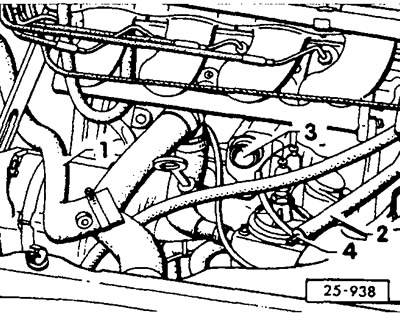
Disconnect hoses -1 and -2 of the crankcase ventilation system from the breather housing and lay them so that only fresh air can be sucked in. Loosen the hose clamps beforehand. Connecting element "4" with a calibrated hole must remain in hose "2".


The idle speed stabilization system control valve should vibrate and buzz. If necessary, check the stabilization system, see below.

Attention: Connect the devices only when the ignition is off.


Connect the tachometer and CO measuring device in accordance with the service manual, paying attention to the safety precautions when working with electronic ignition systems, see chapter "Ignition system".

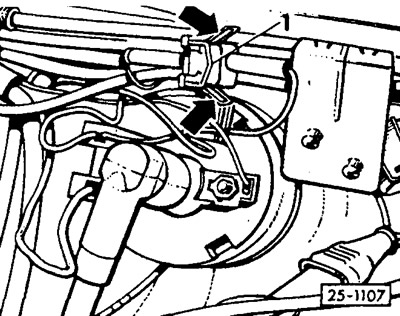
Disconnect plug connector "1" near the ignition coil.
Disconnect plug connector «1» near the ignition coil.


Attention: When carrying out inspection and adjustment work, the cooling system fan must not rotate.


Check the crankshaft speed at idle. Specified value: 1000 ±50 1/min.

Check the CO content. The prescribed value is 1.0 ±0.5% by volume.
Check the CO content. The prescribed value is 1.0 ±0.5% by volume.


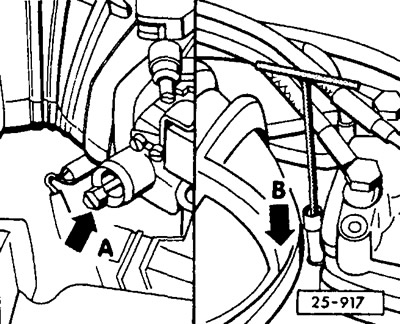
If necessary, adjust the above parameters by alternately rotating the idle speed adjustment screws "A" and the CO content "B".


Pull out the safety cap of the CO adjustment screw. To do this, drill a 2.5 mm drill into the cap and screw a 3 mm screw into the drilled hole. Use pliers to pull out the cap by the screw.

Adjust the CO content using a 3 mm Allen key (arrow), e.g. HAZET 4516.

Caution: When adjusting the CO content, do not press the adjusting screw down or, respectively, do not lift it. Do not apply gas when the adjusting key is inserted (danger of bending).


After each adjustment, remove the adjusting key immediately and briefly apply gas.

Caution: If the engine speed is not regulated to the specified value, check the idle speed control system.


After adjustment, insert a new safety cap using the pin.

Reconnect the high tension wire near the ignition coil.

Connect the crankcase ventilation hoses to the cylinder head and secure with clamps.

Note: If the CO content has now increased, the reason is not incorrect adjustment, but rather the enrichment of the combustible mixture due to the influx of gasoline vapors from the crankcase, where gasoline gets mainly during short-distance trips.


During long, continuous trips, the proportion of gasoline in the engine oil decreases, and the CO content in the exhaust gases returns to normal. This can also happen quickly after about a 30-minute trip or another oil change.

Measuring instruments must be switched off when the ignition is off.

This article is available at russian, bulgarian, belarusian, ukrainian, serbian, croatian, romanian, polish, slovak, hungarian
The text has been checked: Medvedeva Elena

Share information:

Previous articles
KE-Motronic injection system
K-Jetronic injection system
Electrical test of the Digifant injection system
Simos injection system since 10/94
Removal and installation / checking of Digifant/Simos valve injectors
Checking the forced idle and enrichment switch with the throttle fully open
Next articles
Checking the stabilization of the engine speed at idle speed K-Jetronic
Checking the K-Jetronic Idle Switch
Checking the temperature sensor K-Jetronic, KE-Motronic
Checking and adjusting the position of the K-Jetronic, KE-Motronic flow meter flap
Checking the control lever and the distribution piston K-Jetronic, KE-Motronic
Removal and installation the fuel starter valve / K-Jetronic thermostat


Similar articles from other manuals for VW cars:
Adjusting the idle speed parameters of the Digijet injection… Golf 2 (1984-1993)
Checking/adjusting idle speed/ignition timing/CO content Polo 4 (2001-2009)
Checking and adjusting the position of the pump-injector pistons… Touareg 1 (2002-2006)
Checking the operation of the intake manifold flap Tiguan 1 (2007-2015)
Checking the engine oil level and replacing it Sharan 1 (1995-2000)
Checking and adjusting idle speed and CO content Transporter T3 (1979-1992)
Checking and adjusting idle speed Beetle (1960-1986)
Link to this page in different formats


Visitor comments


No comments yet


How much will 47 + 18 =


Passat B6 
  • General information
  • User manual
  • Maintenance
  • Petrol engine 1.6L
  • Engine repair
  • Cooling and lubrication system
  • Fuel injection system
  • Petrol engine 2.0L
  • Engine repair
  • Lubrication system
  • Cooling system
  • Fuel and exhaust systems
  • Diesel engine 2.0L
  • Engine repair
  • Cooling and lubrication system
  • Fuel and exhaust systems
  • Transmission
  • Clutch
  • Mechanical gearbox
  • Automatic gearbox
  • Drive shafts
  • Chassis
  • Wheels and tires
  • Car suspension
  • Steering
  • Brake system
  • Body
  • Exterior (external elements)
  • Electrical equipment
  • Power devices
  • Lighting and appliances
  • Electrical circuits
Passat B5 
  • General information
  • User manual
  • Weekly checks
  • Maintenance
  • Power unit
  • Engine repair
  • Cooling system
  • Fuel system (petrol)
  • Fuel system (diesel)
  • Engine management
  • Exhaust system
  • Transmission
  • Clutch
  • Car gearbox
  • Drive shafts
  • Chassis
  • Car suspension
  • Wheels and tires
  • Steering
  • Brake system
  • Body
  • Exterior (external elements)
  • Interior (internal elements)
  • Doors and covers
  • Ventilation and heating
  • Electrical equipment
  • Power devices
  • Lighting and appliances
  • Electrical circuits
Passat B4 
  • General information
  • User manual
  • Maintenance
  • Technical data
  • 8-valve engine
  • Engine repair
  • Cooling and lubrication system
  • Supply system
  • Ignition system
  • Fuel injection «Mono-Jetronic»
  • Control system «Mono-Motronic»
  • Control system «Digifant»
  • Control system «Simos»
  • 16-valve engine
  • Engine repair
  • Cooling and lubrication system
  • Fuel injection «K-Jetronic»
  • Control system «KE-Motronic»
  • Control system «Digifant»
  • Diesel engine
  • Engine repair
  • Cooling and lubrication system
  • Power and control system
  • Turbocharging system
  • Digital control system
  • Transmission
  • Clutch
  • Manual gearbox
  • Hydromechanical gearbox
  • Front wheel drive
  • Chassis
  • Car suspension
  • Steering
  • Brake system
  • Body
  • Body elements
  • Electrical equipment
  • Power devices
  • Lighting and appliances
  • Electrical circuits
Passat B3 
  • General information
  • User manual
  • Driving Tips
  • Maintenance instructions
  • Technical data
  • Power unit
  • Engine repair
  • Ignition system
  • Lubrication system
  • Cooling system
  • Supply system
  • Petrol injection system
  • Diesel engine
  • Exhaust system
  • Transmission
  • Clutch
  • Car gearbox
  • Chassis
  • Suspension
  • Steering
  • Brake system
  • Wheels and tires
  • Body
  • Exterior
  • Interior
  • Heating system
  • Electrical equipment
  • Power devices
  • Lighting system
  • Equipment and devices
  • Wiper system
  • Electrical circuits
Passat B2 
  • General information
  • Introduction to instructions
  • User manual
  • Power unit
  • Engines 4-cylinder FZ
  • Engines 4-cylinder
  • Engines 5-cylinder
  • Transmission
  • Clutch
  • Four-speed gearbox
  • Five-speed gearbox
  • Hydromechanical gearbox
  • Front wheel drive
  • Chassis
  • Front suspension
  • Rear suspension
  • Steering
  • Brake system
  • Body
  • Body elements
  • Electrical equipment
  • Equipment and devices
  • Electrical circuits
VWmanual.ru © 2016-2026 | Mobile version | News and articles | Sitemap: EN BG BY UA RS HR RO PL SK HU | Write message | Site search
Passat B2 • Passat B3 • Passat B4 • Passat B5 • Passat B6 • Golf 1, diesel • Golf 1, petrol • Golf 2, petrol • Golf 2 • Golf 3 • Golf 4 • Golf 5 • Polo 3 • Polo 4 • Touareg 1 • Tiguan 1 • Sharan 1 • Transporter T3 • Transporter T4 • LT 28 • LT 2D • Beetle • Caddy 3 •
Our website uses cookies to ensure functionality and convenience.